bupticybee/TexasSolver
Open-source poker solver beats the commercial standard on speed
A C++ reimplementation of a Java solver that outruns PioSolver on flop scenarios—at the cost of 3× the RAM.
Not currently ranked — collecting fresh signals.
star history
What it does
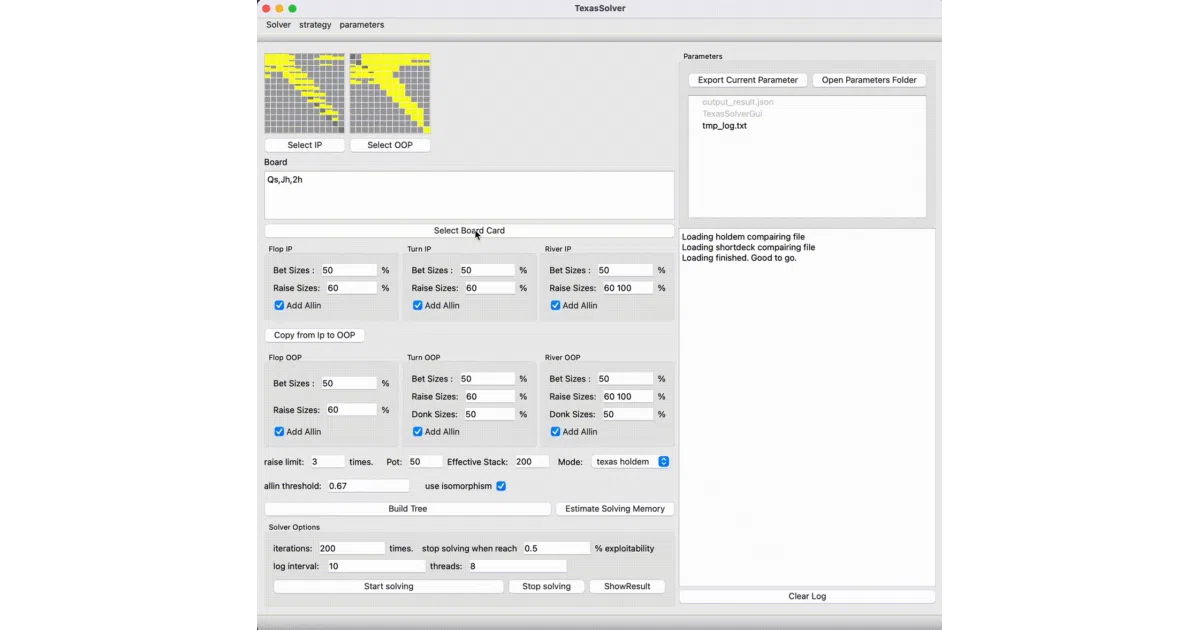
TexasSolver computes Game Theory Optimal (GTO) strategies for Texas Hold’em and short-deck poker. You feed it a betting tree (1–2 bets plus all-in on the flop), and it converges on equilibrium frequencies for each action. There’s a Qt GUI, a console version, and even a Google Colab notebook if you want to tinker without installing anything.
The interesting bit
The author rewrote their own Java solver in C++ and squeezed out a 5× speedup with less than a third of the memory footprint—then kept optimizing until this version actually beats PioSolver 1.0 on the flop (172 s vs. 242 s in their benchmark). The catch: it uses 1.6 GB RAM versus PioSolver’s 492 MB. Trading memory for speed is a classic move; here the numbers are right there in the README.
Key highlights
- Results align with PioSolver (benchmark configs and logs are published)
- Supports cross-language calls and JSON strategy export
- Runs on Windows, macOS, and Linux
- AGPL v3 licensed—free for personal use, commercial license required if you embed the code or offer it as a service
- GPU successor (TexasSolverGPU) now exists; this repo is effectively the CPU legacy branch
Caveats
- Memory hunger is real: 3.3× PioSolver’s footprint in the published benchmark
- The README warns against redistributing binaries due to AGPL; linking is the only approved sharing method
- Qt 5.1.0 is a fairly dated toolkit for the GUI
Verdict
Worth a look if you’re studying GTO poker, building training tools, or just want a reproducible solver to hack on. Skip it if you need the absolute fastest hardware-accelerated version—the GPU edition has superseded this one.
Frequently asked
- What is bupticybee/TexasSolver?
- A C++ reimplementation of a Java solver that outruns PioSolver on flop scenarios—at the cost of 3× the RAM.
- Is TexasSolver open source?
- Yes — bupticybee/TexasSolver is open source, released under the AGPL-3.0 license.
- What language is TexasSolver written in?
- bupticybee/TexasSolver is primarily written in C++.
- How popular is TexasSolver?
- bupticybee/TexasSolver has 2.6k stars on GitHub.
- Where can I find TexasSolver?
- bupticybee/TexasSolver is on GitHub at https://github.com/bupticybee/TexasSolver.