aloshdenny/reverse-SynthID
Six Rounds of Adversarial Surgery on Google's AI Watermark
To discover, detect, and surgically remove Google's imperceptible SynthID watermark from Gemini-generated images using only spectral analysis—no proprietary decoder required.
Not currently ranked — collecting fresh signals.
star history
What it does
This project reverse-engineers Google’s SynthID, the invisible watermark embedded in every Gemini-generated image. Using only signal processing and spectral analysis—no access to Google’s proprietary encoder or decoder—it builds a detector that spots the watermark with 90% accuracy and a multi-stage bypass that strips it while keeping images visually lossless. The latest V4 pipeline targets multiple Gemini models and resolutions through a data-driven spectral codebook.
The interesting bit
The breakthrough came from treating Gemini’s own published failure-mode list as an attack specification: the authors simulate “collage fragmentation” with a smooth elastic warp field that fragments the watermark’s spatial phase consensus without visible distortion. They also use cross-color phase consensus across six solid backgrounds to isolate the watermark from image content, since true watermark carriers are content-independent while real image data phase-scrambles across colors.
Key highlights
- Discovered the watermark’s resolution-dependent carrier frequency structure by amplifying residuals from pure-white Gemini images
- V4 codebook supports per-model profiles for
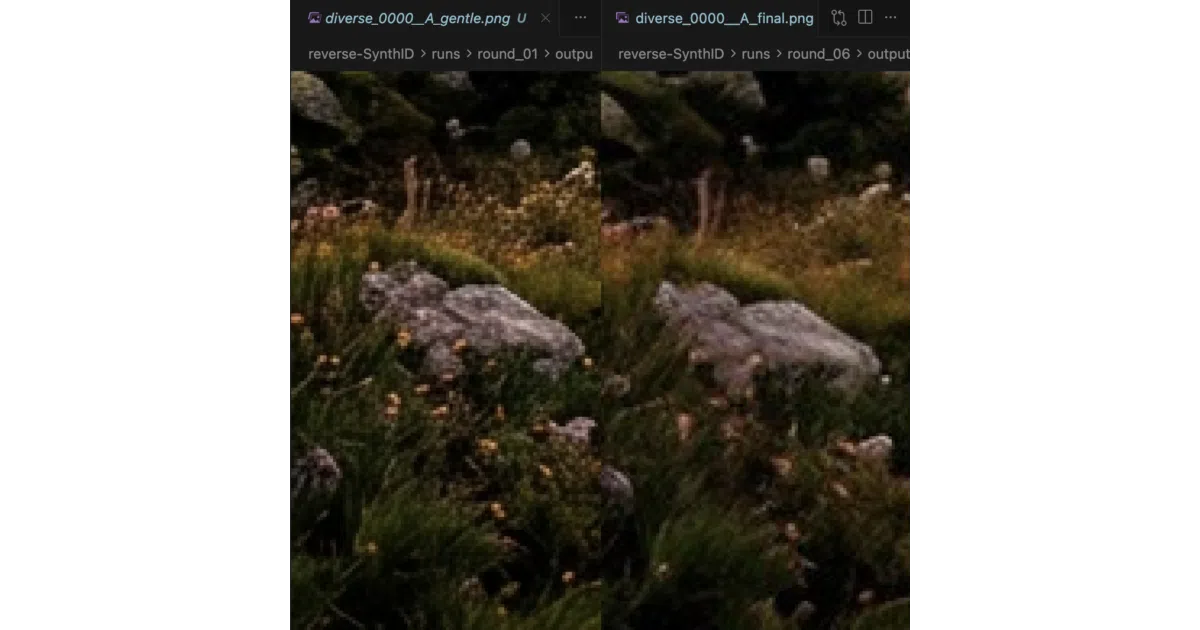
gemini-3.1-flash-image-previewandnano-banana-pro-previewacross multiple resolutions - Round 06 stacks a 7-stage pipeline—VAE round-trip, elastic deformation, geometric warp, resize-squeeze, color nudge, FFT subtraction, and JPEG re-encoding—each stage gated by a PSNR floor with automatic rollback
- Achieves confirmed bypass of the live Gemini app detector on both supported models; V3 bypass maintains 43+ dB PSNR
- Includes a human-in-the-loop calibration loop that updates
carrier_weightsbased on manual Gemini-app detection feedback
Caveats
- The V4 bypass trades V3’s 43+ dB pixel-level PSNR for 18–24 dB because elastic warp displaces pixels rather than altering them, though outputs are described as visually lossless
- The workflow requires uploading images to the Gemini app and feeding back detection results manually to tune the calibration loop
Verdict
Security researchers and adversarial-ML engineers will find this a meticulous case study in watermark evasion; photographers or casual users looking for a one-click scrubber should look elsewhere given the manual calibration overhead and multi-stage pipeline.
Frequently asked
- What is aloshdenny/reverse-SynthID?
- To discover, detect, and surgically remove Google's imperceptible SynthID watermark from Gemini-generated images using only spectral analysis—no proprietary decoder required.
- Is reverse-SynthID open source?
- Yes — aloshdenny/reverse-SynthID is an open-source project tracked on heatdrop.
- What language is reverse-SynthID written in?
- aloshdenny/reverse-SynthID is primarily written in Python.
- How popular is reverse-SynthID?
- aloshdenny/reverse-SynthID has 4.6k stars on GitHub.
- Where can I find reverse-SynthID?
- aloshdenny/reverse-SynthID is on GitHub at https://github.com/aloshdenny/reverse-SynthID.