advimman/HiDT
Turn noon into golden hour without telling it what noon is
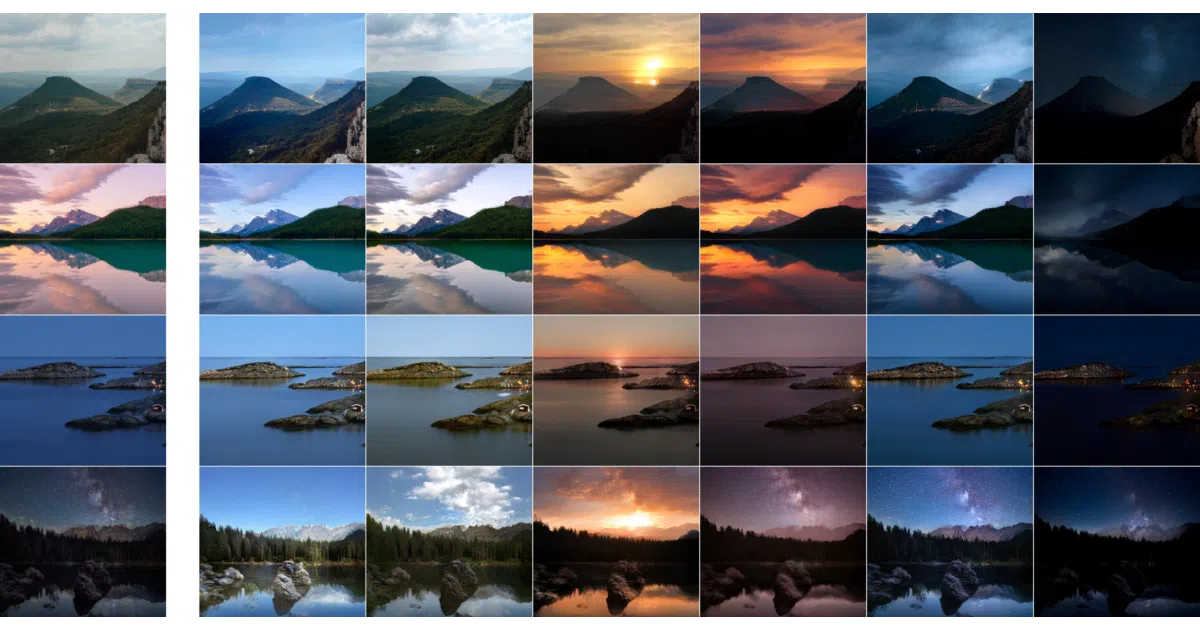
Unsupervised image-to-image translation that swaps lighting conditions in high-res photos without needing paired examples or domain labels.
Not currently ranked — collecting fresh signals.
star history
What it does
HiDT takes a photo and translates its daytime lighting condition—think morning to sunset, overcast to clear—while preserving the underlying scene. It runs at high resolution and includes an optional enhancer network to clean up artifacts. The repo ships with pretrained models for daytime translation and a WikiArt style transfer variant, plus a one-click Colab notebook for the inference-shy.
The interesting bit
The unsupervised angle is the real trick: the model learns to disentangle “content” from “lighting/style” without anyone labeling which photos are sunrise versus noon. The paper (CVPR 2020 Oral) proposes a hierarchical design that handles 1024×1024 images without collapsing into mud—still a genuine pain point in GAN-based translation.
Key highlights
- Inference-only release; training code is not included
- Two enhancement modes: a dedicated upsampling generator (G_enh) or fully-convolutional raw output
- Pretrained checkpoints for daytime and WikiArt domains
- One Colab notebook for browser-based experimentation
- Python ≥3.7, PyTorch, tested with conda
Caveats
- “Only inference part” means you cannot retrain on your own domains without reimplementing the training loop
- The README contains a typo (“requirenments”) and sparse troubleshooting guidance
- No explicit hardware requirements listed, though 1024×1024 GAN inference implies a decent GPU
Verdict
Grab it if you need to relight outdoor photography or prototype style transfer without curating datasets. Skip it if you need fine-grained control over training or are working on non-visual domains—this is a narrow, well-executed tool, not a framework.
Frequently asked
- What is advimman/HiDT?
- Unsupervised image-to-image translation that swaps lighting conditions in high-res photos without needing paired examples or domain labels.
- Is HiDT open source?
- Yes — advimman/HiDT is open source, released under the BSD-3-Clause license.
- What language is HiDT written in?
- advimman/HiDT is primarily written in Jupyter Notebook.
- How popular is HiDT?
- advimman/HiDT has 652 stars on GitHub.
- Where can I find HiDT?
- advimman/HiDT is on GitHub at https://github.com/advimman/HiDT.