a16z-infra/ai-getting-started
A16Z's weekend AI stack: batteries included, opinions too
A pre-wired Next.js template that saves you from choosing between Pinecone and Supabase before your coffee gets cold.
Not currently ranked — collecting fresh signals.
star history
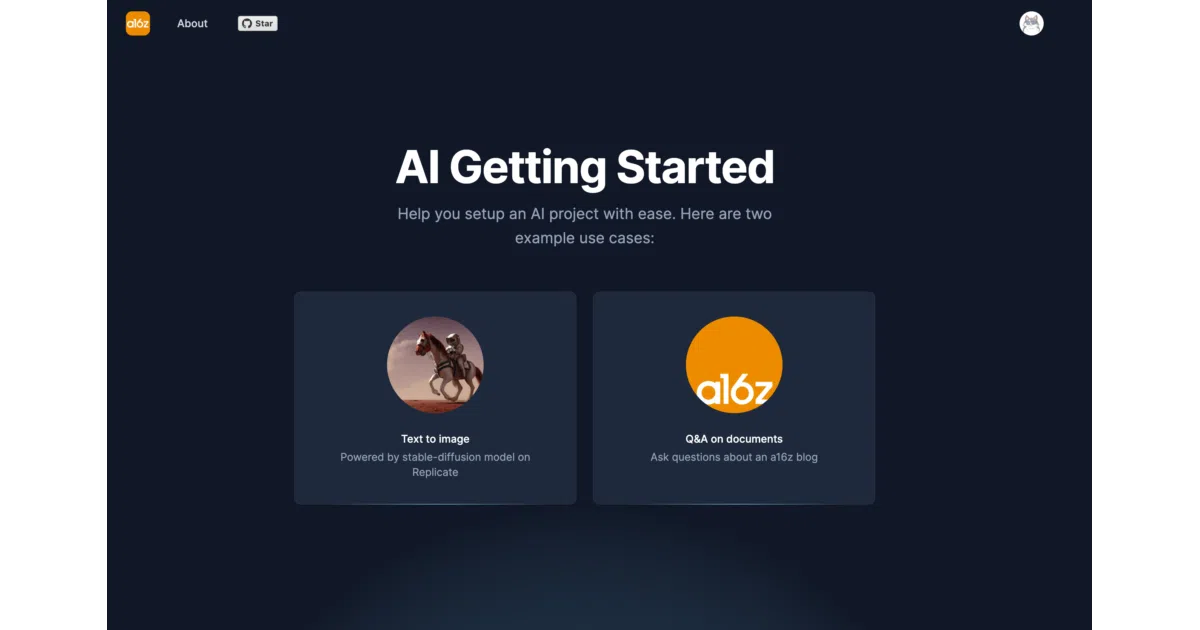
What it does This is a starter template, not a framework. It wires together Clerk for auth, Pinecone or Supabase pgvector for embeddings, LangChain.js for orchestration, OpenAI and Replicate for text and image generation, plus Arcjet for security. The result is a deployable Next.js app with a Q&A interface over your own documents and a text-to-image playground. Fork it, fill in six API keys, generate embeddings from the included blog samples, and run locally or ship to Fly.io.
The interesting bit
The project makes its tradeoffs visible rather than hiding them. You must manually swap a route in QAModel.tsx to switch vector stores, and the README walks you through scaling a single Fly instance to 512MB because the free tier can’t handle the default. That honesty is rarer than it should be in starter repos.
Key highlights
- Dual vector store support: Pinecone by default, Supabase pgvector with a one-line code change
- Streaming text responses via Vercel’s AI SDK
- Image generation through Replicate’s API, not just another OpenAI wrapper
- Pre-built embedding pipeline for local markdown files in
/blogs - Deployment configs for Fly.io, with Netlify and Vercel noted as alternatives
Caveats
- Requires six external service accounts and API keys before first run; the setup is thorough but not quick
- Production Clerk deployment needs domain verification, which the README flags but doesn’t automate
- No mention of testing, CI, or how to handle rate limits across the multiple paid APIs
Verdict Grab this if you want to see how modern AI SaaS pieces fit together without building the plumbing yourself. Skip it if you need a minimal setup or prefer to make your own architectural choices; this stack has opinions and they come with monthly bills.
Frequently asked
- What is a16z-infra/ai-getting-started?
- A pre-wired Next.js template that saves you from choosing between Pinecone and Supabase before your coffee gets cold.
- Is ai-getting-started open source?
- Yes — a16z-infra/ai-getting-started is open source, released under the MIT license.
- What language is ai-getting-started written in?
- a16z-infra/ai-getting-started is primarily written in TypeScript.
- How popular is ai-getting-started?
- a16z-infra/ai-getting-started has 4.1k stars on GitHub.
- Where can I find ai-getting-started?
- a16z-infra/ai-getting-started is on GitHub at https://github.com/a16z-infra/ai-getting-started.