VectorSpaceLab/OmniGen
One diffusion model to replace your ControlNet stack
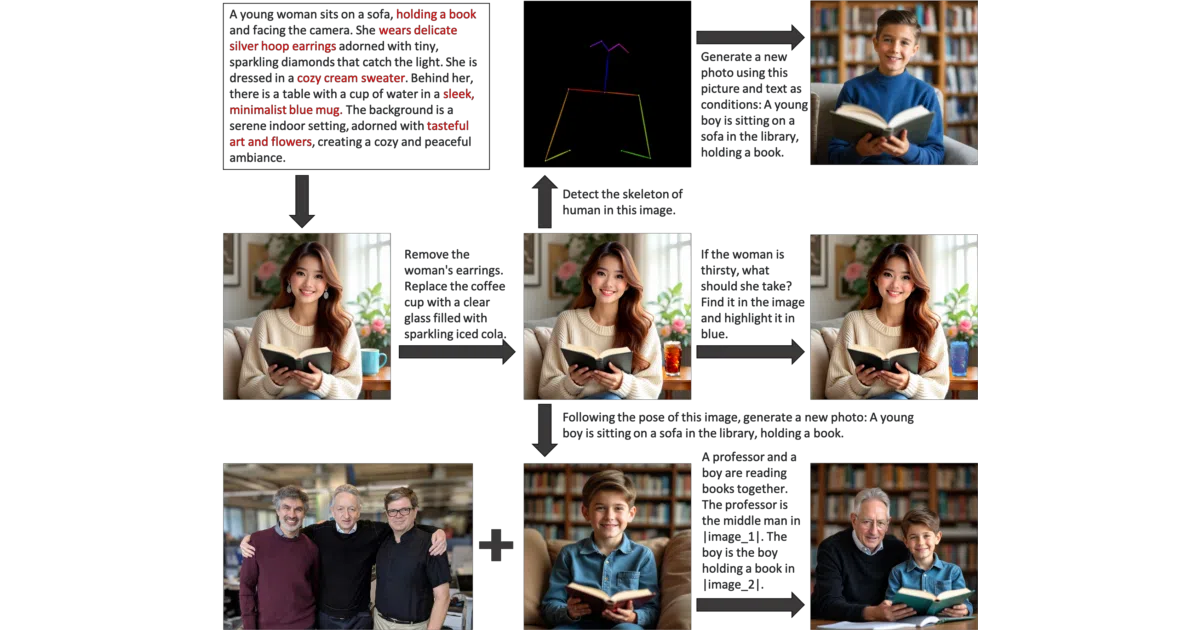
OmniGen handles text-to-image, editing, and subject-driven generation from a single checkpoint without auxiliary networks or preprocessing pipelines.
Not currently ranked — collecting fresh signals.
star history
What it does
OmniGen is a diffusion model that generates and manipulates images from mixed text-and-image prompts. Rather than chaining separate networks like ControlNet or IP-Adapter, you feed it natural language instructions alongside image placeholders, and the model infers objects, poses, and depth maps on its own. It covers text-to-image synthesis, identity-preserving generation, image editing, and image-conditioned creation from one weights file.
The interesting bit
The authors pitch it as “GPT for pixels”—a single model that parses visual context directly from your prompt instead of demanding face detectors, pose estimators, or cropping tools. The goal is to collapse the usual plugin circus into one unified network. Whether it fully matches specialized pipelines is debatable, but the architectural ambition is to make image generation as instruction-driven as large language models.
Key highlights
- Handles generation, editing, subject-driven synthesis, and identity preservation without auxiliary networks or extra preprocessing
- Accepts multi-modal prompts using
<img><|image_*|></img>placeholders to reference uploaded images - Built-in memory optimizations (
offload_model, adjustablemax_input_image_size) for heavier inference workloads - Supports both LoRA and full fine-tuning without redesigning task-specific architectures
- Integrated with Hugging Face Diffusers and available via Replicate API
Caveats
- The authors explicitly state the model “still has room for improvement” due to limited training resources
- Multi-image inference can be slow and memory-hungry; you may need to downsize inputs or enable model offloading
- OmniGen2 has already been released, so this original repository may receive reduced future development
Verdict
Worth exploring if you are tired of orchestrating five separate diffusion plugins for every edit. Skip it if you need battle-hardened production quality today; the team treats this as a research release with acknowledged rough edges.
Frequently asked
- What is VectorSpaceLab/OmniGen?
- OmniGen handles text-to-image, editing, and subject-driven generation from a single checkpoint without auxiliary networks or preprocessing pipelines.
- Is OmniGen open source?
- Yes — VectorSpaceLab/OmniGen is open source, released under the MIT license.
- What language is OmniGen written in?
- VectorSpaceLab/OmniGen is primarily written in Jupyter Notebook.
- How popular is OmniGen?
- VectorSpaceLab/OmniGen has 4.3k stars on GitHub.
- Where can I find OmniGen?
- VectorSpaceLab/OmniGen is on GitHub at https://github.com/VectorSpaceLab/OmniGen.