Tencent-Hunyuan/Hunyuan3D-2
Tencent’s diffusion pipeline builds 3D assets mesh-first, paints later
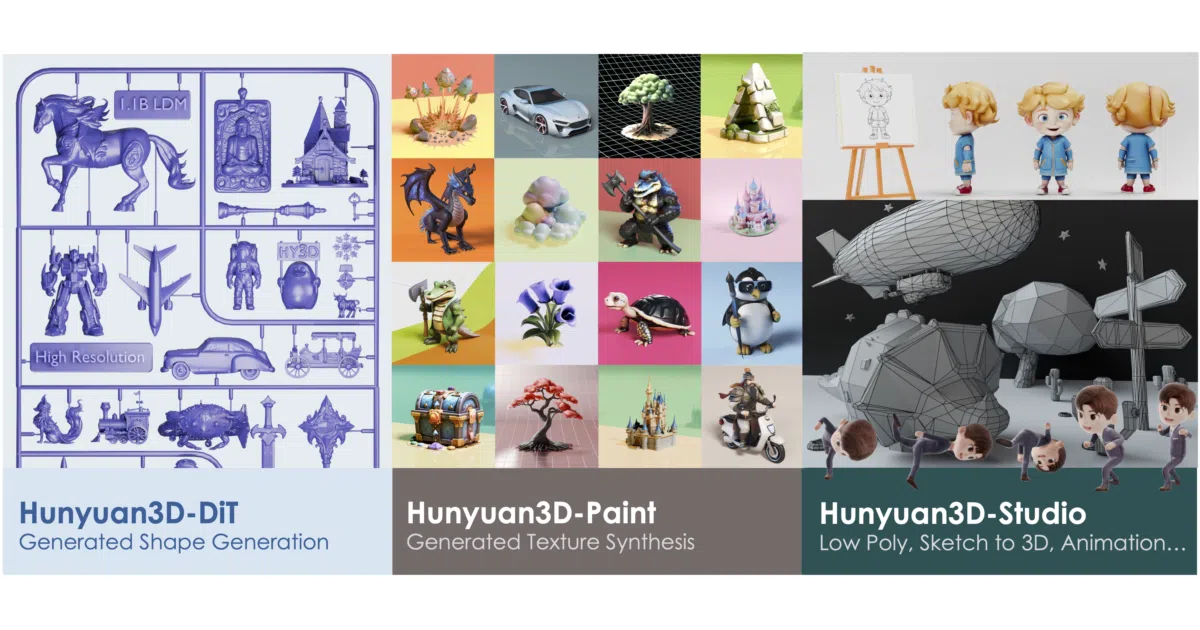
It splits 3D asset creation into two specialist diffusion models—one sculpts the mesh, the other paints it—so you can generate from a photo or retexture existing geometry.
Velocity · 7d
+6.4
★ / day
Trend
↘cooling
star history
What it does
Hunyuan3D-2 generates high-resolution textured 3D assets through two distinct diffusion stages. A flow-based transformer, Hunyuan3D-DiT, first creates a bare mesh aligned to a condition image. Then Hunyuan3D-Paint synthesizes high-resolution texture maps for that mesh. Because the stages are decoupled, you can also throw hand-crafted geometry at the texture model.
The interesting bit Instead of a monolithic end-to-end model, the project treats shape and texture as separate problems with separate diffusion priors. This avoids the common trap where one bad texture forces a full regeneration. The repo also serves as a model zoo, shipping Turbo and Fast distilled variants, a 0.6B mini model, multiview shape models, and a Blender addon.
Key highlights
- Claims to outperform unnamed open- and closed-source baselines on geometry detail, condition alignment, and texture quality according to the project’s benchmark table.
- Shape generation runs on 6 GB VRAM; full shape-plus-texture generation requires 16 GB.
- The texture model accepts either generated or hand-crafted meshes, making it useful for retexturing existing assets.
- Community and official ecosystem includes ComfyUI wrappers, a Windows portable build, and a Blender addon.
- Supports both image-to-3D and text-to-3D workflows (per repository topics).
Caveats
- The performance table compares against anonymous “Top Close-source Model” entries, so the SOTA claims are hard to verify independently.
- The project has already moved on to v2.1, v2.5, and a separate world-generation model (
HunyuanWorld-1.0), meaning this repo may lag behind Tencent’s latest releases.
Verdict A solid bet if you want open-source 3D generation with a clean split between mesh creation and texturing. Look elsewhere if you need a single lightweight, unified model; this is a modular system with a serious GPU appetite.
Frequently asked
- What is Tencent-Hunyuan/Hunyuan3D-2?
- It splits 3D asset creation into two specialist diffusion models—one sculpts the mesh, the other paints it—so you can generate from a photo or retexture existing geometry.
- Is Hunyuan3D-2 open source?
- Yes — Tencent-Hunyuan/Hunyuan3D-2 is an open-source project tracked on heatdrop.
- What language is Hunyuan3D-2 written in?
- Tencent-Hunyuan/Hunyuan3D-2 is primarily written in Python.
- How popular is Hunyuan3D-2?
- Tencent-Hunyuan/Hunyuan3D-2 has 15.2k stars on GitHub and is currently cooling off.
- Where can I find Hunyuan3D-2?
- Tencent-Hunyuan/Hunyuan3D-2 is on GitHub at https://github.com/Tencent-Hunyuan/Hunyuan3D-2.