StanfordBDHG/HealthGPT
Query HealthKit via GPT-4, Llama 3, or your home server
It exists because manually correlating sleep, steps, and heart rate in Apple Health is a chore best outsourced to an LLM.
Not currently ranked — collecting fresh signals.
star history
What it does
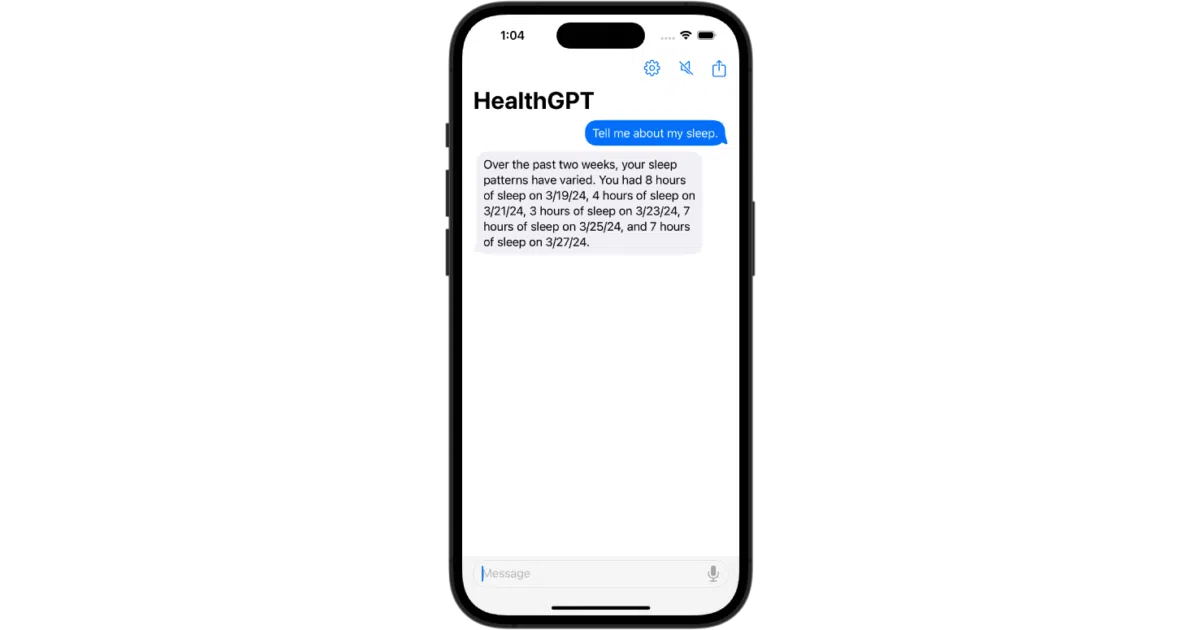
HealthGPT is an experimental iOS app built on Stanford’s Spezi framework that exposes your Apple Health data—sleep, steps, heart rate, and a handful of other metrics—to a chat interface. You type or speak a question, and the app queries HealthKit, packages the last 14 days of aggregated data into a prompt, and routes it to a language model for a conversational answer. It is explicitly not a medical device; it is a reference implementation for LLM-powered health apps.
The interesting bit
The project offers three distinct inference modes: OpenAI’s GPT-3.5/4 in the cloud, a fully local Llama 3 8B running on your iPhone’s Metal GPU, or a “fog” node on your home network discovered via mDNS. That last option is the unusual one: you can park a Docker-based inference server on a local Linux or macOS machine and have the phone stream requests to your own hardware, keeping data off the public cloud while sparing the phone from on-device inference.
Key highlights
- Built on the open-source Stanford Spezi digital-health framework, so the HealthKit plumbing and chat UI are modular and extensible.
- Ships with out-of-the-box support for sleep, step count, active energy, exercise minutes, heart rate, and body mass queries.
- Can run entirely offline using
SpeziLLMLocalwith Llama 3 8B after an automated model download during onboarding. - Supports a local-network “fog” mode via mDNS for low-latency, private inference on a nearby machine.
- Includes accessibility features such as speech-to-text input and text-to-speech synthesis in the chat interface.
Caveats
- The README warns that LLMs hallucinate and the app is not a substitute for professional medical advice; aggregated HealthKit data for the past 14 days is uploaded to OpenAI when using cloud mode.
- Local LLM inference requires a physical iOS device with a modern Metal GPU and will not run in the simulator.
- Extending support to additional HealthKit quantities requires manual edits to three separate Swift files (
AppDelegate.swift,HealthDataFetcher.swift, andPromptGenerator.swift).
Verdict
Worth a look if you are building iOS health apps and need a working reference for integrating HealthKit with LLMs; skip it if you are seeking a polished consumer health product or a no-code way to add natural-language queries to your own data.
Frequently asked
- What is StanfordBDHG/HealthGPT?
- It exists because manually correlating sleep, steps, and heart rate in Apple Health is a chore best outsourced to an LLM.
- Is HealthGPT open source?
- Yes — StanfordBDHG/HealthGPT is open source, released under the MIT license.
- What language is HealthGPT written in?
- StanfordBDHG/HealthGPT is primarily written in Swift.
- How popular is HealthGPT?
- StanfordBDHG/HealthGPT has 2k stars on GitHub.
- Where can I find HealthGPT?
- StanfordBDHG/HealthGPT is on GitHub at https://github.com/StanfordBDHG/HealthGPT.