Shilin-LU/TF-ICON
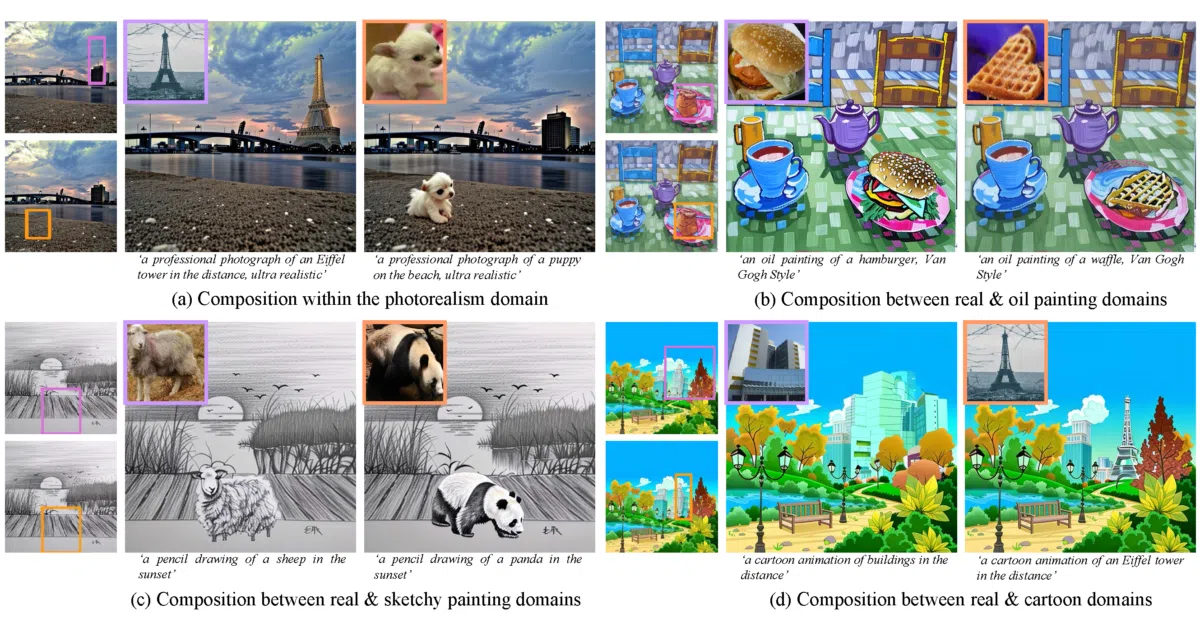
Drop a cartoon cat into an oil painting, no retraining required
TF-ICON uses a weirdly empty "exceptional prompt" to trick Stable Diffusion into inverting and compositing images across visual domains without touching a single weight.
Not currently ranked — collecting fresh signals.
star history
What it does
TF-ICON takes a foreground object and a background image—say, a sketch of a bird and a photorealistic forest—and composites them so the object looks like it belongs. It works across domains (cartoon, oil painting, photorealistic) and crucially needs no fine-tuning, no custom dataset, no per-instance optimization. You provide images, masks, and a location; it handles the blending.
The interesting bit
The trick is the “exceptional prompt,” which the authors describe as containing no information. This empty prompt somehow stabilizes image inversion—turning real images back into latent representations—better than existing inversion methods. That inverted latent then becomes the clay for cross-domain sculpting. It’s a bit like using silence as a tuning fork.
Key highlights
- Built on Stable Diffusion 2.1; needs ~20–23 GB VRAM
- Two modes:
crossfor mismatched visual domains,samefor photorealistic composites - Outperforms prior baselines on CelebA-HQ, COCO, and ImageNet per the paper
- Ships with sample inputs and a full test benchmark via OneDrive
- ICCV 2023; code is straightforward inference scripts, not a library
Caveats
- The README doesn’t quantify “outperforms” with numbers; you’ll need the paper for actual metrics
- No diffusers integration or Gradio demo yet—just CLI scripts
- Foreground resolution “should not be too small,” but no hard threshold given
Verdict
Worth a look if you’re doing research in diffusion-based editing or need cross-domain compositing without training infrastructure. Skip it if you want a polished product API or have less than 20 GB of GPU memory.
Frequently asked
- What is Shilin-LU/TF-ICON?
- TF-ICON uses a weirdly empty "exceptional prompt" to trick Stable Diffusion into inverting and compositing images across visual domains without touching a single weight.
- Is TF-ICON open source?
- Yes — Shilin-LU/TF-ICON is open source, released under the MIT license.
- What language is TF-ICON written in?
- Shilin-LU/TF-ICON is primarily written in Python.
- How popular is TF-ICON?
- Shilin-LU/TF-ICON has 811 stars on GitHub.
- Where can I find TF-ICON?
- Shilin-LU/TF-ICON is on GitHub at https://github.com/Shilin-LU/TF-ICON.