SandAI-org/MAGI-1
A diffusion transformer that generates video like a token stream
MAGI-1 generates video autoregressively in 24-frame chunks, enabling streaming output and long-horizon scene transitions from text and image prompts.
Not currently ranked — collecting fresh signals.
star history
What it does
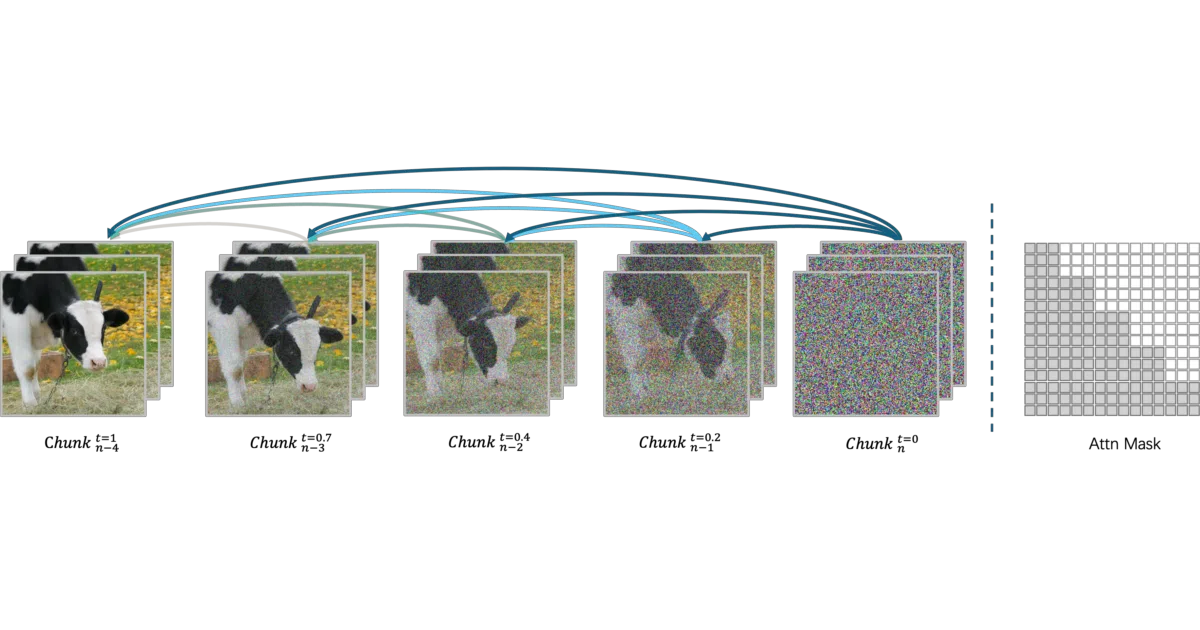
MAGI-1 is a Diffusion Transformer-based video generation model that produces output autoregressively in 24-frame chunks instead of synthesizing an entire clip in one forward pass. Each chunk is denoised holistically, and generation of the next chunk begins as soon as the current one hits a threshold denoising level—allowing up to four chunks to process concurrently and creating a streaming pipeline. It handles image-to-video tasks guided by text instructions, and supports chunk-wise prompting for scene transitions and long-horizon synthesis.
The interesting bit
The model treats time as a causal sequence: per-chunk noise increases monotonically, so each segment is predicted conditioned on previous chunks much like a language model predicts the next token. This is backed by a transformer-based VAE with 8× spatial and 4× temporal compression, and a shortcut distillation trick that trains a single velocity model to approximate flow-matching trajectories across variable step sizes—so you can trade inference steps for speed without switching checkpoints.
Key highlights
- Autoregressive chunking enables causal temporal modeling with up to four chunks processed concurrently.
- Chunk-wise prompting allows smooth scene transitions and fine-grained text control across long videos.
- A 4.5B parameter model fits on a single RTX 4090 (24 GB); a quantized variant drops to 12 GB by setting
window_sizeto 1. - The 24B base model targets H100/H800 clusters, with distilled and FP8-quantized variants reducing the hardware requirements.
- Ships with ComfyUI custom nodes and a Dify DSL workflow for prompt enhancement.
Caveats
- The README claims state-of-the-art results on in-house human evaluation, but the section is truncated mid-sentence, so the evidence is incomplete.
- The 24B model remains hardware-hungry even in distilled+quantized form, requiring either four H100s or eight RTX 4090s.
Verdict
Worth exploring if you are building video generation pipelines and need streaming, long-horizon output with explicit scene control. Skip it if you are looking for lightweight, consumer-grade video synthesis—the 4.5B model is accessible, but the full 24B variant is strictly data-center territory.
Frequently asked
- What is SandAI-org/MAGI-1?
- MAGI-1 generates video autoregressively in 24-frame chunks, enabling streaming output and long-horizon scene transitions from text and image prompts.
- Is MAGI-1 open source?
- Yes — SandAI-org/MAGI-1 is open source, released under the Apache-2.0 license.
- What language is MAGI-1 written in?
- SandAI-org/MAGI-1 is primarily written in Python.
- How popular is MAGI-1?
- SandAI-org/MAGI-1 has 3.8k stars on GitHub.
- Where can I find MAGI-1?
- SandAI-org/MAGI-1 is on GitHub at https://github.com/SandAI-org/MAGI-1.