Robbyant/lingbot-world
An open-source world model that runs fast enough to play
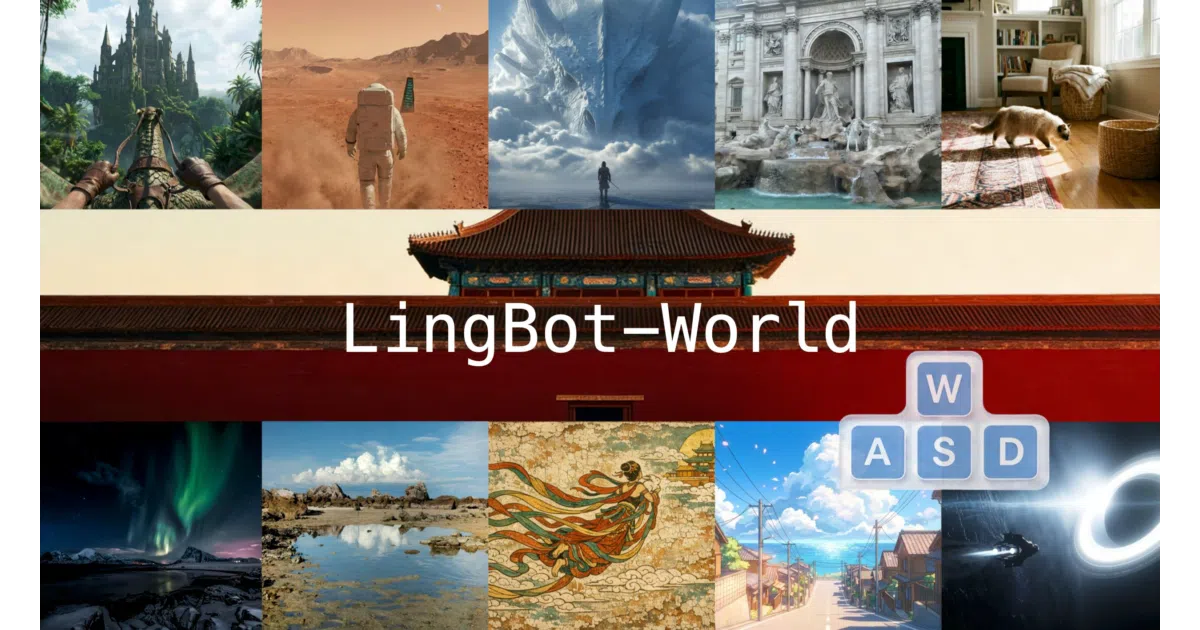
LingBot-World turns a single image and a text prompt into an interactive, minute-long simulated world at 16 FPS with under one second of latency.
Not currently ranked — collecting fresh signals.
star history
What it does
LingBot-World is an image-to-video world simulator built on top of Wan2.2. Feed it a still image, a text description, and optionally camera poses or action strings, and it generates extended video sequences while maintaining visual consistency across hundreds of frames. The project ships three model variants: a base camera-pose version, an action-controlled version with simplified keyboard-style commands, and a fast variant that uses chunked causal inference with KV caching for real-time interaction.
The interesting bit
The “Fast” model is the unusual part. Instead of generating all frames at once, it processes video chunk-by-chunk with KV caching, which is what lets it hit sub-second latency at 16 FPS — actually usable for interactive applications rather than batch rendering. The project also explicitly targets the open-source vs. closed-source gap, which is a nice change from the usual researchware that stops at the paper.
Key highlights
- Three model tiers: Base (Cam), Base (Act) with keyboard-style action strings, and Fast for real-time use
- Supports 480P and 720P output; up to ~961 frames (about a minute at 16 FPS) on sufficient GPU memory
- Control via camera poses (OpenCV format), action strings like
w-10,a-10,d-10, or no control signals at all - Community-provided 4-bit quantized model available for inference on limited VRAM
- Apache 2.0 licensed with weights on HuggingFace and ModelScope
Caveats
- Requires multi-GPU setup for the reference configurations (8 GPUs in the examples); single-GPU users will need the quantized model or significant patience
- Built on Wan2.2, so you’re inheriting whatever installation friction that brings — flash-attention compilation, torch >= 2.4.0, etc.
- The 4-bit quantized model explicitly warns of “minor degradation in visual fidelity and temporal consistency”
Verdict
Worth a look if you’re building interactive world simulators, game environments, or robot learning visualizers and need something actually open-weights. Skip it if you’re hoping for a lightweight single-GPU toy — this is still very much a workstation-or-cloud project.
Frequently asked
- What is Robbyant/lingbot-world?
- LingBot-World turns a single image and a text prompt into an interactive, minute-long simulated world at 16 FPS with under one second of latency.
- Is lingbot-world open source?
- Yes — Robbyant/lingbot-world is open source, released under the Apache-2.0 license.
- What language is lingbot-world written in?
- Robbyant/lingbot-world is primarily written in Python.
- How popular is lingbot-world?
- Robbyant/lingbot-world has 4.4k stars on GitHub.
- Where can I find lingbot-world?
- Robbyant/lingbot-world is on GitHub at https://github.com/Robbyant/lingbot-world.