Rikorose/DeepFilterNet
Real-time noise suppression that won't melt your CPU
A PyTorch/Rust hybrid for cleaning speech at 48kHz, designed to run on embedded devices without sounding like a robot underwater.
Velocity · 7d
+5.9
★ / day
Trend
→steady
star history
What it does
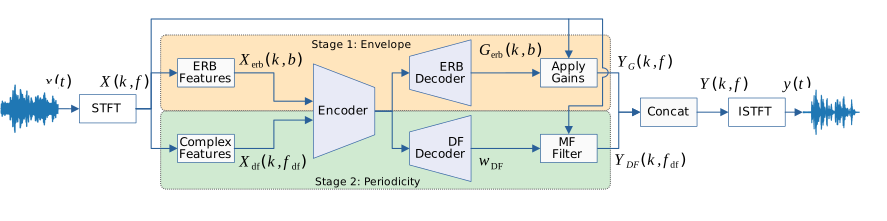
DeepFilterNet strips noise from full-band audio (48kHz) using deep filtering — a learned approach to speech enhancement. It ships as a pre-compiled Rust binary (deep-filter), a Python package, a LADSPA plugin for PipeWire, and a full training framework. The goal is perceptually clean output without the computational bloat that typically accompanies deep-learning audio pipelines.
The interesting bit
The project is deliberately split: Rust handles the real-time STFT/ISTFT loop and data loading (libDF, pyDF), while PyTorch manages the neural network. This lets you run inference on a Raspberry Pi-class device or drop the Python entirely and use the standalone binary. The LADSPA plugin turns it into a virtual noise-suppression microphone on Linux — handy for video calls without buying a Shure SM7B.
Key highlights
- Three published model iterations (DeepFilterNet through v3) with arXiv papers and audio samples for each
- Pre-compiled
deep-filterbinary needs no Python; Python API available for GPU-backed batch processing - LADSPA plugin integrates with PipeWire for real-time mic noise reduction
- Training pipeline supports custom datasets in HDF5 format with configurable over/under-sampling
- Cross-platform framework (Linux/macOS/Windows), though training is Linux-only
Caveats
- Standalone binary only accepts 48kHz WAV files; other formats or sample rates need the Python path
- Training setup is involved: HDF5 dataset creation, config files, and Rust build dependencies
- Demo UI requires nightly Rust toolchain and Linux
Verdict Worth a look if you need deployable, low-latency speech enhancement — especially for embedded or real-time streaming use. Skip if you just want a one-click desktop app; the project is a framework with sharp edges, not a consumer tool.
Frequently asked
- What is Rikorose/DeepFilterNet?
- A PyTorch/Rust hybrid for cleaning speech at 48kHz, designed to run on embedded devices without sounding like a robot underwater.
- Is DeepFilterNet open source?
- Yes — Rikorose/DeepFilterNet is an open-source project tracked on heatdrop.
- What language is DeepFilterNet written in?
- Rikorose/DeepFilterNet is primarily written in Python.
- How popular is DeepFilterNet?
- Rikorose/DeepFilterNet has 4.9k stars on GitHub and is currently holding steady.
- Where can I find DeepFilterNet?
- Rikorose/DeepFilterNet is on GitHub at https://github.com/Rikorose/DeepFilterNet.