RaphaelMeudec/deblur-gan
Deblurring photos with the brute force of adversarial spite
A Keras port of DeblurGAN that learns to undo motion blur by pitting two neural networks against each other until one gives up and produces sharp images.
Not currently ranked — collecting fresh signals.
star history
What it does
This is a straightforward Keras reimplementation of the 2017 DeblurGAN paper. It takes motion-blurred photographs and attempts to reconstruct the sharp original using a conditional GAN setup: a generator network proposes deblurred versions, while a discriminator tries to tell them apart from real sharp images. The repo includes scripts for training on the GOPRO dataset, testing, and deblurring your own images with a saved generator model.
The interesting bit
The adversarial setup is the hook. Rather than training a single network with a pixel-perfect loss function—which tends to produce blurry averages—the discriminator forces the generator to produce outputs that are structurally plausible enough to fool a second network. It’s expensive, unstable, and occasionally magical.
Key highlights
- Clean Keras implementation of the full DeblurGAN pipeline (generator + discriminator)
- Ready-to-use scripts for training, testing, and one-off image deblurring
- Works with the standard GOPRO motion blur dataset; includes data organization helper
- Medium tutorial linked for the “how does this actually work” crowd
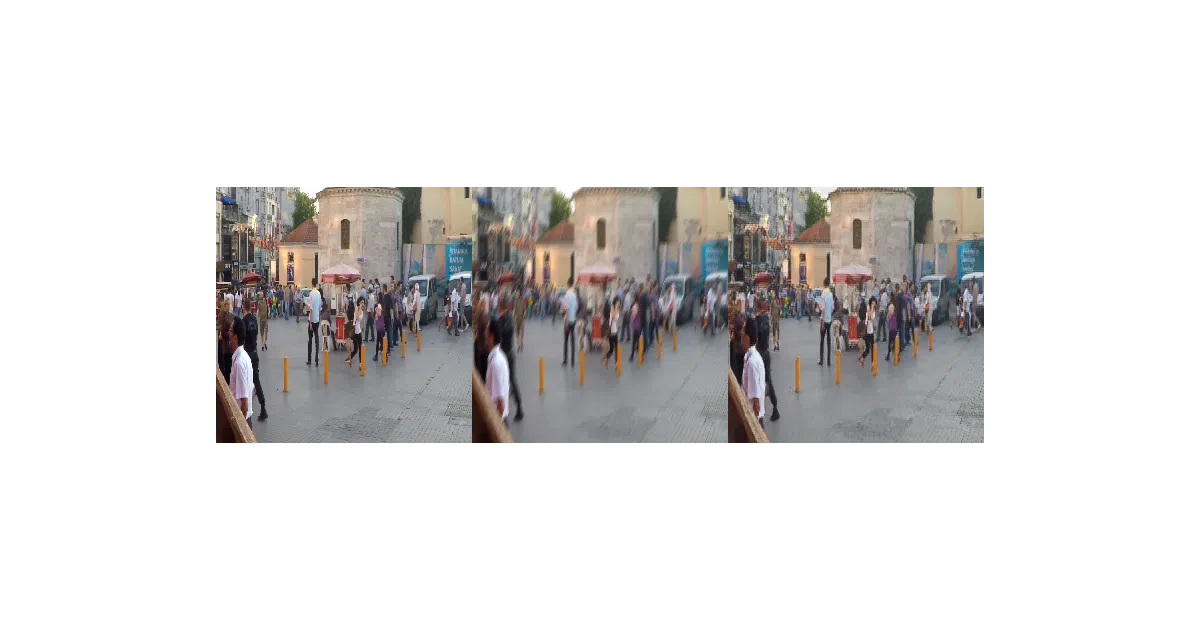
- Sample results shown in-repo: sharp → blurred → deblurred triptych
Caveats
- README is minimal; no pretrained weights provided, so you’re training from scratch or sourcing your own
- Paper is from 2017; newer deblurring methods (notably diffusion-based and more efficient GAN variants) have since advanced the state of the art
- GOPRO dataset is a chunky Google Drive download; no automatic fetch script
Verdict
Worth a look if you’re teaching or studying GAN architectures, or need a hackable Keras baseline for motion deblurring. Skip it if you want production-ready deblurring out of the box—this is a research reproduction, not a product.
Frequently asked
- What is RaphaelMeudec/deblur-gan?
- A Keras port of DeblurGAN that learns to undo motion blur by pitting two neural networks against each other until one gives up and produces sharp images.
- Is deblur-gan open source?
- Yes — RaphaelMeudec/deblur-gan is an open-source project tracked on heatdrop.
- What language is deblur-gan written in?
- RaphaelMeudec/deblur-gan is primarily written in Python.
- How popular is deblur-gan?
- RaphaelMeudec/deblur-gan has 600 stars on GitHub.
- Where can I find deblur-gan?
- RaphaelMeudec/deblur-gan is on GitHub at https://github.com/RaphaelMeudec/deblur-gan.