QwenLM/Qwen-Image-2.1
Qwen's 7B image model generates, edits, and knocks out backgrounds
A compact DiT-based model that unifies text-to-image generation, transparent cutouts, and multi-reference editing under one 7B-parameter checkpoint.
Collecting fresh signals — velocity needs a few days of history.
collecting data…
star history
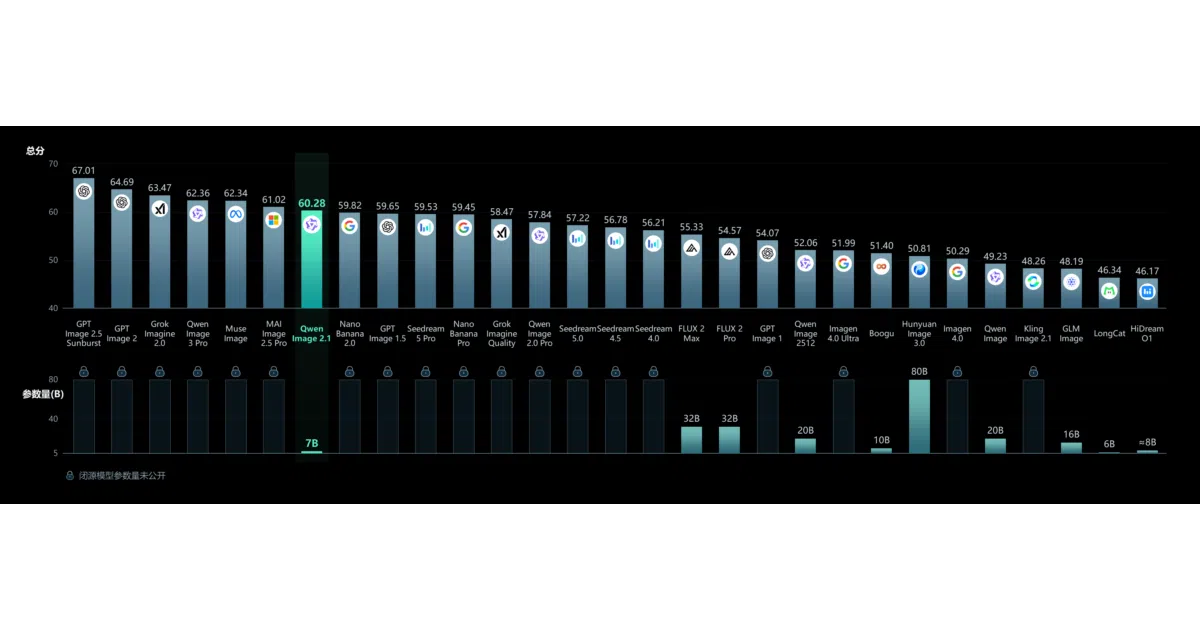
What it does Qwen-Image-2.1 is a unified text-to-image and image-editing model built around a 7B-parameter Single-Stream DiT. It generates images from text, edits existing photos, composites up to ten reference subjects into a single scene, and natively outputs transparent RGBA images for background removal. The model targets 2K resolution and ships with companion prompt-rewriting models—fine-tuned Qwen3.5-VL 9B checkpoints—that expand terse descriptions into detailed generation prompts.
The interesting bit Instead of chaining separate tools for generation, inpainting, and subject extraction, Qwen-Image-2.1 folds them into one checkpoint. Prefix KV cache reuse and mixed-granularity attention keep the 2K-capable pipeline from becoming a VRAM fireball, and Day-0 integrations with Diffusers, ComfyUI, vLLM-Omni, and SGLang mean you can actually run it without writing a custom inference stack.
Key highlights
- 7B-parameter visual DiT with native 2K resolution across multiple aspect ratios
- Unified generation and editing: text-to-image, image-to-image, transparent RGBA output, and subject extraction
- Multi-reference composition with up to 10 condition images and identity preservation for people and products
- Day-0 ecosystem support: Diffusers, ComfyUI, vLLM-Omni, SGLang, and LightX2V
- Optional prompt-rewriting models (T2I and I2I) to auto-expand short prompts into detailed descriptions
Caveats
- Prompt rewriting is described as “recommended for best results,” which suggests raw short prompts may underperform
- The README advertises local editing via “circles, painted annotations, or separate masks,” but the provided code examples only demonstrate basic image-to-image prompting
- 2K inference at 7B still demands significant GPU memory; the README explicitly includes
enable_model_cpu_offload()for limited VRAM
Verdict Worth exploring if you want a single open-source checkpoint that handles both creative generation and practical editing tasks like background removal and subject compositing. Probably overkill if you only need simple text-to-image generation and are already happy with smaller, faster models.
Frequently asked
- What is QwenLM/Qwen-Image-2.1?
- A compact DiT-based model that unifies text-to-image generation, transparent cutouts, and multi-reference editing under one 7B-parameter checkpoint.
- Is Qwen-Image-2.1 open source?
- Yes — QwenLM/Qwen-Image-2.1 is an open-source project tracked on heatdrop.
- What language is Qwen-Image-2.1 written in?
- QwenLM/Qwen-Image-2.1 is primarily written in Python.
- How popular is Qwen-Image-2.1?
- QwenLM/Qwen-Image-2.1 has 1k stars on GitHub.
- Where can I find Qwen-Image-2.1?
- QwenLM/Qwen-Image-2.1 is on GitHub at https://github.com/QwenLM/Qwen-Image-2.1.