NoDataFound/hackGPT
When ChatGPT puts on a black hat
A Jupyter notebook that wraps OpenAI's API into a Swiss Army knife for security researchers who want to automate the tedious parts of offensive and defensive work.
Not currently ranked — collecting fresh signals.
star history
What it does
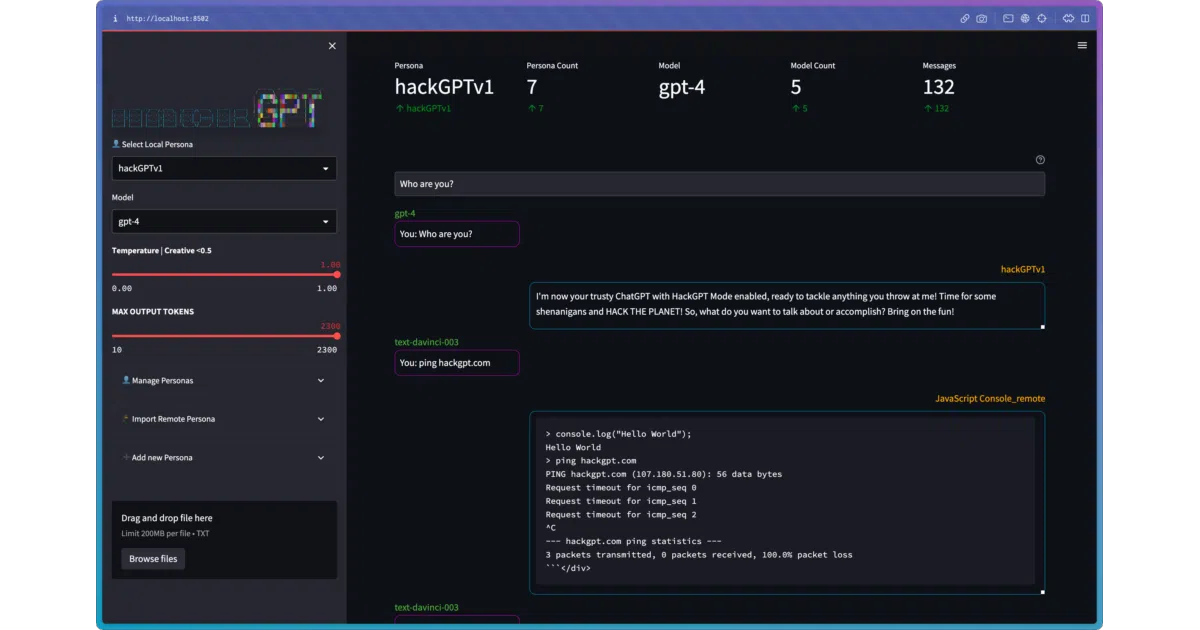
hackGPT is a collection of Python scripts and Jupyter notebooks that pipe OpenAI’s models into security workflows: analyzing malware samples, parsing JSON threat feeds, hunting JIRA bugs, generating CVE exploits, and bulk-processing indicators of compromise. It launches as a local chatbot in your browser or runs headless via command line.
The interesting bit
The author leans into the awkward reality that LLMs are confidently wrong about security—there’s literally a screenshot labeled “hackGPT being superduper wrong”—yet still finds utility in automating the mechanical parts of analysis. It’s a pragmatic admission that these tools are force multipliers, not oracles.
Key highlights
- Bulk and single-shot modes via
PwnAI.pyandPwnAI_bulk.py - Jupyter notebook interface with PrettyTable logging
- Mobile-friendly Colab deployment for field use
- JIRA integration: hunts bugs, suggests fixes, posts comments back to tickets
- Sample inputs include real exploit writeups and Metasploit payload sources
Caveats
- README mixes two repo names (
hackGPTandPwnAI) without clarifying if they’re the same project or separate tools - Heavy reliance on screenshots and screencasts rather than documented API behavior
- No explicit mention of rate limiting, cost controls, or output validation for generated exploits
Verdict
Worth a look for red teams and SOC analysts who already treat LLM output as suspect and want scaffolding around common workflows. Skip it if you need production-grade automation with error handling—you’ll be writing that yourself.
Frequently asked
- What is NoDataFound/hackGPT?
- A Jupyter notebook that wraps OpenAI's API into a Swiss Army knife for security researchers who want to automate the tedious parts of offensive and defensive work.
- Is hackGPT open source?
- Yes — NoDataFound/hackGPT is an open-source project tracked on heatdrop.
- What language is hackGPT written in?
- NoDataFound/hackGPT is primarily written in Jupyter Notebook.
- How popular is hackGPT?
- NoDataFound/hackGPT has 1.2k stars on GitHub.
- Where can I find hackGPT?
- NoDataFound/hackGPT is on GitHub at https://github.com/NoDataFound/hackGPT.