NVIDIA-NeMo/Guardrails
NVIDIA's safety net for chatbots that won't just say "no"
A programmable policy layer that sits between your users and your LLM, using a custom language called Colang to enforce dialog rules without hardcoding every edge case.
Velocity · 7d
+5.9
★ / day
Trend
→steady
star history
What it does
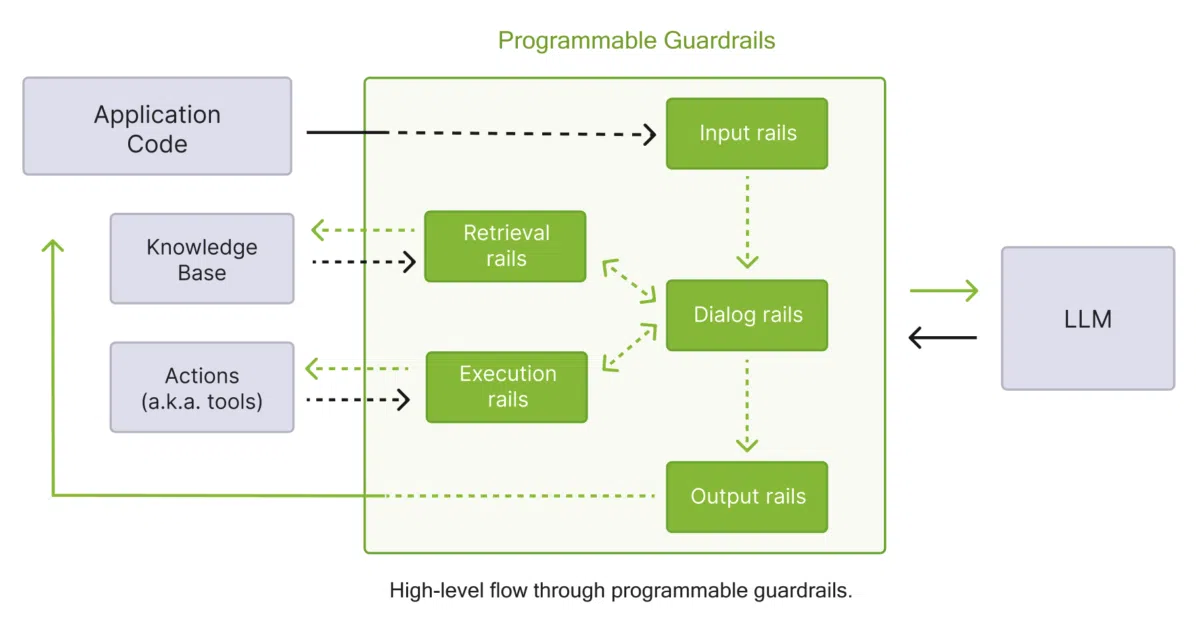
NeMo Guardrails wraps your LLM calls in a configurable policy engine. You define rules in YAML and a Python-like DSL called Colang, and the toolkit intercepts user inputs, retrieved documents, tool calls, and model outputs to enforce them. It supports OpenAI, LLaMA-2, Falcon, and others, and can run as a Python library or a standalone server.
The interesting bit
The Colang language is the unusual part. Instead of regexes or prompt engineering, you write dialog flows like define user express insult → bot express calmly willingness to help. The system compiles these into canonical forms that steer the LLM without stripping away its generative flexibility. It’s a bet that guardrails should be first-class infrastructure, not afterthought filters.
Key highlights
- Five rail types: input, dialog, retrieval, execution, and output — each can reject, rewrite, or reroute
- Async-first API with sync wrappers;
LLMRails.generateandgenerate_asyncmirror OpenAI’s chat format - Optional LangChain integration via environment variable or
set_default_framework("langchain") - Includes vulnerability scanning results for an example bot, showing jailbreak and prompt-injection coverage
- Apache 2.0 licensed, published on arXiv with a technical evaluation
Caveats
- Requires a C++ compiler because of the
annoydependency; platform-specific setup needed - README notes two versions of Colang (1.0 and another) but cuts off mid-sentence, so migration status is unclear
- The “seamless and secure” tool connection claim is stated but not substantiated with specifics
Verdict
Worth evaluating if you’re shipping production chatbots or RAG pipelines and need auditable, version-controlled safety policies. Probably overkill for internal prototypes or cases where a simple system prompt suffices.
Frequently asked
- What is NVIDIA-NeMo/Guardrails?
- A programmable policy layer that sits between your users and your LLM, using a custom language called Colang to enforce dialog rules without hardcoding every edge case.
- Is Guardrails open source?
- Yes — NVIDIA-NeMo/Guardrails is an open-source project tracked on heatdrop.
- What language is Guardrails written in?
- NVIDIA-NeMo/Guardrails is primarily written in Python.
- How popular is Guardrails?
- NVIDIA-NeMo/Guardrails has 7.4k stars on GitHub and is currently holding steady.
- Where can I find Guardrails?
- NVIDIA-NeMo/Guardrails is on GitHub at https://github.com/NVIDIA-NeMo/Guardrails.