MycroftAI/mycroft-precise
A wake-word listener that runs on a Pi, not a data center
Open-source speech detection small enough to live on embedded hardware, trained by a community pooling audio samples.
Not currently ranked — collecting fresh signals.
star history
What it does Precise listens to a microphone stream and fires an event when it hears a specific phrase — “Hey, Mycroft” by default, though you can train it on anything from a name to, apparently, a cough. It’s designed to run on Linux desktops and Raspberry Pi, not to phone home to cloud APIs.
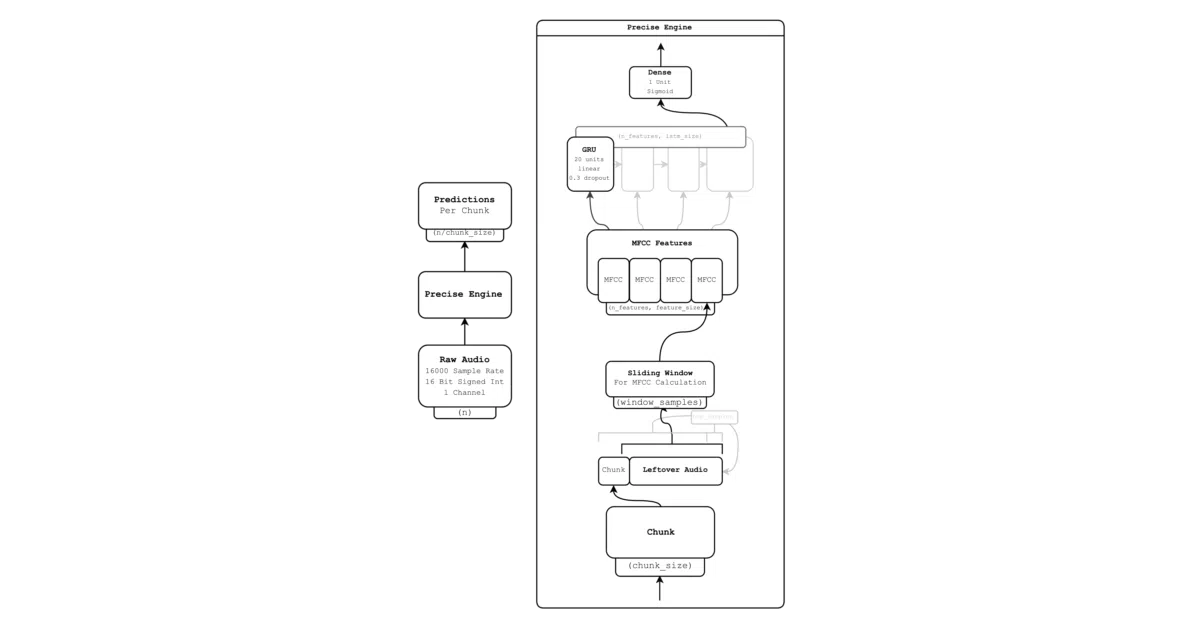
The interesting bit The whole model is a single GRU — no ensemble, no transformer, just one recurrent network and a lot of careful data prep. The Mycroft community also pools training data publicly, so you don’t need to record thousands of samples yourself to get started.
Key highlights
- Binary install for x86_64 and armv7l (Raspberry Pi) via
precise-engine.tar.gz - Python wrapper (
precise-runner) keeps integration to a few lines of code - Source install adds training tools and
precise-listenfor live microphone testing - Community datasets and pre-trained models available at
precise-community-dataandprecise-data - Fully open source, with explicit comparison to proprietary alternatives in the docs
Caveats
- Linux only; “probably operates on other *nx distributions” is the README’s own hedge
- Binary releases track master branch, so version mismatch between engine and models is possible
- Source install dependency list is Ubuntu-centric; other distros need manual work
Verdict Worth a look if you’re building voice hardware and need local wake-word detection without cloud dependencies. Skip it if you’re on Windows or need speaker-independent recognition out of the box without any training effort.
Frequently asked
- What is MycroftAI/mycroft-precise?
- Open-source speech detection small enough to live on embedded hardware, trained by a community pooling audio samples.
- Is mycroft-precise open source?
- Yes — MycroftAI/mycroft-precise is open source, released under the Apache-2.0 license.
- What language is mycroft-precise written in?
- MycroftAI/mycroft-precise is primarily written in Python.
- How popular is mycroft-precise?
- MycroftAI/mycroft-precise has 965 stars on GitHub.
- Where can I find mycroft-precise?
- MycroftAI/mycroft-precise is on GitHub at https://github.com/MycroftAI/mycroft-precise.