Kizzuwatnaa/DLSS5-Autopilot
DLSS 5 for games that never asked for it, minus the manual labor
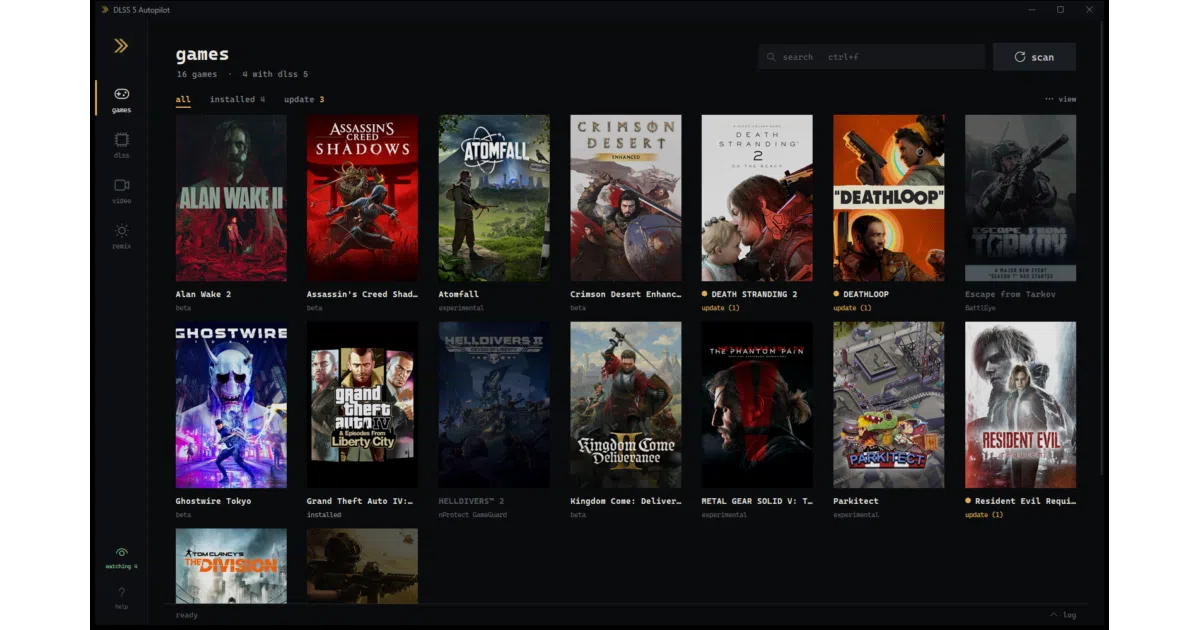
A single Windows exe that scans your library, picks the right hack for each game's graphics API, and injects NVIDIA's newest neural rendering pass — reversibly.
Too new to rank. Velocity needs a few days of history.
not enough history yet
star history
What it does DLSS 5 Autopilot retrofits NVIDIA’s neural re-lighting pass (materials, skin, tone — the thing shipped in NBA 2K27 for RTX 50) into games that never had it, and updates the DLSS files in games that do. It scans Steam, Epic, GOG, EA, Ubisoft, Battle.net, Rockstar, Xbox, plain folders and 19 emulators, reads each executable, and picks one of nine injection routes covering DirectX 8–12, Vulkan, OpenGL, 32-bit games and RTX Remix mods. Uninstall restores exactly what was replaced.
The interesting bit
It’s honest glue code — and proud of it. Nothing is bundled: every component (ReShade, OptiScaler forks, DXVK, the right nvngx_dlssnr.dll for your card) is fetched at run time from its original publisher. It also checks its own work: after you play, it reads ReShade’s log, the add-on’s, OptiScaler’s and Windows’ crash records to tell you which part of the chain failed, and offers the next route. The graphics-API detection is genuinely fussy — it cross-checks delay-load tables, Agility SDKs and Unity’s quirks because import tables lie.
Key highlights
- Nine routes, from in-process hooks (
renodx-dlss5) to ReShade depth-buffer feeding for games with no DLSS at all what will happen?dry-run lists every file an install would write, without writing any- Pooled community results: once five people report on a game, it tells you which route worked most often
- The
dlsspage tracks every game’s shipped DLSS version against NVIDIA’s newest, with per-game update and restore - Beyond games: the same pass runs on video files, YouTube, webcams and VR via ReShade’s OpenXR layer
- Reports the cost in milliseconds per frame, read back from the add-on’s own logs
Caveats
- Unofficial by design — it re-targets the runtime so RTX 20–40 cards run something NVIDIA shipped for RTX 50; expect breakage
autopilot(install, launch, verify, retry) is explicitly experimental, and the VR path is described as unproven- Windows 10/11 and NVIDIA RTX 20+ only
Verdict For anyone who’s hand-dropped OptiScaler DLLs into a game folder and squinted at logs afterward, this is that whole ritual automated and made reversible. If you’re on AMD, Intel, or Linux, it’s not for you at all.
Frequently asked
- What is Kizzuwatnaa/DLSS5-Autopilot?
- A single Windows exe that scans your library, picks the right hack for each game's graphics API, and injects NVIDIA's newest neural rendering pass — reversibly.
- Is DLSS5-Autopilot open source?
- Yes — Kizzuwatnaa/DLSS5-Autopilot is open source, released under the MIT license.
- What language is DLSS5-Autopilot written in?
- Kizzuwatnaa/DLSS5-Autopilot is primarily written in Python.
- How popular is DLSS5-Autopilot?
- Kizzuwatnaa/DLSS5-Autopilot has 1k stars on GitHub.
- Where can I find DLSS5-Autopilot?
- Kizzuwatnaa/DLSS5-Autopilot is on GitHub at https://github.com/Kizzuwatnaa/DLSS5-Autopilot.