Forget-C/Jellyfish
Treating AI Short Dramas Like Real Film Productions
It brings production discipline to AI-generated short dramas.
Velocity · 7d
+34
★ / day
Trend
↗accelerating
star history
What it does
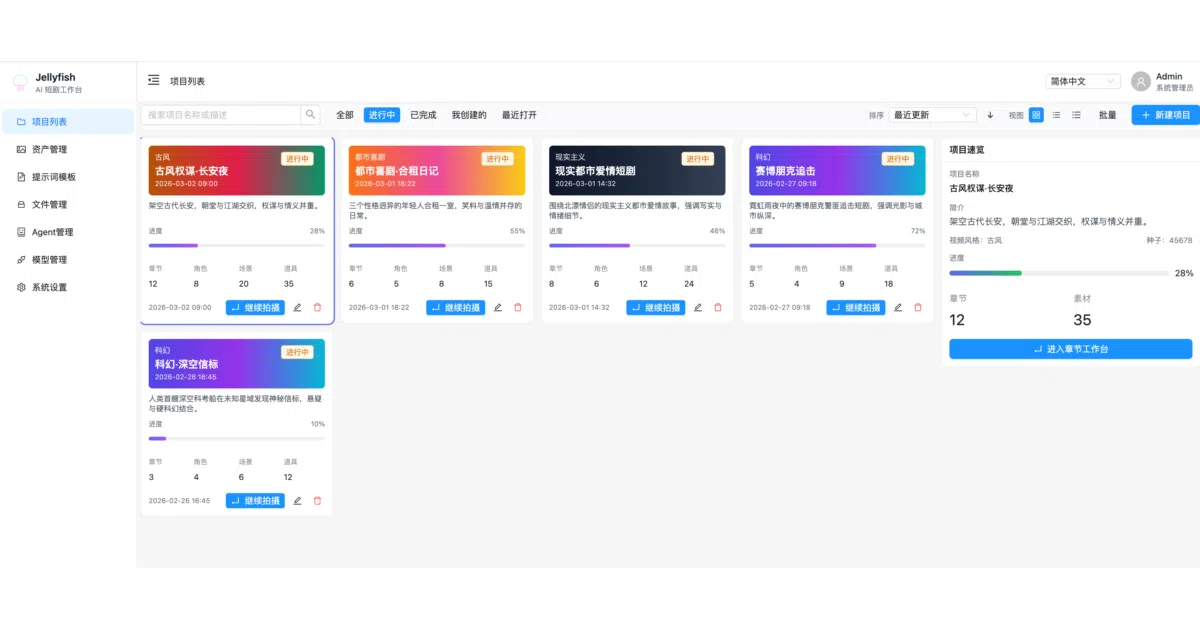
Jellyfish is a full-stack workspace that turns text scripts into structured shot lists, reusable character libraries, and tracked generation tasks. It breaks chapter scripts into individual shots, extracts entities like characters, props, and costumes, and manages them across the project so visuals stay consistent. The entire pipeline—script input, shot preparation, asset confirmation, and video generation—lives in one React and FastAPI application.
The interesting bit
Jellyfish explicitly positions itself as a production workspace rather than a single AI image or video utility. Its shared entity model links characters, scenes, props, and costumes across shots to keep generated visuals consistent, while an async task center with cancellation and recovery handles the unglamorous work of tracking long-running renders.
Key highlights
- Breaks chapter scripts into shots and extracts characters, scenes, props, costumes, and dialogue automatically
- Centralized asset library enforces reuse and style consistency across multiple shots
- Async task center tracks text, image, and video generation jobs with status, elapsed time, and cancellation
- Multi-provider model management and prompt templates for images, video, and shots
- OpenAPI-driven contracts between React frontend and FastAPI backend
Caveats
- The README describes the architecture clearly but never names the specific image or video generation providers actually supported
- Export capabilities are mentioned in the project description but not detailed in the feature breakdown
Verdict
Worth exploring if you are building AI video pipelines that need structured shot management and asset reuse. Skip it if you want a consumer video app—this is a production backend that expects you to curate characters, shots, and tasks.
Frequently asked
- What is Forget-C/Jellyfish?
- It brings production discipline to AI-generated short dramas.
- Is Jellyfish open source?
- Yes — Forget-C/Jellyfish is open source, released under the Apache-2.0 license.
- What language is Jellyfish written in?
- Forget-C/Jellyfish is primarily written in Python.
- How popular is Jellyfish?
- Forget-C/Jellyfish has 7k stars on GitHub and is currently accelerating.
- Where can I find Jellyfish?
- Forget-C/Jellyfish is on GitHub at https://github.com/Forget-C/Jellyfish.