Farama-Foundation/Minigrid
Discrete grid worlds for RL experiments that need speed
Minigrid gives RL researchers a set of lightweight, Gymnasium-compatible grid worlds for testing agents on everything from key-and-door puzzles to natural-language instruction following.
Not currently ranked — collecting fresh signals.
star history
What it does
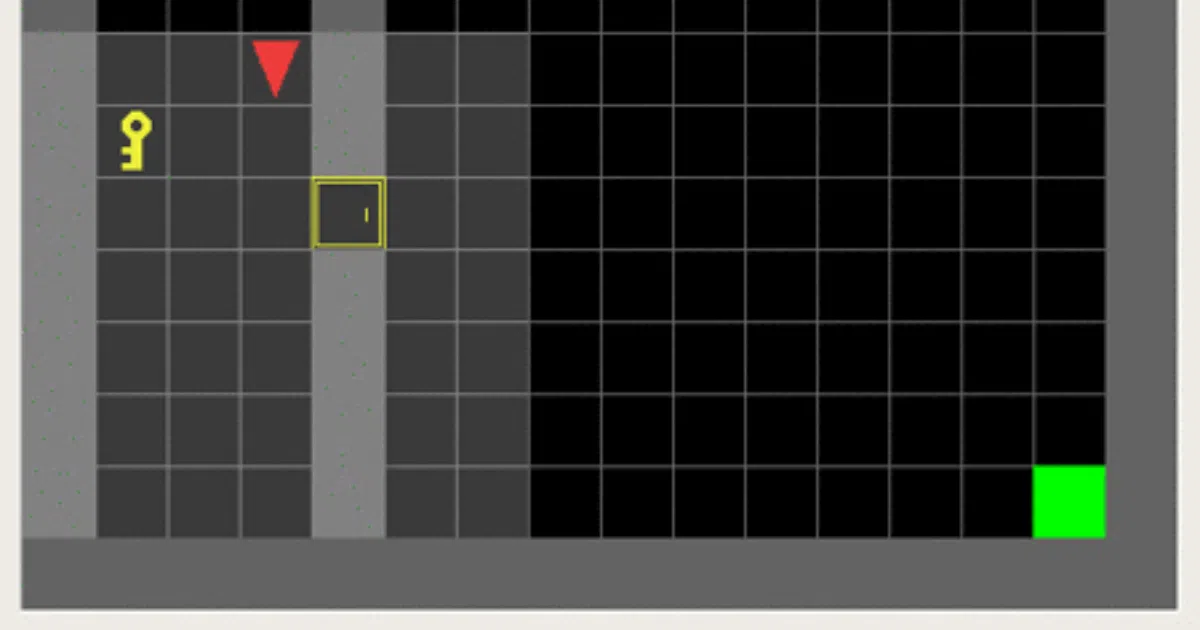
This library is a collection of discrete 2D grid-world environments for reinforcement learning research. The environments expose the standard Gymnasium API and center on a triangle-like agent navigating maps with walls, lava, and dynamic obstacles. Tasks are goal-oriented missions—unlocking doors, picking up objects, reaching goals—delivered as text strings in the agent’s observation. A second suite, BabyAI, layers synthetic natural-language instructions (e.g., “put the red ball next to the box on your left”) on top of the same grid engine to test grounded language learning.
The interesting bit
The environments are programmatically tunable in size and complexity, which makes them useful for curriculum learning or dialing difficulty up and down without rewriting the world generator. The whole thing is deliberately lightweight and fast, so you spend less time waiting for episodes and more time questioning why your policy gradient is still flatlining.
Key highlights
- Follows the Gymnasium standard API, so it drops into existing RL training loops.
- Two distinct collections: classic Minigrid for navigation and manipulation, and BabyAI for language-conditioned tasks.
- Programmatically adjustable size and complexity for curriculum learning.
- Missions are communicated as text strings, giving you a built-in signal for hierarchical or instruction-following research.
- Environments are discrete and low-dimensional, which means you can actually inspect what the agent sees.
Caveats
- Windows is not officially supported; the maintainers will accept PRs but do not test on it.
- The library was previously known as
gym-minigrid, so older papers may reference that name.
Verdict
Grab this if you need a fast, legible sandbox for RL algorithm prototyping, curriculum learning, or grounded language research. Skip it if you are looking for photorealistic visual observations or continuous control; this is deliberately a grid world, not a simulator.
Frequently asked
- What is Farama-Foundation/Minigrid?
- Minigrid gives RL researchers a set of lightweight, Gymnasium-compatible grid worlds for testing agents on everything from key-and-door puzzles to natural-language instruction following.
- Is Minigrid open source?
- Yes — Farama-Foundation/Minigrid is an open-source project tracked on heatdrop.
- What language is Minigrid written in?
- Farama-Foundation/Minigrid is primarily written in Python.
- How popular is Minigrid?
- Farama-Foundation/Minigrid has 2.5k stars on GitHub.
- Where can I find Minigrid?
- Farama-Foundation/Minigrid is on GitHub at https://github.com/Farama-Foundation/Minigrid.