Enemyx-net/VibeVoice-ComfyUI
Microsoft’s VibeVoice, ComfyUI-ified
It embeds Microsoft’s VibeVoice speech model directly into ComfyUI so you can synthesize and clone voices inside node workflows rather than managing a separate TTS pipeline.
Not currently ranked — collecting fresh signals.
star history
What it does
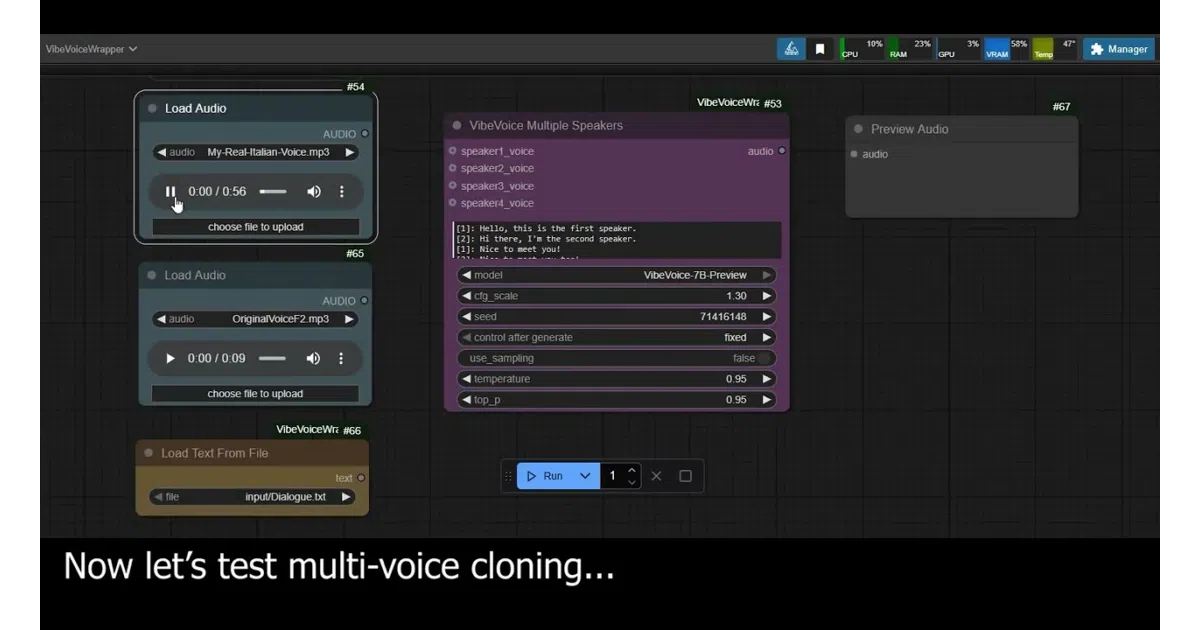
VibeVoice-ComfyUI is a self-contained set of custom nodes that wraps Microsoft’s VibeVoice text-to-speech model for ComfyUI. It lets you generate speech, clone voices from audio samples, and run multi-speaker conversations with up to four distinct voices, all wired into ComfyUI’s node graph. A dedicated Free Memory node and optional quantization aim to keep VRAM usage manageable.
The interesting bit The project treats a heavy LLM-based speech synthesizer like a diffusion model you’d already use in ComfyUI: you can chain TTS nodes, apply LoRA adapters to the language model or acoustic connectors, and insert manual VRAM cleanup between generations. It even supports Apple Silicon via MPS and offers 4-bit/8-bit quantized variants so the ~18.7 GB Large model can squeeze onto mid-range GPUs.
Key highlights
- Single-speaker synthesis and multi-speaker dialogue (up to four voices) with per-speaker cloning.
- LoRA support across the LLM, diffusion head, acoustic, and semantic connectors.
- VRAM controls: auto cleanup, a manual
Free Memorynode, and dynamic 4-bit/8-bit LLM quantization. - Cross-platform backends: CUDA, CPU, and Apple Silicon MPS.
- Self-contained wrapper with embedded VibeVoice code and no external package dependencies.
Caveats
- Since v1.6.0, models and the Qwen2.5-1.5B tokenizer must be downloaded and placed manually; nothing is fetched automatically.
- The README ends abruptly mid-sentence in the model caching section, suggesting the docs may still be catching up with the code.
Verdict Worth a look if you live in ComfyUI and want native TTS nodes in your image or video pipelines. If you just need a quick command-line voice generator, this is unnecessary plumbing.
Frequently asked
- What is Enemyx-net/VibeVoice-ComfyUI?
- It embeds Microsoft’s VibeVoice speech model directly into ComfyUI so you can synthesize and clone voices inside node workflows rather than managing a separate TTS pipeline.
- Is VibeVoice-ComfyUI open source?
- Yes — Enemyx-net/VibeVoice-ComfyUI is open source, released under the MIT license.
- What language is VibeVoice-ComfyUI written in?
- Enemyx-net/VibeVoice-ComfyUI is primarily written in Python.
- How popular is VibeVoice-ComfyUI?
- Enemyx-net/VibeVoice-ComfyUI has 1.5k stars on GitHub.
- Where can I find VibeVoice-ComfyUI?
- Enemyx-net/VibeVoice-ComfyUI is on GitHub at https://github.com/Enemyx-net/VibeVoice-ComfyUI.