Dooy/chatgpt-web-midjourney-proxy
One frontend for ChatGPT, Midjourney, Suno, and a dozen other AIs
A fork of chatgpt-web that evolved into a unified dashboard for text, image, video, music, and dance generation APIs.
Not currently ranked — collecting fresh signals.
star history
What it does
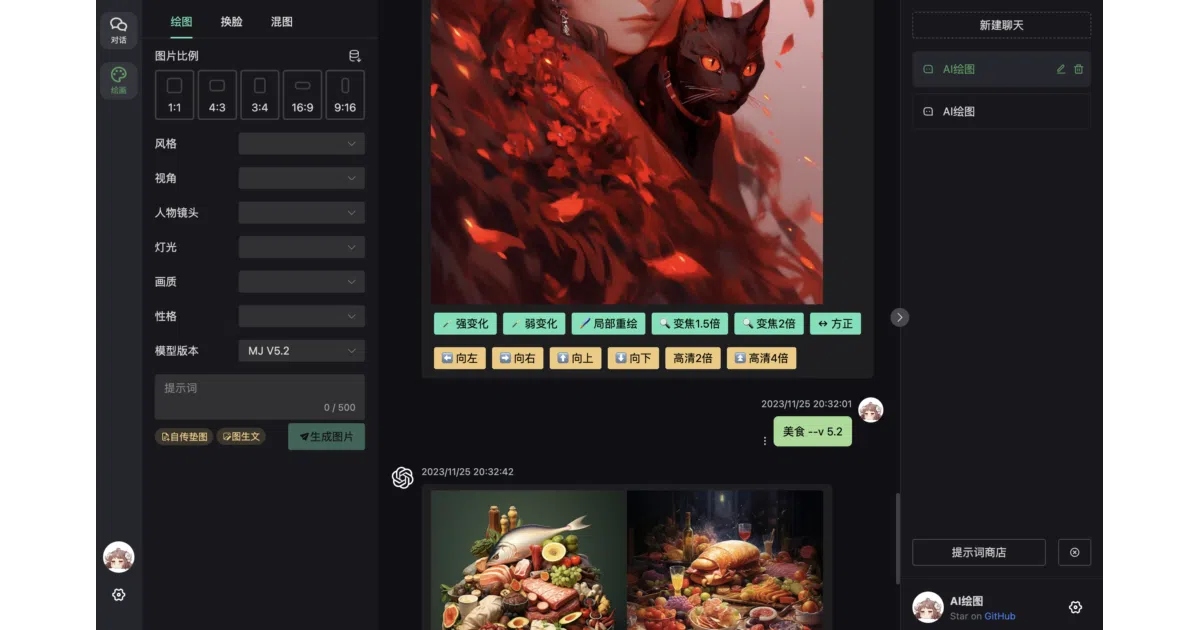
This project is a JavaScript frontend that bundles access to a sprawling list of generative AI services—ChatGPT, Midjourney, GPTs, Suno, Udio, Runway, Luma, Pika, Flux, Ideogram, Kling, and others—into a single interface. It began as a fork of ChenZhaoYu’s chatgpt-web and grew into a multi-modal control panel. The codebase runs as a web app, PWA, or standalone desktop client on Linux, Windows, and macOS, and is deployable through Vercel or Docker. The README is candid about its architecture: it is essentially an aggregation layer built atop midjourney-proxy, Suno-API, and Luma-API.
The interesting bit The breadth is almost comical. Instead of treating each generative model as a separate tool, the UI folds them into one utility grid, with menu tabs for music, video, dance, and real-time voice chat alongside standard text and image generation. It even exposes niche Midjourney operations like pan-and-zoom, face swapping via InsightFace, and seed extraction—features usually trapped inside Discord bots. The project openly recommends using a third-party API aggregator so that a single key and endpoint can power the entire suite.
Key highlights
- Supports text (ChatGPT/GPTs), image (Midjourney, Flux, DALL·E, Ideogram), video (Runway, Luma, Pika, Kling), music (Suno, Udio), and dance generation (Viggle) in one interface
- Includes OpenAI Realtime voice conversations, browser-native speech recognition, and TTS/Whisper integration
- Midjourney features cover inpainting, upscaling, directional panning, face replacement, image blending, and seed retrieval
- Runs as a web app, PWA, or desktop client; deployable through Vercel or Docker
- Desktop builds and Docker deployments support file uploads and brute-force protection, while Vercel deployments do not
Caveats
- It is explicitly a secondary fork and glue layer: you will need separate backend proxies (
midjourney-proxy, Suno-API, Luma-API, etc.) running for the corresponding features to work - Several capabilities—such as Cloudflare R2 file storage and anti-brute-force authentication—are marked as unsupported on Vercel and require Docker or desktop installs
- The “one key” convenience relies on a specific recommended commercial aggregator (openai-hk.com), introducing a hard dependency if you want unified billing
Verdict Consider it if you are self-hosting multiple generative APIs and want a single dashboard instead of a browser tab farm. Skip it if you need a lightweight, single-purpose ChatGPT clone or prefer native first-party interfaces.
Frequently asked
- What is Dooy/chatgpt-web-midjourney-proxy?
- A fork of chatgpt-web that evolved into a unified dashboard for text, image, video, music, and dance generation APIs.
- Is chatgpt-web-midjourney-proxy open source?
- Yes — Dooy/chatgpt-web-midjourney-proxy is open source, released under the MIT license.
- What language is chatgpt-web-midjourney-proxy written in?
- Dooy/chatgpt-web-midjourney-proxy is primarily written in JavaScript.
- How popular is chatgpt-web-midjourney-proxy?
- Dooy/chatgpt-web-midjourney-proxy has 6.8k stars on GitHub.
- Where can I find chatgpt-web-midjourney-proxy?
- Dooy/chatgpt-web-midjourney-proxy is on GitHub at https://github.com/Dooy/chatgpt-web-midjourney-proxy.