CookSleep/gpt_image_playground
A browser-native image lab that hoards your history in IndexedDB
A polished front-end for image generation APIs that exists because your prompt history shouldn’t live in someone else’s database.
Velocity · 7d
+7.0
★ / day
Trend
↗accelerating
star history
What it does
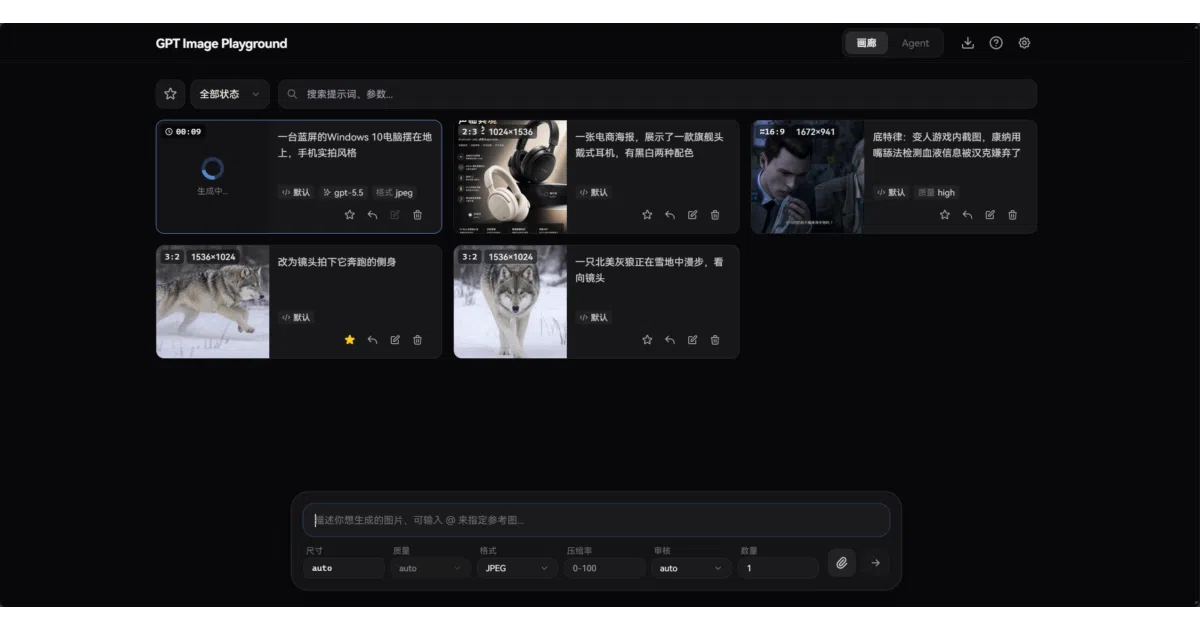
GPT Image Playground is a React interface for generating and editing images through OpenAI’s gpt-image-2 and compatible APIs. It covers text-to-image, reference images with mask editing, and multi-turn agent conversations, while keeping every task, image, and parameter in the browser’s IndexedDB. It also supports fal.ai and custom HTTP providers, with optional CORS proxying for self-hosted setups.
The interesting bit
The app treats the browser like a native client: it deduplicates stored images with SHA-256, supports desktop drag-to-select and mobile swipe multi-select, and exposes the exact API-side parameters—including the model’s rewritten prompt—so you can audit how your request was mutated. Its Agent mode, built on the Responses API, can branch conversations and batch-generate related images in parallel.
Key highlights
- Pure local persistence: all records and images live in IndexedDB, with one-click ZIP export for backups.
- Visual mask editor and up to 16 reference images per generation, with automatic resolution preprocessing.
- Streaming previews for both Images API and Responses API to dodge connection timeouts.
- Multi-provider support: OpenAI-compatible endpoints, fal.ai queues, and custom HTTP services via JSON import.
- Smart parameter diffing: highlights gaps between your requested settings and the API’s actual response, including rewritten prompts.
Caveats
- Enabling the built-in API proxy turns your server into an open relay; the README explicitly warns you to add access controls or keep it on a local network.
- Vercel’s
.devdomain enforces HTTPS, so local or intranet API endpoints require GitHub Pages or self-hosted Docker instead.
Verdict
Useful if you generate images often and want a dashboard-quality UI without cloud-syncing your creative history. Overkill if you just need a quick curl one-liner or don’t trust browser storage with your work.
Frequently asked
- What is CookSleep/gpt_image_playground?
- A polished front-end for image generation APIs that exists because your prompt history shouldn’t live in someone else’s database.
- Is gpt_image_playground open source?
- Yes — CookSleep/gpt_image_playground is open source, released under the MIT license.
- What language is gpt_image_playground written in?
- CookSleep/gpt_image_playground is primarily written in TypeScript.
- How popular is gpt_image_playground?
- CookSleep/gpt_image_playground has 4k stars on GitHub and is currently accelerating.
- Where can I find gpt_image_playground?
- CookSleep/gpt_image_playground is on GitHub at https://github.com/CookSleep/gpt_image_playground.