Chainlit/chainlit
Your LLM app needs a UI, but you don't want to build one
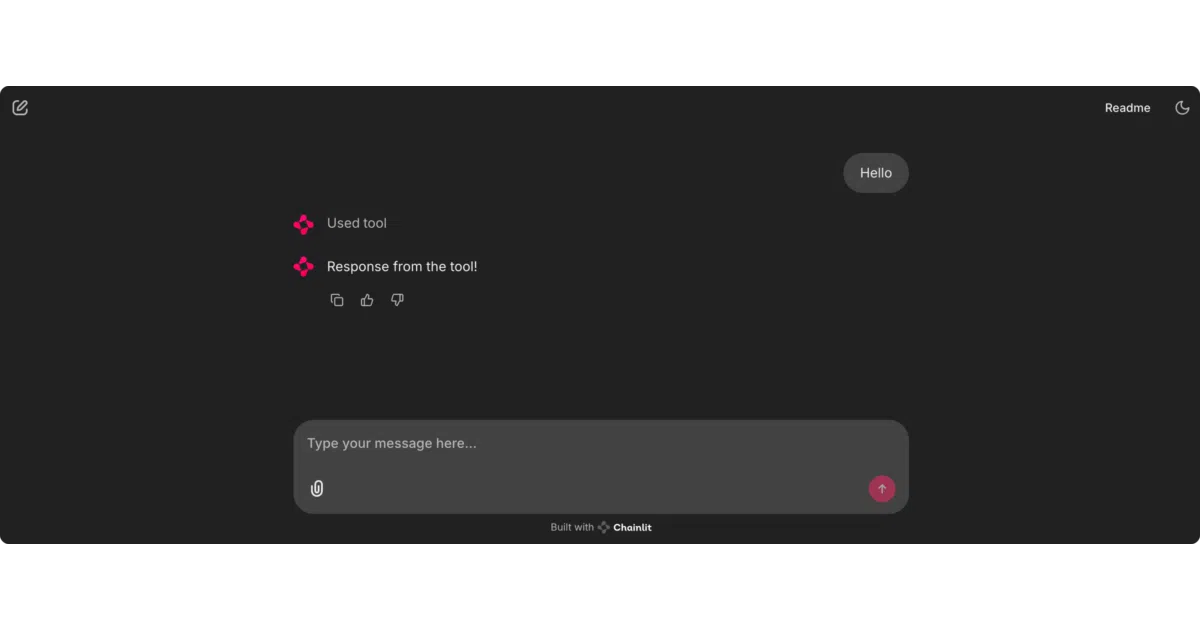
Chainlit turns a Python function into a chat interface with one decorator.
Not currently ranked — collecting fresh signals.
star history
What it does
Chainlit is a Python framework that wraps your conversational AI logic in a web UI. You write an async function decorated with @cl.on_message; Chainlit handles the browser, the message history, and the plumbing. It also supports tool steps (@cl.step) so intermediate operations show up as collapsible progress indicators in the chat.
The interesting bit
The “production-ready in minutes” claim is doing a lot of heavy lifting, but the actual pitch is simpler: most LLM demos die in a Jupyter cell because there’s no interface. Chainlit is essentially scaffolding code that solves the “just give it a UI” problem without reaching for Streamlit or a React build pipeline. The cookbook examples cover LangChain, LlamaIndex, vector DBs, and the usual suspects, suggesting it’s positioned as glue between your backend logic and a user-facing chat.
Key highlights
- Pure Python workflow: one decorator for message handling, another for tool steps
- Hot-reload dev server via
chainlit run -w - Cookbook with integrations for OpenAI, Anthropic, LangChain, LlamaIndex, ChromaDB, Pinecone
- Apache 2.0 licensed
- 12K+ stars, suggesting broad adoption in the LLM-prototype space
Caveats
- As of May 1, 2025, the original team has stepped back; the project is now community-maintained under a formal agreement, with Chainlit SAS explicitly providing “no warranties on future updates”
- The README doesn’t specify what “production-ready” means in terms of auth, persistence, or deployment patterns
Verdict
Worth a spin if you’re building LLM prototypes and need a chat UI yesterday without touching JavaScript. If you’re already invested in Gradio or Streamlit, or if you need enterprise guarantees about long-term maintenance, the community-handover notice should give you pause.
Frequently asked
- What is Chainlit/chainlit?
- Chainlit turns a Python function into a chat interface with one decorator.
- Is chainlit open source?
- Yes — Chainlit/chainlit is open source, released under the Apache-2.0 license.
- What language is chainlit written in?
- Chainlit/chainlit is primarily written in Python.
- How popular is chainlit?
- Chainlit/chainlit has 12.5k stars on GitHub.
- Where can I find chainlit?
- Chainlit/chainlit is on GitHub at https://github.com/Chainlit/chainlit.