AvaLovelace1/BrickGPT
LLM writes Lego instructions that actually stand up
A fine-tuned Llama model generates physically stable brick structures from text, then checks its work with a physics solver.
Not currently ranked — collecting fresh signals.
star history
What it does
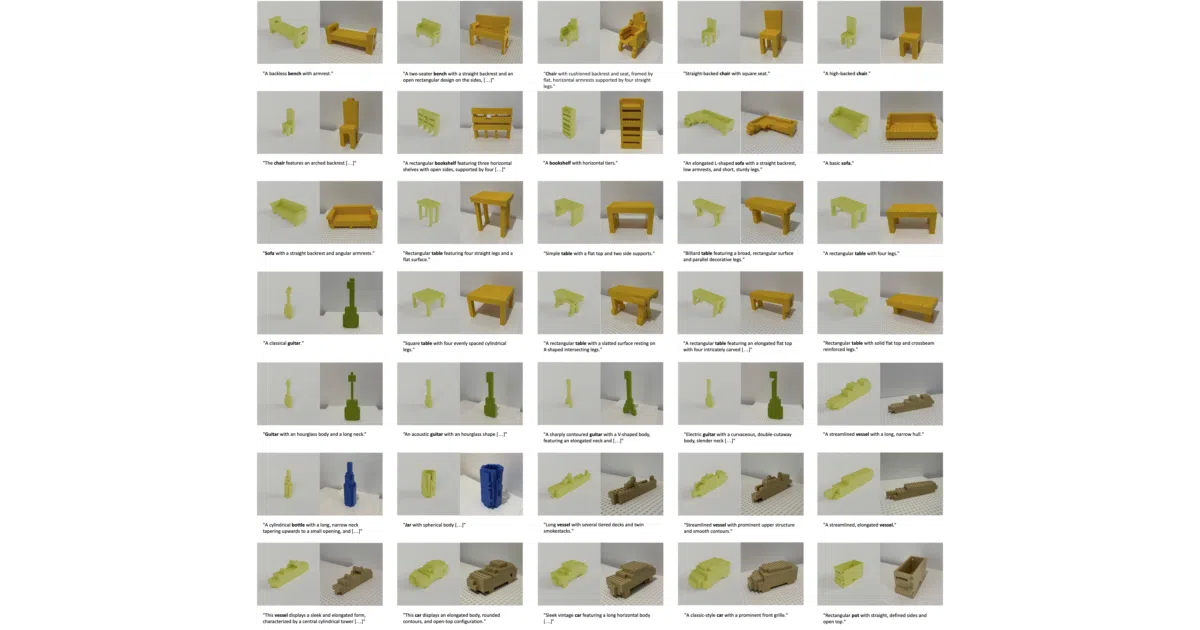
BrickGPT takes a text prompt like “table with four evenly spaced legs” and outputs a buildable brick structure in standard LDraw format. It is a Llama-3.2-1B model fine-tuned on a custom dataset, with a post-generation stability check that rejects bricks that would collapse or collide. The repo includes inference, texturing, mesh-to-brick conversion, and fine-tuning pipelines.
The interesting bit
The model doesn’t just hallucinate a shape and hope for the best. It generates brick-by-brick coordinates, then runs a rejection loop using Gurobi for physics-based stability analysis (or a simpler connectivity fallback). The README shows a real trace: 59 bricks accepted, 98 rejected, 4 regenerations. It is slow, but it is honest.
Key highlights
- Fine-tuned from Llama-3.2-1B-Instruct on the StableText2Brick dataset
- Outputs LDraw (.ldr), rendered PNG, and plain-text brick lists
- Optional Gurobi-based physics validation; falls back to connectivity check without a license
- Additional pipelines for UV texturing and converting existing 3D meshes to bricks
- ICCV 2025 Best Paper (Marr Prize)
Caveats
- Requires gated Hugging Face access for the base Llama model and a separate Gurobi license for full physics checks
- Rendering needs ImportLDraw, a background EXR file from Google Drive, and the LDraw parts library in your home directory
- Inference takes ~60 seconds per prompt on the example hardware shown
Verdict
Grab this if you are doing generative 3D, robotic assembly, or just want to see an LLM constrained by actual Newtonian mechanics. Skip it if you need real-time generation or lack patience for academic software setup.
Frequently asked
- What is AvaLovelace1/BrickGPT?
- A fine-tuned Llama model generates physically stable brick structures from text, then checks its work with a physics solver.
- Is BrickGPT open source?
- Yes — AvaLovelace1/BrickGPT is open source, released under the MIT license.
- What language is BrickGPT written in?
- AvaLovelace1/BrickGPT is primarily written in Python.
- How popular is BrickGPT?
- AvaLovelace1/BrickGPT has 1.7k stars on GitHub.
- Where can I find BrickGPT?
- AvaLovelace1/BrickGPT is on GitHub at https://github.com/AvaLovelace1/BrickGPT.