274056675/springboot-openai-chatgpt
A Chinese Spring Cloud wrapper for GPT, Baidu, and Midjourney
A full-stack Java project that glues together multiple AI APIs behind a microservices facade with web, iOS, and Android clients.
Not currently ranked — collecting fresh signals.
star history
What it does
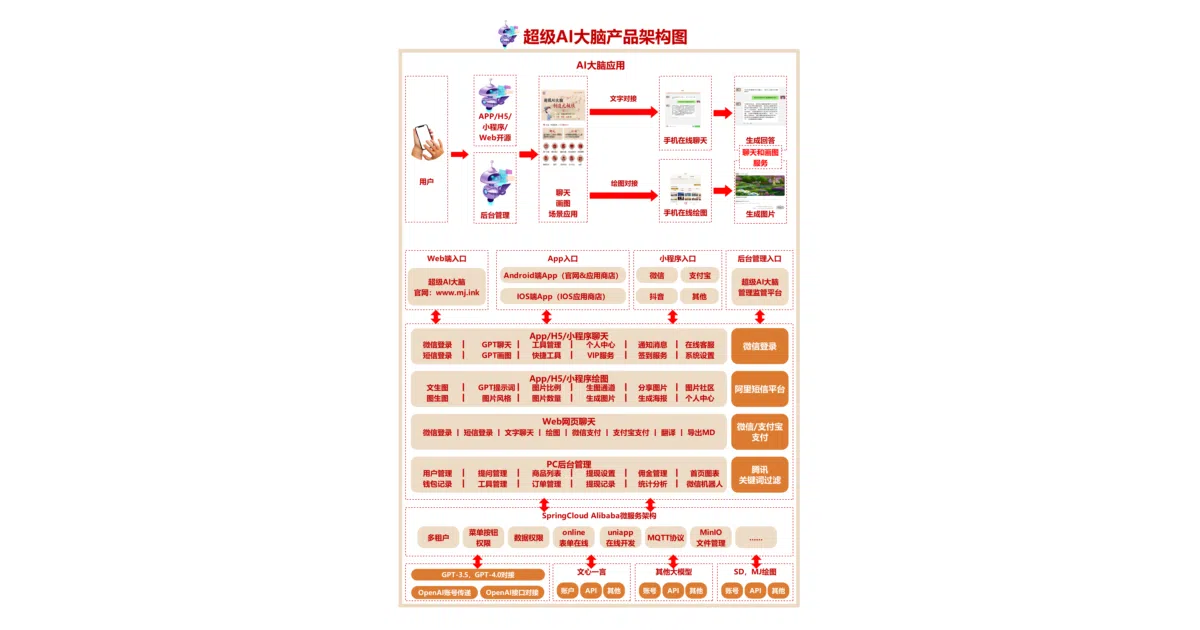
This is a Spring Cloud microservices application that proxies calls to OpenAI’s GPT-3.5/4, Baidu’s Ernie Bot, Stable Diffusion, and Midjourney. It exposes chat and text-to-image generation through web, Android, iOS, and H5 frontends. The repo includes a live demo, Bilibili video tutorials, and a WeChat-based login flow.
The interesting bit
The project is built on top of BladeX 3.7.1, an existing Chinese low-code platform — so much of the scaffolding (admin UI, user management, payment-adjacent “points” system) comes pre-assembled. The actual “AI” is entirely third-party API calls; the value is in the integration plumbing and the polished multi-client packaging.
Key highlights
- Supports GPT-3.5, GPT-4, Baidu Wenxin Yiyan, Stable Diffusion, and Midjourney from one backend
- Spring Cloud microservices architecture (Nacos, Gateway) with a Spring Boot monolith variant also available
- Multi-platform clients: web, iOS App Store app, Android APK, WeChat mini-program/official account
- Includes “AI toolbox” presets for education, encyclopedia, life, and entertainment prompts
- Community gallery for sharing generated images with heat-based ranking and poster generation
- Points/credit system via daily check-in for image generation access
Caveats
- README is entirely in Chinese; no English documentation visible
- Heavy reliance on external Chinese CDN assets (
oss.mj.ink) that may be slow or blocked outside mainland China - The “knowledge graph” and “programming assistant” claims in the description are aspirational marketing; the actual implementation appears to be standard prompt-based API calls
- No visible tests, CI configuration, or license file in the provided README excerpt
Verdict
Worth a look if you need a reference architecture for wrapping multiple Chinese and Western AI APIs in a Spring Cloud stack with mobile clients. Skip it if you want a clean, minimal SDK or if you need English-language support and documentation.
Frequently asked
- What is 274056675/springboot-openai-chatgpt?
- A full-stack Java project that glues together multiple AI APIs behind a microservices facade with web, iOS, and Android clients.
- Is springboot-openai-chatgpt open source?
- Yes — 274056675/springboot-openai-chatgpt is open source, released under the Apache-2.0 license.
- What language is springboot-openai-chatgpt written in?
- 274056675/springboot-openai-chatgpt is primarily written in Java.
- How popular is springboot-openai-chatgpt?
- 274056675/springboot-openai-chatgpt has 1k stars on GitHub.
- Where can I find springboot-openai-chatgpt?
- 274056675/springboot-openai-chatgpt is on GitHub at https://github.com/274056675/springboot-openai-chatgpt.