yihui-dev/awesome-opus5-5-videos · 14 Oct 2026 · Feature
The Best AI Video Generator Is a Coding Model

Lukas Brandt
Staff Writer
A GitHub list of 389 viral Claude Opus 5.5 videos argues that motion graphics' future runs through code, not diffusion — and the prompts are the proof.
yihui-dev/awesome-opus5-5-videos
★4.8k stars Velocity · 7d +536 ★/day ↗accelerating
star history
Somewhere between the release of Claude Opus 5.5 and the latest round of text-to-video model one-upmanship, something odd happened on X. A wave of creators started posting slick motion graphics — kinetic typography, particle systems, 3D flythroughs, playable pixel-art games — and none of it came from Veo, Sora, Kling, or any of the video models that Zapier’s annual roundup dutifully catalogs each year. It came from a coding model asked to write animations as HTML, Canvas, SVG, and Three.js, rendered in a browser and screen-recorded.
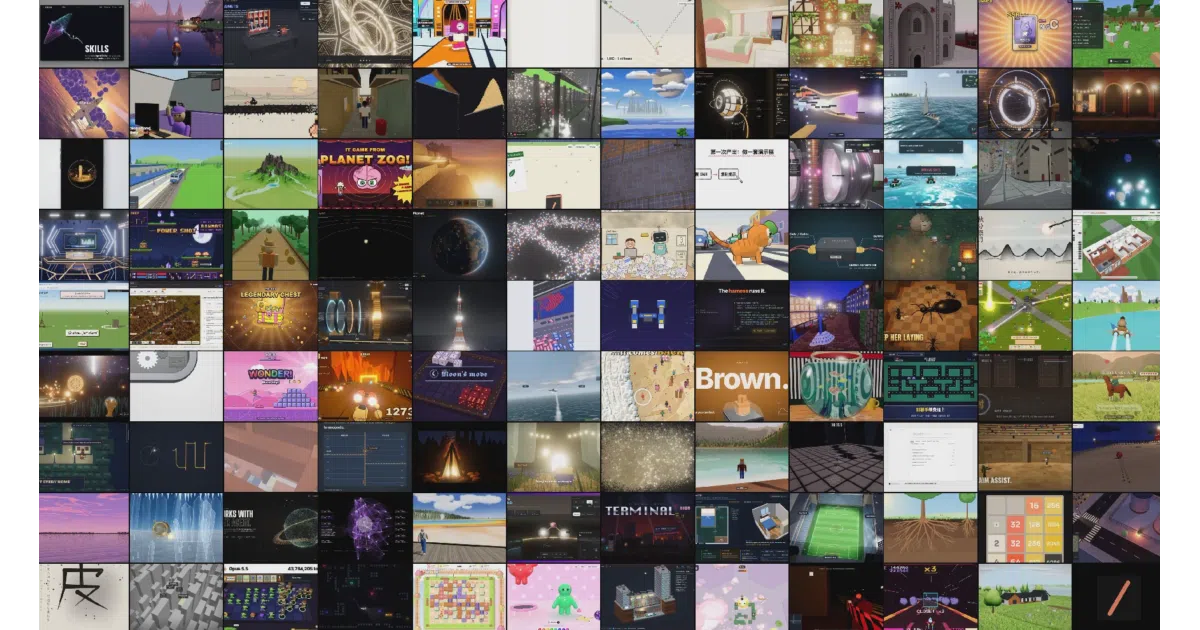
The repository awesome-opus5-5-videos is the archive of that moment: 389 videos, each paired with the prompt its creator shared, organized into motion graphics (58 highlighted entries), explainers (16), 3D scenes (14), and games and interactive pieces (12). It is not software. It is a curated corpus — and that turns out to be the interesting part.
The hype, compressed
The timeline is tight. Opus 5.5 landed, and within days the X posts started stacking up — the repo’s own entries are almost all dated to a single explosive week in late September 2026, with the latest update (September 28) adding 107 videos, skewed heavily toward games and 3D scenes. Two Minute Papers covered the model on September 24 and pulled 370,000 views in two weeks, framing it as “an incredible leap forward” and demonstrating it on physics simulations — walking creatures, coiling honey — rather than the usual diffusion-model showreel. A thread on r/claude titled “Opus 5.5 is just amazing at creating videos and I love it” exists, though Reddit’s login wall now hides its contents; the title alone tells you the temperature of the community.
So the repo arrived at peak attention and did the one thing the feed couldn’t: it made the phenomenon durable. Tweets rot, algorithms bury, and prompts — the actual valuable artifact — get lost in quote-tweets. Here they’re files.
What’s actually in the box
Strip away the mosaic of preview thumbnails and the repository is three things: a directory of prompt files, a JSON dataset of all 389 videos, and links back to each creator’s original post. Every entry is tagged with its rendering stack — Canvas, SVG, GSAP, Three.js, GLSL, Web Audio, occasionally “Playable” or “Pixel art.” The tags alone sketch a technical thesis: this is the standard web-animation toolkit, the same one agencies have used for years, now driven by a model that can write it fluently.
The companion site (skillry.dev, which we’ll get to) adds the genuinely clever bit: each original video is shown next to a live remake, meaning the prompt re-run so you can watch the result reproduce — or drift — in real time. That’s a verification mechanism disguised as a gallery. In a field drowning in unverifiable demo claims, “here is the prompt, here is the re-run, compare them yourself” is a small epistemological victory.
The README is honest about incompleteness, too: some creators shared only part of their prompt, or only described the result, and those files say so. That candor matters, because the difference between a full prompt and a vibes-only description is the difference between a reproducible artifact and a rumor.
Why code beats diffusion — for this genre
The interesting question isn’t “can Opus make pretty videos.” It’s why anyone would route video through a coding model when an entire industry — Runway, Higgsfield, invideo, and the model vendors behind them — is selling text-to-video directly.
João Queirós’s analysis of the Opus 5.5 video wave nails the answer: it depends entirely on the genre. His framing splits production into three paths — a video model for rapid visual concepts and complex textures, HTML/JavaScript for exact typography, charts, and repeatable motion, and After Effects for editable professional timelines. Code gives precision and repeatability; a video model gives visual richness but less control. Change one word in a diffusion prompt and you may need a fresh render, with no guarantee the other ninety-nine percent of the shot survives. Change one line of a prompt that generates code, and the code changes where you pointed it.
Look at the repo’s category distribution and you can see that trade-off playing out in public. Motion graphics dominate — kinetic type, logo animations, data-driven explainers — precisely the genres where typography must be exact, timing must be frame-locked, and the client will ask for the logo to be 10% bigger. These are videos where the source of truth is a spec, not a vibe. Diffusion models are famously bad at rendering text and worse at honoring a revision request. A coding model doesn’t render text at all; it emits a font declaration.
The September update’s tilt toward games and 3D scenes suggests the frontier is moving, too. Playable canvas games and Three.js scenes with GLSL shaders are a step up in complexity from a 15-second kinetic-type loop — they require game state, physics, collision, and coherent spatial reasoning, not just easing curves. Two Minute Papers’ physics demonstrations point the same direction: the model isn’t just styling frames, it’s reasoning about systems that behave over time.
The corpus as evidence
Here’s the underappreciated value of the repo. Individual viral posts tell you nothing — one great demo might be a lucky prompt, a cherry-picked render, or forty retries. A corpus of 389 attributed prompts, tagged by stack and genre, with live remakes, is something else: an informal capability map. You can see which genres the model handles reliably (motion graphics, overwhelmingly), which are emerging (interactive games), and what the community’s prompting conventions look like at scale — how people describe timing, camera moves, and visual hierarchy to a model that will implement them literally.
It also functions as a transfer mechanism. The README’s framing — “pick one, copy its prompt, and try it with your own agent” — makes the list a de facto cross-model benchmark. If a prompt that produces a polished Three.js scene on Opus 5.5 produces mush elsewhere, you’ve learned something the vendor’s benchmark table won’t tell you. Queirós’s piece includes exactly this kind of side-by-side: the same brief run through Claude and ChatGPT, exported and compared under identical narration. It’s a visual experiment, as he’s careful to say, not a controlled ranking — but it’s the right shape of experiment.
The caveats, stated plainly
This is a curated list, and it is also, unmistakably, a marketing asset. Every link carries UTM parameters routing to skillry.dev, the site hosting the side-by-side gallery; the README is as much a funnel as a document. That doesn’t invalidate the corpus — the prompts are real, the attribution is real, the MIT license covers the list and data files, and the credits section explicitly leaves ownership of every video and prompt with its creator, with an open invitation to request changes or removal. But a reader should know the commercial engine is humming one click away. The “awesome list” format has always lived comfortably adjacent to self-promotion; this one is just more instrumented than most.
Second, it’s curation, not software — there’s no tooling here to evaluate, no architecture to critique. Its rough edges are the rough edges of any scrape-the-feed archive: partial prompts, uneven attribution of production details, and the inherent survivorship bias of viral content. The 389 videos that made the cut are the ones that looked good on X. The failed renders, the broken shaders, and the hundredth retry are invisible, which means the repo overstates ease by construction. Queirós flags the same caveat in his own gallery: it demonstrates possibilities, not a guarantee that every result takes one prompt.
Third, the comparison to video models is genre-bound. For photorealistic footage, complex organic motion, and texture richness, the diffusion path still wins, and the business-video economics — traditional production at $4,000–$5,000 per finished minute versus AI-assisted at $300–$400 — are being driven mostly by the model-and-template tools, not by coding agents. The repo’s videos are motion graphics and interactive pieces, a real but specific slice of what “video” means.
Where this goes
Two trajectories are worth watching. One is capability: if the games-and-3D trend in the latest update continues, the coding-agent path starts competing for territory — interactive content, data visualization, simulation — that video models structurally cannot touch, because a rendered MP4 cannot respond to a mouse. A video model makes footage; a coding model makes software that happens to look like footage. That distinction will matter more as audiences expect things to be playable, scrubable, and live-updatable.
The other trajectory is convergence. Runway already markets itself as generation-plus-editing in one place; Higgsfield sells deterministic camera control over generative video; everyone is racing toward the thing code already has — control. Meanwhile the coding side keeps borrowing from the video side, with creators like those in Queirós’s gallery chaining Opus with Seedance renders and HeyGen avatars. The three paths he describes are not competing so much as being stapled together, and the stapler is increasingly the coding agent, because code is the only medium all three paths can speak.
The repo itself will probably be remembered as a snapshot — a week in late 2026 when a language model’s fluency with GSAP briefly outshone every diffusion showreel on the timeline. But snapshots of inflection points are worth keeping. The prompts collected here are the fossil record of an argument: that the shortest path from idea to moving image might not be through a model that imagines pixels, but through one that writes the machine which draws them.
Sources
- AI Video Generator - Sora, Kling, Veo, Seedance & More
- How do you use AI video tools in business? What are the ...
- Opus 5.5 is just amazing at creating videos and I love it : r/claude
- The 16 best AI video generators in 2026
- What are some potential use cases of AI-generated video content?
- Claude Opus 5.5 AI: An Incredible Leap Forward
- AI Video Generator
- What are the common usages on an AI video generator?
- Opus 5.5 Video: 30 Creator Examples, Demos, and Prompts
- Free AI Video Generator
- 10 Business Use Cases for AI Video | ngram.com
- How I Make Insane Motion Graphics with Opus 5.5 (Better than ...