yi1108/printfilm · 21 Oct 2026 · Feature
China's Micro-Drama Machine, Now Self-Hostable

Giulia Conti
Editor
printfilm open-sources the full factory floor of AI short-drama production — pipeline, billing desk, and all — betting that the boring orchestration is worth more than the models.
yi1108/printfilm
★5.8k stars Velocity · 7d +594 ★/day ↗accelerating
star history
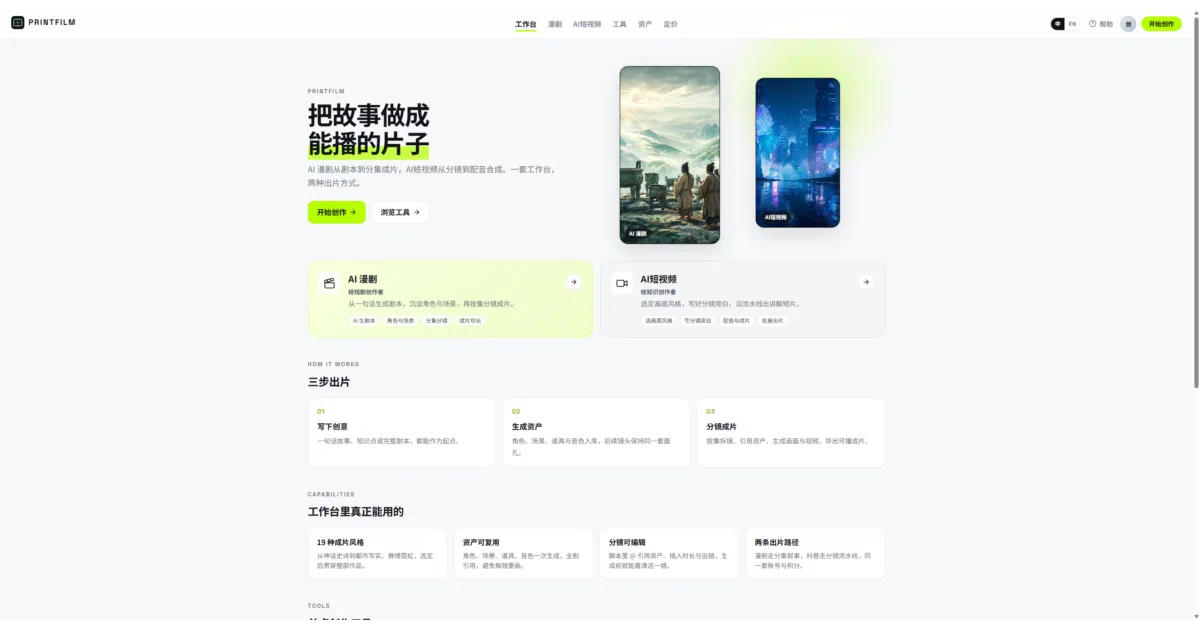
The name is a trap. Search for “printfilm” and you will find BERGGER’s blue-sensitive darkroom stock for making interpositives, Kodak’s motion-picture print films, and Dunmore’s coated polyester for label converters — a whole quiet industry of physical film that has nothing to do with yi1108/printfilm on GitHub. The repo in question is something entirely different and much more of-this-moment: a template-driven platform for producing AI short videos and animated micro-dramas, from theme to script to storyboard to generated footage to finished film. Version 0.2.0, MIT-licensed, and — unusually for this category — shipped as a complete commercial-looking product rather than a research demo.
Why anyone is paying attention
The context is the Chinese micro-short drama boom. These are vertical, serialized, minutes-long episodes distributed through mobile apps and algorithmic feeds, and they have become one of the most commercially significant video formats in China. CCTV+ has been running coverage of how AI is revolutionizing short-drama production in the country, and academic work is starting to treat the form as its own object of study: a 2026 paper in Frontiers in Communication examines how the visual persuasive features of AI micro-short dramas drive sharing behavior through immersion, information density, and emotional empathy. That paper’s framing is telling — it treats AI-generated drama not as a novelty but as a distinct media form with its own aesthetics and its own audience dynamics.
Against that backdrop, most of the tooling conversation in the West revolves around hosted products. Zapier’s roundup of AI video generators for 2026 catalogs the familiar names — Google Veo for consistency, Runway for filmmaking, LTX Studio for creative control, Synthesia for avatar-driven corporate video — all of them SaaS, all of them closed, all of them priced per seat or per minute. printfilm sits in a different position entirely: it is the production stack as open source, the kind of thing you’d expect a Chinese short-drama studio to build internally and, in this case, decide to publish.
The one genuinely clever idea
Strip away the admin panels and the billing and the React frontends, and printfilm’s pipeline is straightforward: a theme or script goes in, a language model splits it into shots, an image model generates the frames, a video model animates them, and FFmpeg stitches everything into a final cut. Two product lines run on this machinery — an animated-drama track that emphasizes character and scene consistency across episodes via a reusable asset library, and a short-video track built on twenty-plus visual templates (paper-cut, picture-book, chalk, collage, pixel, ink-wash, and more) that turn a piece of copy into a finished explainer-style clip.
The interesting design decision is audio. Most AI video pipelines treat voiceover as a separate stage: generate speech with a TTS model, then align it to footage, then hope the timing works. printfilm skips that entirely. The narration is generated by the video model itself — ByteDance’s Seedance — at render time, as part of producing the shot. No separate dubbing step, no voice-asset management, no audio-video alignment pass. The repo’s documentation repeats this point almost defensively, as if aware it sounds too simple: the voice comes with the footage, full stop.
This is more than a convenience. Collapsing dubbing into generation means the model that decides when a character’s mouth moves is the same model that decides when the words land. For a serialized drama format where episodes are produced in bulk and consistency across shots is the whole game, removing an entire synchronization stage from the pipeline is a real architectural simplification. It also means the platform’s asset system deliberately doesn’t bind characters to voices — the drama asset library covers characters, scenes, and props, and audio is simply not its problem.
The honest part: this is glue code, and that’s the point
It should be said plainly: printfilm contains no model research. Every generative capability is rented. Text comes from an LLM (the docs default to a Kimi model), images from ByteDance’s Seedream, video from Seedance, all routed through a single upstream gateway called TokenFree New API, which the open-source version treats as fixed. If you stripped out the API calls, you’d have a FastAPI backend, a task runtime, two React frontends, and FFmpeg.
But dismissing it as glue would misread where the value lives. The genuinely hard, genuinely boring work in AI video production is not generation — that’s a paid API call. It’s everything around it: a server-side state machine that moves each project through scripting, imaging, video, and compositing while the user walks away; a task runtime with a scheduler, executor, and poller that runs inside the API process; per-user and per-project concurrency limits so one heavy project doesn’t starve the platform; the ability to redraw a single storyboard frame or regenerate a single shot without redoing the whole video; and an FFmpeg composition stage that handles burned-in Chinese subtitles, complete with the font problems that entails on bare Linux.
Then there’s the part that almost no open-source project ships: the business. printfilm includes user accounts, an optional metered wallet charged against actual upstream costs, payment integration through the Epay gateway, a full operations console with user management, order flows, financial ledgers, content review, template management, and a task center, plus an open API with per-user keys for the image and video endpoints. This is not a library. It is a SaaS company’s codebase with the doors opened. Someone could plausibly stand up a paid AI drama service on it this week — which appears to be precisely the intent, since the billing documentation describes pricing at upstream cost with no markup by default, as if the operator’s margin is meant to come from elsewhere.
Where it sits in the field
Compared to the Western tools in Zapier’s taxonomy, printfilm is neither a generator nor an editor nor a creation suite in their sense — it’s closer to an open-source answer to the whole category at once, aimed at a format (vertical micro-drama, bulk-produced) that the Western suites mostly don’t target. Synthesia wants to turn your PowerPoint into a corporate explainer with an avatar in 140 languages. printfilm wants to turn a story outline into a multi-episode animated serial with recurring characters. Different ambitions, different audiences, and notably different economics: one is a subscription, the other is a Docker stack you own.
The self-hosting story is real, if China-flavored. Prebuilt images live on Alibaba Cloud’s container registry in a public namespace, the stack is Postgres and Redis plus three application containers behind nginx, and there’s a mock mode that substitutes local placeholder assets so you can inspect the entire interface without any API keys — a small courtesy that more AI projects should copy. The community, meanwhile, lives on WeChat, with a group organized around short-drama technique, deployment questions, and template sharing. That’s a deliberate choice about who this is for, and it tells you the intended audience is Chinese creators and operators, not the HN crowd.
The rough edges, visible from outside
Several are worth naming. The task runtime is in-process — scheduler, executor, and poller all start with the FastAPI application — and the documentation explicitly warns that the API container should stay at a single worker to avoid multiple processes fighting over task leases. That’s a workable design for a small deployment and a ceiling for a large one; a serious operator would eventually want a real queue. The production deployment manual for the maintainers’ own live site is, by their own admission, not in the public repository, so the open-source path is the Docker path or nothing. There are no demo accounts. The docs are Simplified Chinese throughout, with an English/Chinese toggle in the user interface but not in the documentation. And the hard dependency on one upstream gateway means the project’s generative ceiling is whatever TokenFree and the Doubao models happen to be — model portability is, at 0.2.0, more aspiration than architecture.
Smaller frictions abound in the way they do with any young project: password recovery silently doesn’t work unless Redis is properly configured, payment gateway callbacks must avoid a particular URL path because some WAFs block it, and the team’s contribution guidelines ask for Chinese user-facing copy and server-side pagination — house rules that suggest a small, single-vision team rather than a sprawling community. None of this is damning. All of it says: 0.2.0, one maintainer’s shape, useful today, unfinished.
Outlook
The open questions are the obvious ones. Will the model layer stay pluggable enough to survive Seedance’s successors, or will the pipeline calcify around one vendor’s quirks — especially the voice-in-video trick, which is only as durable as Seedance’s willingness to keep narrating? Will the in-process task runtime scale past hobby deployments, or will someone contribute the Celery-shaped hole that serious operators will notice? And will the project’s China-first infrastructure choices — Aliyun registry, Epay billing, WeChat community — keep it invisible to the English-speaking world that is currently arguing about which hosted video generator to subscribe to?
That last one cuts both ways. The Western market has plenty of tools and almost no open stacks; printfilm has a stack and almost no Western presence. If AI micro-drama production is becoming a real industry — and both the CCTV+ coverage and the academic attention suggest it is — then a complete, MIT-licensed, self-hostable production platform with billing built in is a genuinely unusual artifact, whatever its maturity. The models will keep changing. The factory floor, it turns out, is the part somebody open-sourced.
Sources
- BERGGER Print Film
- The 16 best AI video generators in 2026
- AI Revolutionizes Short Drama Production in China ...
- Print Films
- Free Marketing Video Maker - Create AI ...
- How AI micro-short dramas shape users' sharing behavior
- Printable Film, Graphics Film
- What's the best AI video generation tool for content ...
- How I Use AI to Make Short Drama : r/aitubers
- The Darkroom's comprehensive photography film index
- AI YouTube Shorts Maker
- China's short-dramas flood the market — and let viewers ...