xai-org/grok-build · 18 Jul 2026 · Feature
Grok Build Arrives: A Terminal Agent to Compile, Not Contribute To

Megan Russo
Staff Writer
SpaceXAI's Rust-based coding agent open-sources its harness to prove that inspectable context assembly matters more than model hype.
xai-org/grok-build
★27.5k stars Velocity · 7d +11 ★/day ↘cooling
star history
The July Drop
In early July 2026, xAI dropped Grok Build into an AI coding-agent market that already had established favorites. The terminal-based tool launched on July 8 powered by Grok 4.5, then open-sourced its Rust codebase on July 15 under the Apache 2.0 license. The timing was deliberate. Terminal agents were having a moment—Aider, Claude Code, Codex CLI, and Gemini CLI had already proven developers would abandon browser tabs for a shell prompt—and xAI wanted to demonstrate that it could ship a complete harness, not just another chat interface wrapped around a model.
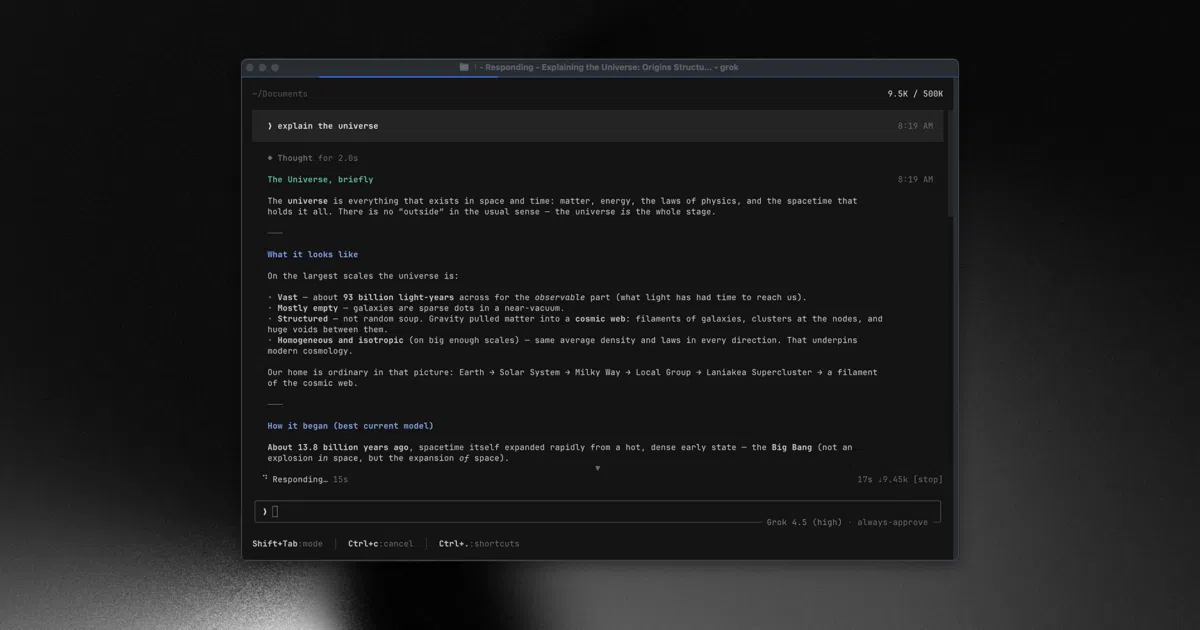
The announcement framed open-sourcing as a move to harden the harness by letting users inspect exactly how it works. That is a subtle but important distinction. xAI did not claim the model itself was open; it exposed the machinery that turns model outputs into file diffs, shell executions, and web searches. The source, xAI stated, now serves as the definitive reference for how skills, plugins, hooks, MCP servers, and subagents are loaded and invoked.
The Harness as Product
Grok Build is written in Rust and organized as a workspace of crates handling distinct responsibilities. The pager crate draws the full-screen TUI, managing scrollback, prompts, modals, rendering, and an inline diff viewer. The shell crate hosts the agent runtime and exposes leader, stdio, and headless entry points so the same engine can drive an interactive session or a CI script. The tools crate implements the actual capabilities—reading and editing files, searching code, running terminal commands, and searching the web—while the workspace crate abstracts the host filesystem, version control, execution environment, and checkpoints. A composition-root crate assembles these into the binary that ships as the command-line interface.
This architecture matters because the agent loop is where competitors often falter. Reviews of GitHub Copilot Agent Mode note that it sometimes updates only explicitly mentioned call sites while skipping nearby comments, produces invalid syntax, or asks permission before trivial changes. Windsurf has been observed requiring many turns to complete tasks, generating duplicate code, or getting stuck in infinite loops. Grok Build’s response is to make the loop inspectable: users can trace how context is assembled from the codebase, how the model’s response is parsed into structured tool calls, and how those calls are dispatched against the filesystem.
The tool also supports the Agent Client Protocol for editor embedding and the Model Context Protocol for external tool integration, placing it in the emerging ecosystem of standardized agent interfaces rather than a proprietary silo. It runs sandboxed execution for untrusted code and streams terminal output live, treating the shell as a first-class citizen rather than an afterthought.
Safety Valves and Parallel Workers
Two design choices attempt to solve the reliability problem from different angles. The first is plan mode. Before touching any file, the agent generates a structured plan and blocks all edits until the user approves, comments on, or rewrites it. Approved changes are output as clean diffs. This directly addresses the anxiety that agents will refactor half a repository before the developer notices, and it stands in contrast to tools that eagerly edit first and ask forgiveness later.
The second is subagents that run in parallel with independent context windows and deep worktree support. Rather than forcing research, build, and review into a single sequential conversation, Grok Build spins up parallel workers that operate simultaneously. For ambiguous tasks, the main agent prompts the user with multiple-choice questions to refine design direction, then folds those answers back into the plan.
The tool also captures reusable skills from sessions via a feature called skillify. These skills can be auto-invoked later or called by name, effectively letting teams encode tribal knowledge into the agent’s repertoire. A plugin marketplace allows teams to bundle and share capabilities, installable from the marketplace or self-hosted Git repositories, with integrations for Linear, Sentry, Postgres, Grafana, and browsers. Cross-session memory and per-directory AGENTS.md conventions extend this personalization, allowing project-specific rules to travel with the repository. UI theming rounds out the package, acknowledging that developers who live in the terminal still care about aesthetics.
Local-First, But Read-Only
Despite the Apache 2.0 license, Grok Build is not a community project. The README explicitly states that external contributions are not accepted. The repository is periodically synced from the SpaceXAI monorepo, making it a public source mirror rather than a collaborative codebase. Users can compile the binary themselves, point it at their own local inference endpoint, and control behavior via a configuration file. That enables a local-first deployment model rare among major vendor agents. But the no-contributions policy means bug fixes, platform ports, and harness improvements flow only from xAI’s internal pipeline.
This is a significant tension. In a landscape where Aider maintains an active open-source community, Claude Code benefits from Anthropic’s research feedback loops, and Zhipu’s GLM 5.2 ships as an MIT-licensed open-weight model with community benchmarks, Grok Build’s read-only open source serves transparency and local deployment, not collective evolution. Windows builds are already marked best-effort and untested, a rough edge that a community might have addressed quickly but that xAI will have to prioritize internally.
Borrowed Tools and Vendored Parts
A closer look at the repository reveals that Grok Build is not entirely greenfield. The third-party notices file acknowledges in-tree source ports of openai/codex and sst/opencode tool implementations, alongside vendored crates, bundled UI themes, and a Mermaid diagram stack. This is standard practice, but it does mean that portions of the tool layer are adaptations of existing open-source work rather than original inventions. For a project whose value proposition centers on the uniqueness of its harness, the presence of ported tooling is worth noting. The root Cargo.toml is itself generated, treated as read-only, which hints at a build system managed upstream in the monorepo rather than shaped by external hands.
The Grok 4.5 Backend and the Paywall
Grok Build is tightly coupled to xAI’s Grok 4.5 model. Early access requires a SuperGrok or X Premium+ subscription, placing the tool inside the X platform ecosystem. One industry ranking cites token pricing of $2/$6 per one million tokens for Grok 4.5, positioning it as a mid-tier option in a market where cost has become a primary decision factor. The tool is described as free-to-try, but the subscription gate and platform bundling are clear.
This backend dependency defines Grok Build’s ceiling. Unlike model-agnostic command-line interfaces that let users swap between OpenAI, Anthropic, Google, and local endpoints, Grok Build is designed around a single provider’s model. The open-source harness mitigates this by allowing local inference, but the out-of-the-box experience—the skills, the subagent orchestration, the plan mode—is tuned for Grok 4.5.
A Crowded Shell
Grok Build enters a terminal ecosystem that is already densely populated. Curated directories like Terminal Trove and awesome-terminals-ai catalog dozens of CLI and TUI programs, from pair-programming agents like Aider and Codex to chat clients, GPU monitors, and MCP debugging tools. The category has matured enough that developers now choose between IDE-embedded agents like Cursor and VS Code-native tools, and terminal-first agents for serious refactoring or automation.
Industry rankings reflect this maturity. Faros AI’s 2026 evaluation places Cursor, Claude Code, Codex, GitHub Copilot, and Cline as the front-runners, judging them on cost, token efficiency, code quality, and repo understanding. MightyBot’s July 2026 ranking lists OpenAI’s Codex first, Claude Code second, and Grok Build among new entrants alongside Zhipu’s GLM 5.2. Grok Build’s challenge is not proving that terminal agents are viable; that case has been made. Its challenge is proving that its specific combination of inspectable harness, plan mode, and parallel subagents justifies switching costs in a market where developers already have strong loyalties.
Verdict in Progress
Grok Build’s open-source release is best understood as a trust exercise. By letting users compile the agent, inspect the context assembly, and verify tool-call dispatch, xAI is betting that developers care more about verifiable behavior than about community governance or model choice. Whether that bet pays off depends on whether the harness is genuinely more reliable—fewer hallucinated edits, safer execution, better context management—than the opaque systems it seeks to displace. For now, it is a readable, local-first terminal agent with a subscription gate, a no-PRs policy, and a rapidly maturing field of rivals. In a market obsessed with autonomy, Grok Build is selling visibility. Whether visibility is enough remains an open question.
Sources
- Grok Build
- Codai: AI code assistant in terminal with understanding the ...
- Best AI Coding Agents Summer 2025 | by Martin ter Haak - Medium
- Grok Build
- Ai Terminal Tools
- Best AI Coding Agents for 2026: Real-World Developer Reviews
- Grok Build is Now Open Source
- Agents: Terminal UI
- Best AI Coding Agents in 2026, Ranked
- Grok Build CLI - Cobus Greyling - Medium
- BNLNPPS/awesome-terminals-ai
- 5 Best AI Agents for Coding in 2026 [Tried & Tested]