vectorize-io/hindsight · 25 Sep 2026 · Feature
Hindsight and the Case for Agents That Learn, Not Just Remember

Tomás Almeida
Editor
Vectorize’s open-source memory system treats persistence as structured reasoning, not vector retrieval.
vectorize-io/hindsight
★27.8k stars Velocity · 7d +566 ★/day ↗accelerating
star history
The Stateless Problem
Agents forget everything when the session ends. A procurement bot that spent an hour negotiating terms starts from zero on the next ticket. A coding assistant loses track of yesterday’s architectural decisions. Large language models have no native persistence; their context window is working memory, and once it closes, the slate wipes clean. [6][9]
The industry has papered over this with vector databases and chat-history buffers. Append the last few turns to the prompt, or retrieve semantically similar snippets from an embedding store. These approaches work for simple personalization, but they struggle with temporal reasoning, factual updates, and implicit inference—questions like “what changed since June?” or “why did that outreach fail?” [1][6] Retrieval often surfaces linguistically similar yet logically irrelevant text, while missing differently phrased but crucial facts. [6]
Gartner projects that 40 percent of enterprise applications will integrate task-specific AI agents by the end of 2026, up from under five percent in 2025. [8] If that prediction holds, the difference between a stateless tool and a stateful employee becomes a production requirement, not a nice-to-have. Hindsight, an open-source project from Vectorize, arrives at this inflection point claiming to be the most accurate agent memory system yet tested. [1][10]
Memory as Reasoning Substrate
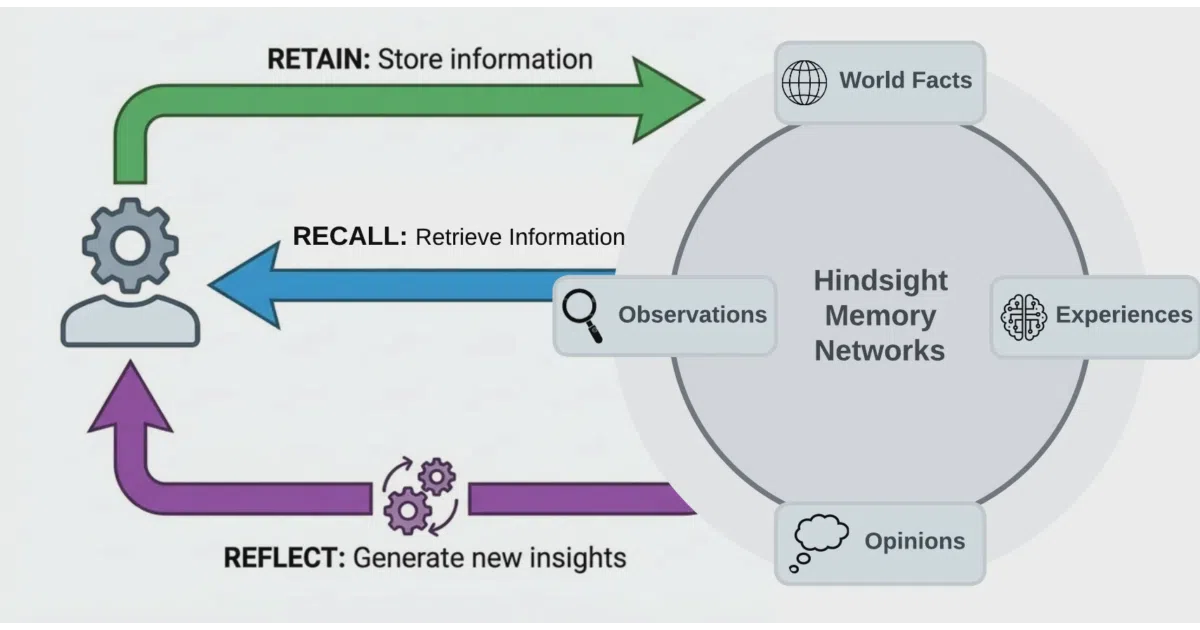
Most memory layers treat the past as a filing cabinet: store embeddings, fetch nearest neighbors, stuff them into the prompt. Hindsight argues that this is retrieval, not memory. Its architecture is built around four logical networks: world facts (objective external knowledge), agent experiences (the system’s own actions), observations (consolidated summaries that track historical changes), and mental models (user-curated or synthesized beliefs). [1][10]
The design is biomimetic only in the loose sense that it borrows categories from cognitive science, but the engineering insight is specific. When new information enters the system through the retain operation, an LLM extracts entities, relationships, timestamps, and facts, then normalizes them into canonical representations. [1] This is the boring part that matters: raw conversation text is transformed into structured pathways before it ever needs to be queried. A later recall operation then runs four parallel strategies—semantic vector search, BM25 keyword matching, graph traversal across entities and causal links, and temporal filtering—and merges the results with reciprocal rank fusion and cross-encoder reranking. [1] The system calls this TEMPR. [1]
Where Hindsight diverges most sharply from vector-store memory is reflect. Rather than simply retrieving what was said, the reflection layer reasons over the memory bank to generate new connections, update beliefs, and answer implicit questions. [1][10] An AI project manager might reflect on accumulated risks; a sales agent might infer why certain outreach patterns succeed. The reflection layer checks sources in priority order—mental models first, then observations, then raw facts—so that synthesized knowledge is preferred over noisy logs. [1] In effect, Hindsight tries to make the agent learn, not just remember.
The Benchmark War
The project’s credibility rests on a set of aggressive benchmark claims, detailed in an arXiv paper submitted in December 2025. [10] Paired with an open-source 20-billion-parameter backbone, Hindsight raised overall accuracy from 39 percent to 83.6 percent against a full-context baseline using the same model, and reportedly exceeded the performance of a full-context GPT-4o. Scaling the backbone further pushed scores to 91.4 percent on LongMemEval and up to 89.61 percent on LoCoMo. The strongest prior open system on LoCoMo sat at 75.78 percent. [10]
The README notes that these results have been independently reproduced by researchers at Virginia Tech’s Sanghani Center and by The Washington Post, though the broader leaderboard includes self-reported vendor scores. [1] Hindsight also claims a top ranking on the BEAM benchmark, according to a comparison article published by Vectorize itself—a useful data point, but one that carries the obvious bias of a vendor ranking its own product first. [11]
Benchmarks in agent memory are still young. LongMemEval, LoCoMo, and BEAM are becoming standard yardsticks, yet the field lacks a neutral arbiter. [8] What makes Hindsight’s numbers worth watching is not the leaderboard position alone, but the magnitude of the gap over full-context baselines. If a 20B model with structured memory can outrun GPT-4o with its entire context window, the implication is that architecture may matter more than parameter count for long-horizon tasks.
The Field and the Friction
Hindsight enters a crowded landscape. Mem0, the incumbent with roughly forty-eight thousand GitHub stars, offers vector-plus-graph memory and broad framework integration. Letta provides a tiered, OS-inspired architecture. Zep and Graphiti specialize in temporal knowledge graphs. Cognee, SuperMemory, LangMem, and LlamaIndex Memory each stake out different trade-offs between structure, lock-in, and ease of use. [11]
Hindsight’s differentiator is its insistence on normalization and consolidation. Every retain call triggers an LLM to parse, extract, and canonicalize facts. That design choice improves retrieval accuracy but adds latency and token cost to every write. For high-throughput agents, this is not a free lunch. The system also requires a PostgreSQL or Oracle backend for persistence, and while Docker images make self-hosting straightforward, running the full stack is heavier than dropping in a vector-client library. [1]
The project offers a two-line LLM wrapper for quick adoption, plus SDKs in Python and Node.js and a REST API. [1][12] Multi-user isolation is handled through bankId scoping, which maps cleanly to per-user memory. [12] In practice, this means Hindsight can serve as a shared memory service for multiple agents or tenants, a necessity for enterprise deployments.
Limits and Unresolved Tensions
For all its structural ambition, Hindsight is still early. Its GitHub star count sits around four thousand, an order of magnitude below Mem0’s. [11] The ecosystem is nascent, and production testimonials—while claiming Fortune 500 adoption—remain light on operational detail. [1]
There is also a deeper architectural tension. Hindsight blurs the boundary between memory and computation. Reflect is essentially an on-demand inference pass over the knowledge base; it produces insights, not just lookups. The capability is genuine, but it complicates the mental model of memory as a passive store. In the taxonomy drawn from cognitive science, Hindsight is less like long-term memory and more like a hybrid neuro-symbolic layer that constantly rewrites its own notes. [2][6] The Agentic AI survey literature warns against forcing classical symbolic frameworks onto stochastic LLM systems—a hazard called conceptual retrofitting—and Hindsight will have to prove that its structured pathways do not become brittle abstractions atop fluid neural outputs. [2]
Cost is the other open question. If agent memory requires an LLM call on every retention event, plus cross-encoder reranking on every recall, plus reflection passes for synthesis, the token budget scales with agent activity, not just knowledge base size. For agents that run autonomously over hours or days, that bill compounds quickly.
Outlook
Agent memory is graduating from peripheral utility to first-class architecture. The field has shifted in the last eighteen months from dumping conversation history into context windows to treating persistence as a system component with its own benchmarks, retrieval strategies, and consolidation logic. [8] Hindsight embodies that shift. It bets that agents need structured knowledge—entities, time series, causal links, and synthesized beliefs—rather than raw chat logs or embedding dumps.
Whether that bet pays off depends on whether production users accept the operational overhead in exchange for the accuracy gains. If the benchmark gaps hold under independent scrutiny, Hindsight could define the expectation for what agent memory should do: not merely search the past, but understand it.
Sources
- Hindsight: Overview
- Agentic AI: A Comprehensive Survey of Architectures ...
- AI Memory System: Types, Architecture, and Enterprise ...
- HINDSIGHT Definition & Meaning
- Architecting Agent Memory - Richmond Alake, MongoDB
- Agent memory: the missing layer in enterprise AI systems
- Hindsight bias
- State of AI Agent Memory 2026: Benchmarks & Trends
- What Is AI Agent Memory? | IBM
- Hindsight is 20/20: Building Agent Memory that Retains ...
- Best AI Agent Memory Systems in 2026: 8 Frameworks ...
- Community Providers: Hindsight