titanwings/colleague-skill · 21 Aug 2026 · Feature
Your Colleague Is Now a Markdown File

Derek Calloway
Editor
dot-skill turns chat logs and design docs into portable, versioned agent skills that replicate how a specific person thinks and talks.
titanwings/colleague-skill
★23.8k stars Velocity · 7d +188 ★/day
star history
The Hype and the Premise
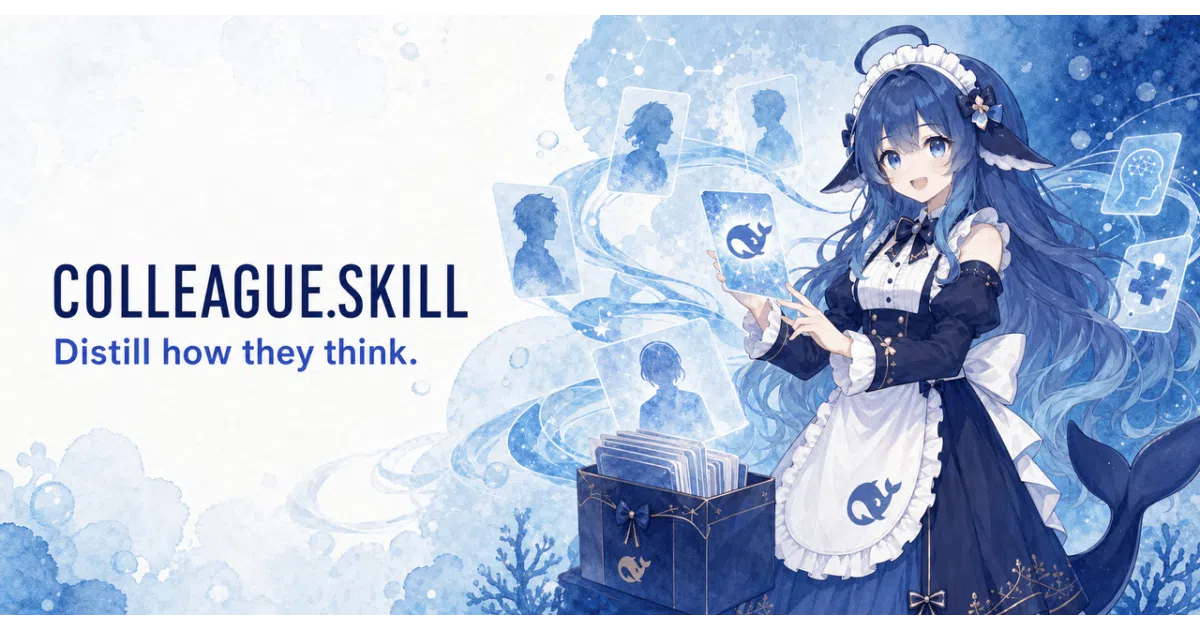
In August 2026, the repository now known as dot-skill passed twenty thousand GitHub stars. That milestone arrived only months after its predecessor, colleague.skill, appeared on arXiv with roughly eighteen and a half thousand stars already behind it. The README opens with a half-joking manifesto—“Flesh is weak! Ascend to cyberspace!"—and then poses three questions. What if your mentor quit and took their playbook with them? What if you wanted to hold onto the texture of a drifting relationship? What if you could ask your favorite thinker a question they will never hear in life? The project’s answer is to distill the source material into a portable AI Skill: a bounded, inspectable package that thinks in their frame and speaks in their voice.
This is happening inside a broader boom. General-purpose coding skills—workflow guides like Superpowers and behavioral rule-sets derived from public figures—have accumulated hundreds of thousands of stars by treating agent instructions as shareable artifacts. dot-skill narrows the scope to people. Its community gallery lists two hundred fifteen skills from one hundred sixty-five contributors, and the project claims more than one hundred thousand cumulative stars across listed skill cards. The premise is no longer about how to code, but about who is coding.
A Skill Is a Directory, Not a Prompt
The artifact dot-skill produces is not a prompt injection or a hidden memory vector. It is a directory. The system follows the AgentSkills open standard, a specification backed by multiple hosts in which a skill is a folder containing a metadata file, optional scripts, and reference materials. As described in platform documentation, the architecture relies on progressive disclosure: YAML frontmatter advertises the skill at all times, the main instruction file loads only when triggered, and deeper resources are fetched on demand. The metadata costs roughly a hundred tokens per skill; the body stays under five thousand tokens until invoked.
This filesystem model matters because it makes the distilled person inspectable and portable. You can diff two versions, rollback a bad correction, or hand the directory to another host. The generated skills install into Claude Code, Hermes, OpenClaw, Codex, and DeepSeek Harness by dropping the same folder into the host’s skills directory. The package is a software artifact, not an opaque chat history. That shift—from ephemeral prompting to versioned files—is the quiet infrastructure bet underneath the emotional marketing.
Distillation, Not Memorization
The technical report behind the project frames the process as trace-to-skill distillation. Heterogeneous traces—Feishu threads, Slack messages, PDFs, email exports, interview subtitles—are difficult to work with because actionable knowledge is embedded in conversation rather than written as clean instructions. Existing memory and persona systems capture fragments of this evidence, while skill frameworks provide portable packaging formats; dot-skill attempts to close the loop by generating the package automatically. The output is a coordinated two-track package. One track captures capabilities: practices, mental models, decision heuristics, and workflow preferences. The other captures bounded behavior: communication style, interaction rules, emotional triggers, and a correction history. The project calls these Work Skill and Persona.
They can be invoked separately or together. A colleague skill might answer a code-review question using only the work track, or it might layer in the persona track to deliver the feedback with the original’s characteristic bluntness or deflection. The system does not merely retrieve chunks of source text; it attempts to reconstruct how the person would have decided and phrased the answer.
The package is also designed to evolve. Users can append new files, and the system analyzes the delta against existing conclusions without overwriting them. Natural-language feedback writes to a Correction layer that takes effect immediately. Every update is archived, so the skill can be rolled back. This lifecycle distinguishes the artifact from static prompt libraries. The paper is careful to call these bounded representations rather than simulations, acknowledging that the goal is actionable expertise, not resurrection.
Three Families, Three Data Strategies
The upgrade from colleague.skill to dot-skill generalized the engine into three character families, each with its own intake pipeline and source hierarchy.
For colleagues, the system auto-collects from Feishu via API, DingTalk via browser automation, and Slack via bot installation, though Slack’s free plan limits history to ninety days. The ideal source is the colleague’s own long-form writing—design documents, review comments—followed by decision-making replies, with casual group chat ranked last. The generated skill separates technical standards from workplace posture.
For relationships, the priority is complete chat history, letters, or diaries, ideally spanning long time periods and covering both conflict and repair. The resulting skill models expression DNA, emotional triggers, and repair patterns. A photo-sharing feature is planned that would have the distilled entity initiate image sharing unprompted, mimicking the rhythm of a real correspondence.
For celebrities and public figures, the system ships with a six-dimension research toolchain that downloads subtitles, cleans transcripts, merges research notes, and runs a quality check. The preferred material is first-person books, blogs, and long interviews; third-party commentary is explicitly discouraged. The goal is not tone mimicry but the reproduction of mental models and decision frameworks.
The README is blunt about the dependency: source material quality equals skill quality. A colleague distilled only from group-chat banter will be a caricature. A celebrity built from gossip columns will be a parrot.
The Agent Host Landscape
dot-skill’s cross-host support reflects a bet on interoperability at a moment when the industry is fragmenting into competing agent environments. IBM’s research notes that eighty percent of executives are increasing investment in agentic AI, with spending projected to nearly triple by 2027, and that seventy-five percent of leaders anticipate multi-agent systems handling different problems. Microsoft’s AgentSkills documentation describes a future in which portable packages extend agents without changing their core, using a provider pattern that advertises, loads, reads resources, and runs scripts on demand. dot-skill rides that wave by generating packages that conform to the filesystem convention rather than any single vendor’s API.
The repo itself is a skill directory. The skills it generates are also skill directories. It is skills all the way down.
Limits and the Uncanny Valley
For all its stars, the project admits it is still a demo version. The generated skills depend on the user’s willingness to correct them. Without the feedback loop, the artifact is static mimicry. There is also an unresolved tension in the relationship family, where the marketing leans on emotional fidelity while the underlying mechanism is a deterministic package executed by a language model. The “flesh is weak” joke works because the project knows it is trading blood for bytes, and the trade is lossy.
The paper and the README both emphasize boundedness. These are inspectable, correctable packages—not drop-in replacements, not resurrections. Whether the enterprise use case (preserving institutional knowledge) or the personal one (holding onto a voice) proves more durable is still an open question. What dot-skill has already demonstrated is that the agent ecosystem is ready to treat human expertise as a file format.
Sources
- Agent Skills - Claude Platform Docs
- AI Agent Use Cases - IBM
- Automated AI Skill Generation via Expert Knowledge ...
- Building Great Agent Skills: The Missing Manual - YouTube
- Real world examples of AI agents - use cases that really matter - Reddit
- Create colleague - Distill your coworkers into AI skills ...
- The most popular AI coding skills right now - DEV Community
- What are AI agents? Definition, examples, and types | Google Cloud
- colleague-skill download
- Agent Skills | Microsoft Learn
- Building AI Agents that actually work (Full Course) - YouTube
- Automated AI Skill Generation via Expert Knowledge ...