shiyu-coder/Kronos · 29 Jul 2026 · Feature
Kronos Wants to Tokenize the Noise of Financial Markets

Megan Russo
Staff Writer
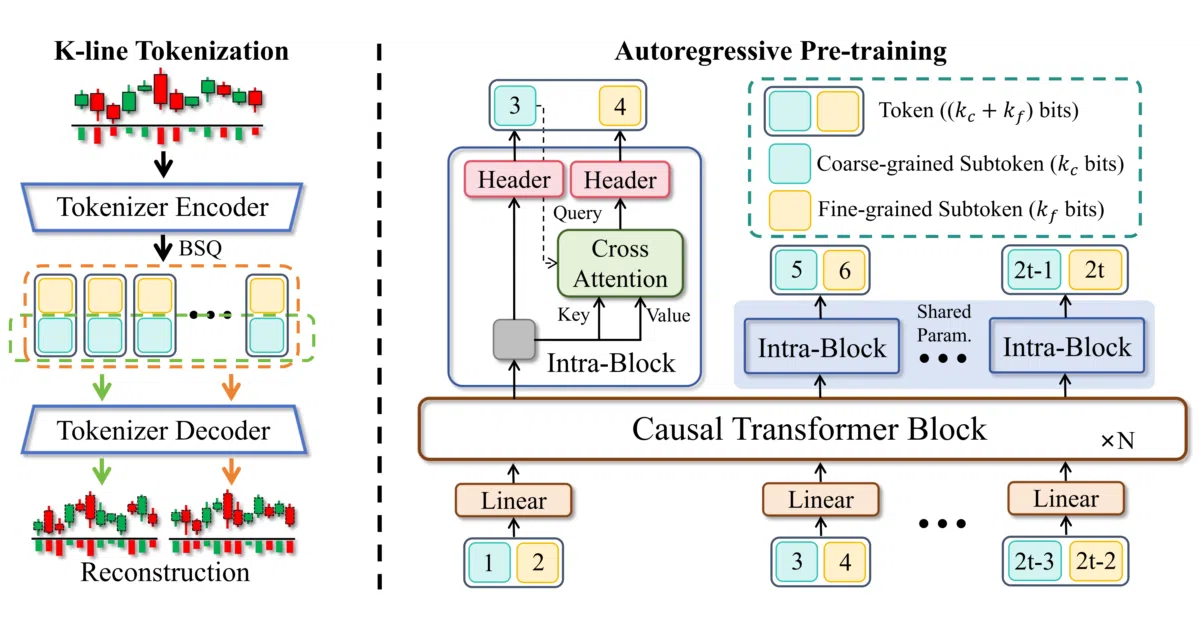
Kronos is an open-source autoregressive foundation model that quantizes multi-dimensional OHLCV market data into hierarchical discrete tokens, treating price sequences as a generative language to be pre-trained rather than mere time-series to be smoothed.
shiyu-coder/Kronos
★43.9k stars Velocity · 7d +309 ★/day ↗accelerating
star history
The Hype: When Candlesticks Meet Foundation Models
The repository opens with academic swagger: a paper accepted to AAAI 2026, an arXiv preprint, and the claim of being the first open-source foundation model trained on the raw geometry of financial candlesticks. Kronos arrives at a moment when the quantitative world is cautiously flirting with generative AI. While natural language and vision have been thoroughly colonized by Transformer-based foundation models, financial machine learning has remained stubbornly pragmatic. Gradient-boosted decision trees and hand-crafted features still dominate fraud detection, credit scoring, and cashflow prediction [5]. The project bets that the same autoregressive recipe behind large language models—pre-train on vast corpora, then fine-tune for downstream tasks—can be force-fit onto the chaotic, high-noise sequences of open-high-low-close-volume (OHLCV) data drawn from 45 global exchanges.
This ambition sits within a broader industry drift toward what researchers are calling Financial Foundation Models. Institutional interest is growing despite data-privacy headwinds and regulatory caution, and many organizations are exploring hybrid architectures that combine frontier models with domain-specific tooling [3]. Kronos is MIT-licensed, weighs as little as 4.1 million parameters in its smallest public form, and releases weights through standard hubs, fitting the open-source profile that industry analysts identify as cost-efficient and flexible for proprietary fine-tuning [3]. The authors also provide a live demo forecasting the BTC/USDT pair over a 24-hour horizon, a gesture clearly aimed at convincing the quant community that this is not merely an academic toy.
The Technical Bet: Tokenizing Price Action
The core insight is architectural, not cosmetic. General-purpose Time Series Foundation Models treat finance as one domain among many, using continuous embeddings that must handle everything from electricity demand to electrocardiograms. Kronos argues that candlesticks deserve their own tokenizer because the noise characteristics of bid-ask microstructure are unlike the smooth seasonality of weather data. It therefore employs a two-stage pipeline that deliberately mirrors natural-language processing. First, a specialized tokenizer quantizes continuous, multi-dimensional K-line data into hierarchical discrete tokens. Second, a decoder-only Transformer learns to predict the next token in the sequence, conditioned on a context window of past price bars.
This is a conceptual reframing with practical consequences. OHLCV data is five-dimensional—six if amount is included—continuous, and plagued by microstructure noise. Regressing directly on raw floats forces a model to waste capacity on the precise calibration of outliers and bid-ask bounce. By learning a codebook of discrete tokens, Kronos collapses local price configurations into a finite vocabulary. The downstream Transformer can then optimize categorical cross-entropy rather than mean-squared error, turning price forecasting into a next-token prediction problem. The repository describes the tokens as hierarchical, though it does not fully detail how the layering is structured, leaving the exact mechanics of the codebook architecture as an open question for now.
The approach inherits the probabilistic machinery of modern generative models. The predictor can sample multiple future trajectories via temperature and nucleus sampling, yielding a distribution of paths rather than a single deterministic line. For risk management and option-like thinking, a distribution is often more useful than a point estimate. Batch prediction is supported as a product characteristic, leveraging GPU parallelism to forecast multiple assets simultaneously—a necessary concession to the computational realities of portfolio construction.
The model family scales from a 4.1-million-parameter variant with a 2,048-token context up to a 102.3-million-parameter base model with a 512-token context. A 499.2-million-parameter large version exists but remains closed. The modest context lengths for the mid-size variants suggest the architecture is tuned for short-horizon pattern recognition rather than macro-regime narratives that might require thousands of bars.
A New Dialect in the Financial Foundation Model Ecosystem
Kronos occupies a distinct niche within the emerging Financial Foundation Model taxonomy. Recent industry efforts such as Revolut’s PRAGMA demonstrate how tokenization schemes can tame tabular transaction data—events, profile states, and timestamps encoded as key-value tokens—for fraud detection and credit scoring [5]. PRAGMA uses ordinal encoding, numeric bucketing, and byte-pair encoding for text fields, a hybrid strategy suited to irregular user behavior logs [5]. Kronos applies a similar tokenization-first philosophy to candlestick charts rather than transaction streams, which is a materially different modality. Price bars are regular in time but dense in continuous dimensions; user events are sparse and heterogeneous. This specificity mirrors a broader industry realization that financial data is too idiosyncratic for generalist models to master without domain-specific adaptations [5].
Meanwhile, the better-known FinLLMs—BloombergGPT, FinGPT, FinMA—largely operate on text: earnings reports, news sentiment, regulatory filings, and social media chatter [11]. These models excel at named entity recognition, sentiment analysis, and question answering, but they do not ingest raw OHLCV vectors. Kronos ignores the headlines and stares directly at the price bars, positioning itself as a complement to text-based analysis rather than a replacement. In a field where domain-specific small models are increasingly valued for privacy and compliance reasons [3], Kronos’s compact open-source variants offer an on-premise alternative to API-dependent closed-source giants.
The Gap Between Demo and Trading Floor
For all its mythological ambition—Kronos, after all, was the Titan who devoured time [10]—the project is refreshingly candid about its limitations. The fine-tuning pipeline, demonstrated on Chinese A-share data via Microsoft’s Qlib framework, comes with an explicit disclaimer: the provided backtest is a simplified demonstration, not a production trading system. Raw forecast signals, the authors note, must still be fed through portfolio optimization and risk-factor neutralization to isolate anything resembling pure alpha. Transaction costs, slippage, and market impact are absent from the demo logic. This honesty is rare and necessary; the history of quantitative finance is littered with models that sparkle in backtests and disintegrate live.
Several rough edges are visible. The largest model checkpoint is withheld, which somewhat undercuts the open-source ethos for researchers seeking maximum capacity. More tellingly, the repository admits that many code comments in the fine-tuning directory were generated by an AI assistant and may contain inaccuracies—a charming confession that the project is moving fast, perhaps faster than its documentation can verify. The predictor automatically truncates inputs that exceed the 512-token context ceiling, a product characteristic that hints at the engineering compromises required to keep inference economical.
Outlook: Pre-Trained Intuition or Overfit Mythology?
Whether Kronos represents durable progress or an overfit fairy tale will depend on transfer. The pre-training corpus spans 45 exchanges, but financial time series are notoriously non-stationary. A pattern learned on the Tokyo Stock Exchange may evaporate in the A-share market unless the tokenizer has captured genuinely invariant structural features across geographies and asset classes. The hierarchical tokenization scheme is the critical variable here. If the discrete vocabulary preserves multi-scale dynamics—volatility clustering, liquidity shocks, opening gaps, and trend persistence—then fine-tuning on specific assets could yield genuine alpha. If the quantization is too coarse, the model may simply generate plausible-looking but economically meaningless chart patterns, the visual equivalent of generative hallucinations.
The probabilistic forecasting interface is theoretically elegant, yet autoregressive models can violate basic no-arbitrage constraints if sampling produces impossible price paths—say, a close below the low or a negative open. It remains unclear whether the tokenizer architecture enforces such structural rules, or whether the model must learn them implicitly from data. The AAAI acceptance suggests the academic peer-review process found merit in the approach, but the ultimate jury will not be conference reviewers; it will be the Sharpe ratios and maximum drawdowns of any strategies built atop it. The name is apt: in Greek myth, Kronos devoured his children in fear of being overthrown, and in markets the model devours sequences of time. The irony is that the Titan was eventually overthrown by Zeus. In quantitative finance, the equivalent fate awaits any foundation model that cannot adapt to regime shifts—its own offspring, in the form of specialized fine-tuned variants or newer architectures, may render it obsolete. For now, Kronos stands as a fascinating experiment in giving market noise a grammar—and waiting to see whether a Transformer can truly learn to speak the language of price.
Sources
- Cronus
- Advancing Financial Engineering with Foundation Models
- Practical Guide for LLMs in the Financial Industry
- log in - to https://community.kronos.com.
- The Rise of Financial Foundation Models (FFMs)
- What I learned trying to get AI to actually analyze financial scenarios (not just describe charts
- Kronos HR | Easy time & shift management
- Foundation models reshape financial engineering: New survey maps ...
- How I use Large Language Models for financial analysis and algorithmic trading
- CRONUS (Kronos) - Greek Titan God of Time, King of the Titans (Roman Saturn)
- Exploring Large Language Models for Financial Applications
- Best Model To Use For An AI Financial Analyst? - API