sergebulaev/linkedin-skills · 13 Sep 2026 · Feature
LinkedIn Marketing Skills for Claude Code: When Your Growth Stack Lives in a Terminal

Yuki Tanaka
Editor
An open-source skill bundle turns Anthropic’s coding agents into a gated, voice-aware LinkedIn marketing team—no dashboard required.
sergebulaev/linkedin-skills
★2.1k stars Velocity · 7d +201 ★/day ↗accelerating
star history
The Hype Moment: Skills, Not Apps
LinkedIn is now the most-cited domain for professional queries across major AI search platforms, including ChatGPT, Google AI Overviews, and Perplexity. For creators and founders, the platform has shifted from social channel to discoverability asset. The natural response has been a proliferation of SaaS dashboards—Podawaa, Supergrow, Taplio, AuthoredUp—each promising to handle scheduling, analytics, and AI-generated drafts from a single pane of glass.
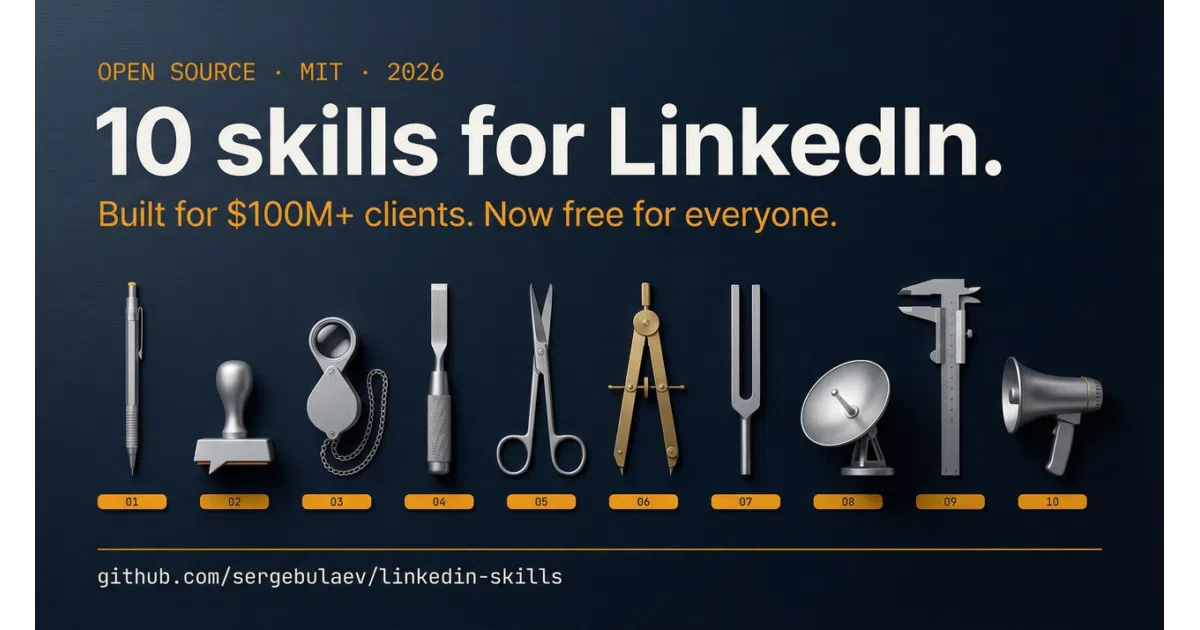
Then a different kind of project started circulating in technical circles. sergebulaev/linkedin-skills is not a web app. It is a repository of eleven markdown instruction sets—“skills” in the Claude Code and Codex sense—that teach an agent to draft, audit, humanize, and schedule LinkedIn content without leaving the terminal. It belongs to a family of open-source bundles covering X, Instagram, YouTube, TikTok, Threads, and Facebook, all sharing the same voice engine and the same approve-before-publish flow. The hype is not about a new algorithm hack. It is about the emergence of agent-native marketing infrastructure: software that assumes the runtime is a conversational coding agent, not a browser tab.
What a Skill Actually Is
In the Anthropic ecosystem, a skill is a reusable instruction set, typically a SKILL.md file, that the agent auto-discovers when a prompt matches its declared domain. Unlike a ChatGPT custom GPT, which lives inside a chat interface, a Claude Code skill executes in the same environment where you review pull requests. It can read local files, call Python scripts, and interact with APIs. As one practitioner running a similar social-media skill stack put it, the best skills “hold context you would otherwise repeat,” “do one job well,” and “close the loop” by handing off to the next skill in a chain.
This repository contains eleven such jobs: Post Writer, Comment Drafter, Reply Handler, Post Audit, Humanizer, Hook Extractor, Content Planner, Engagement Monitor, Profile Optimizer, Employee Advocacy, and Repurposer. Each is triggered by natural-language intent rather than a button click. Ask Codex to comment on a post, and the Comment Drafter skill activates, fetches the post body via an Apify actor if you have provided a token, drafts a response in your configured voice, and waits for your approval before anything touches LinkedIn’s servers.
The Anti-AI-Tell Engineering
The most technically interesting part of the bundle is not the content generation; it is the content sanitation. The Humanizer skill is essentially a reverse-prompt-engineering tool. It strips em dashes—identified in the documentation as the “biggest AI tell in 2026”—along with a blacklist of AI vocabulary (“leverage,” “delve,” “harness,” “streamline,” “unlock”). It penalizes rule-of-three lists, scores emoji density, and even bundles a multi-detector spread tester that runs drafts against GPTZero, Originality.ai, ZeroGPT, Sapling, and Copyleaks to check for synthetic fingerprints.
This is a tacit admission that the median LinkedIn feed in 2026 is polluted by homogenized AI prose, and that the competitive advantage lies in sounding like a person rather than a language model. The voice rules are hardcoded with almost bureaucratic specificity: capitalize names always; prefer “$14,200” over “significant savings”; keep comments between 200 and 350 characters and posts between 900 and 1,300. The Post Audit skill checks drafts against “2026 algorithm rules and AI-detection patterns” before publication. Whether those algorithm rules are empirically derived or heuristic is unclear from the documentation, but the rigor of the constraint system is the point. The repo treats voice not as a stylistic preference but as a runtime configuration.
Architecture: Read, Write, and the Glue Between
Beneath the skills directory lies a small but deliberate software layer. The lib/ folder contains pure Python utilities for parsing LinkedIn’s three different post-URN formats, handling the platform’s two-level comment-thread flattening, and thin clients for Apify and Publora. LinkedIn’s URL scheme is messier than it appears: activity URNs, share URNs, and ugcPost URNs each require different extraction logic, and reply threading demands that a reply-to-a-reply point to the top-level comment URN rather than the immediate parent. The url_parser.py and reply-handler logic are the kind of boring, exacting code that separates a toy demo from a tool that will not break on edge cases.
The read-write loop is similarly pragmatic. Without an Apify token, the skills fall back to asking the user to paste text. With one, they scrape post bodies, comment threads, recent user comments, and post engagers at roughly $1 to $5 per thousand results—well inside Apify’s free tier for typical usage. On the write side, Publora acts as a publishing API that abstracts LinkedIn’s reaction-type quirks and URL-format inconsistencies. The default mode is approval-gated: every skill shows a draft and waits for an explicit OK. Direct publishing is optional, not the default, which sidesteps much of the reputational risk associated with autonomous social-media bots.
The Founder Layer: Anti-Viral by Design
Most LinkedIn growth tools optimize for impressions. This bundle includes a dedicated founder layer that optimizes for trust with a narrow, high-stakes audience: the next investor, the next hire, the design partner who might become a case study. It ships ten founder-specific angle templates—“reprice the category,” “the scarce-shots math,” “the unglamorous bet,” “designed serendipity”—and four structural hook formulas (controlled A/B anecdote, false-binary dissolve, anecdote-meets-evidence bridge, diverging-curves close) that shape a post’s logic rather than its sentiment.
The Content Planner offers a founder-edition weekly arc: Conviction, Building in Public, The Math, Proof. It is a rare example of an AI content tool that acknowledges that not every founder needs to go viral. Some need to signal competence to twelve people who matter. The founder layer is the strongest evidence that this is not generic prompt slop repackaged as open source; it is a opinionated editorial system encoded into agent instructions.
Position in the Field: Terminal vs. Dashboard
The repository sits awkwardly—and productively—between two worlds. On one side are the all-in-one LinkedIn SaaS platforms: Supergrow offers carousel makers and voice-to-post transcription; Podawaa focuses on algorithmic post boosting during the first-hour distribution window; Taplio and AuthoredUp provide analytics and scheduling dashboards. These tools are polished, mobile-friendly, and expensive.
On the other side are single Claude prompts and custom GPTs, which are free but stateless and fragile. The linkedin-skills bundle attempts to split the difference. It offers the modularity and zero marginal cost of open-source software, but with persistent context, feedback loops, and runtime integration that a browser-based chatbot cannot match. The trade-off is friction. Despite the README’s claim that “no coding required,” the installation matrix spans Claude Code CLI, Codex CLI, Claude Desktop, OpenClaw, Hermes Agent, Cursor, Cline, Aider, Manus, LangChain, and AutoGen. Each runtime loads SKILL.md files differently. The generic Python quickstart still requires manual sys.path manipulation. For a non-technical user, the setup is arguably more complex than signing up for Taplio.
Rough Edges and Unresolved Tensions
The project is fundamentally glue code and prompt engineering, and it does not pretend otherwise. Its value lies in the integration and the editorial opinions, not in novel model architecture. That is a honest bargain, but it comes with dependencies. The scraping layer requires Apify credits; the publishing layer requires Publora; the voice layer requires you to already know what you sound like. If either third-party service changes its API or pricing, the skills degrade.
There is also an unresolved tension around standardization. The repo supports an npx skills add command that works across Claude Code, Codex, and Cursor, suggesting an aspiration for skills to become a package-manager primitive like npm for prompts. Yet the runtime compatibility table reveals fragmentation: some agents auto-discover skills, some require manual system-prompt injection, and some cannot use them at all. Until a true cross-agent skill standard solidifies, bundles like this one will spend significant surface area on installation gymnastics rather than feature depth.
Outlook
The broader shift is clear. As LinkedIn becomes a critical discoverability asset for professional queries, the tools used to manage it are migrating into the environments where technical professionals already work. A founder running Claude Code in VS Code is more likely to ask their agent to “draft a post” than to open a separate browser tab for a social-media dashboard. The linkedin-skills repository is an early, well-structured bet on that workflow. Whether it becomes a durable standard or merely a sophisticated prompt pack will depend on whether the agent-skill ecosystem converges around shared formats—or fragments into runtime-specific silos. For now, it is one of the most complete arguments that marketing software does not need to be an app. Sometimes it can just be a conversation in your working directory.
Sources
- LinkedIn Learning: Online Training Courses & Skill Building
- 6 Best LinkedIn AI Tools in 2026 (Content, Visibility & Growth)
- How I Automate 95% Of My Content Creation With Claude Code
- The Best Skills to Add to LinkedIn in 2026
- Best LinkedIn Personal Branding Tools for Creators in 2026
- I open sourced 13 Claude Code skills that help you write ...
- 25 Best skills to add to Linkedin for 2025 : r/Resumeio
- The Ultimate AI LinkedIn Content Creation Tool Stack for 2026 ...
- Social Media Advertising - Claude Code Skill for Paid Social
- Why It's Important to List Skills on Your LinkedIn Profile
- 10+ Best LinkedIn Content Creation AI Tools in 2025
- 7 Claude Skills That Run My Social Media in 2026