s1dashu/ip-as-logo-skill · 23 Aug 2026 · Feature
When AI Agents Start Designing Your Repository’s Brand Identity

Ethan Caldwell
Staff Writer
This agent skill compresses a logo-design system into a markdown brief so coding agents can generate production-ready mascot logos from repository context without leaving the terminal.
s1dashu/ip-as-logo-skill
★5.8k stars Velocity · 7d +19 ★/day ↘cooling
star history
The Agent Skill That Briefly Trended
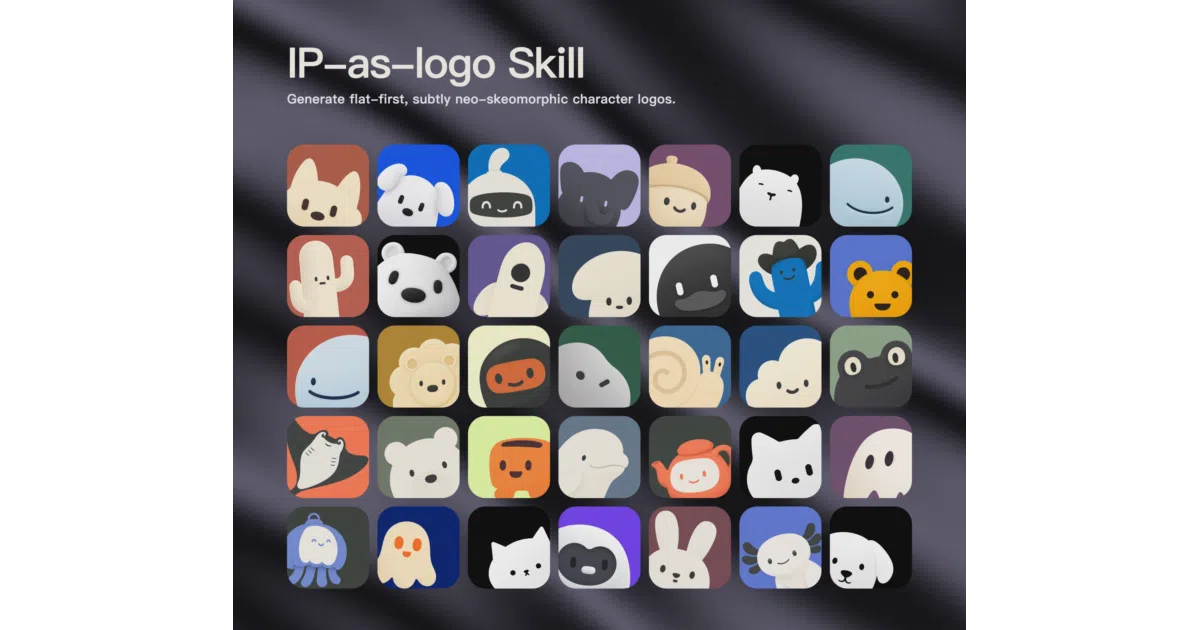
On August 19, 2026, a repository containing a single markdown file and a showcase image climbed to third place on Trendshift’s daily trending list across all languages. The project, ip-as-logo-skill, has no source code in the conventional sense. No scripts, no dependencies, no build pipeline. It is a compact Agent Skill—a structured instruction set in the open Agent Skills format designed for compatible AI agents to ingest and execute. Its sudden visibility signals a shift in what developers consider valuable tooling. The hype is not about algorithmic sophistication; it is about delegation. The skill lets an agent handle a task every open-source project faces and most developers avoid: creating a brand mark that actually works at favicon size.
A Design System Compressed Into Prose
What separates this skill from a typical prompt-engineering cheat sheet is its fanatical specificity. The document does not ask an image model for a “cute mascot.” It enforces a logo-first, character-second hierarchy. The output must be built from roughly six to ten basic shapes forming one dominant silhouette. Forms must be thick and rounded, with explicit rejection of sharp or fragile details. The composition demands a 75 to 85 percent lower-corner crop, preserving paired identifying features while keeping the subject bold enough to survive aggressive scaling.
Color is equally regimented. The default palette is exactly three semantic colors: two IP base colors plus one background. Ultra-light highlight and shade variants may appear for a neo-skeuomorphic effect, but they must remain close to their parent base color and do not count as additional semantic colors. The skill prefers softened chromatic backgrounds over neon or muddy gray, targeting restrained OKLCH bands when numeric control is available. Warm off-white paired with charcoal or deep navy is the default mood. Gradients are not banned, but they are tightly leashed: continuous low-frequency gradients are capped at a 0.08 OKLCH lightness span, producing a subtle depth that keeps the mark from looking like flat clip art without tipping into illustration-level complexity. Outputs must be opaque squares, never app-icon masks or transparent margins.
This is essentially a creative director’s brief compressed into agent-readable prose. When the user already names an IP subject, the skill proposes three controlled design treatments. When the subject is open, it proposes three genuinely different directions tied to product attributes or brand promises. If the agent is running inside a product repository, it inspects read-only context—READMEs, manifests, landing page copy—before asking questions. Once context is sufficient, it presents three concise directions and proposes generating six independent full-resolution square assets, never a contact sheet. Compatible agents may spawn subagents to generate candidates in parallel up to runtime concurrency limits.
Why a Repository Needs a Mascot
The practical use case is deceptively simple. A developer publishes a new Python package, a CLI tool, or an internal dashboard. They need a PyPI avatar, a GitHub organization icon, a Slack app image. The mark must remain legible at 32 by 32 pixels and read clearly as a silhouette. Generic text-to-image tools tend to produce detailed character illustrations that turn to mud when scaled down. The ip-as-logo skill treats small-size survival as a foundational constraint, not an afterthought.
This utility explains why the format has gained traction beyond the repository itself. A post on X by Tran Mau Tri Tam highlighted the skill as a way to create “company-ready IP mascots,” referencing a gallery of thousands of generated logos. The Open Agent Skill blog framed it as a workflow tool for developers who would rather not break flow to open Figma. The skill reads repository tone and package purpose—say, a data pipeline tool—and delivers options like a streamlined whale, a minimal robot, or a rounded ghost. The user picks one, drops it as the repo avatar, and returns to coding. In a hackathon, it provides placeholder branding in minutes. For internal tools, it generates a mark consistent with existing design tokens without explaining brand values to a freelancer.
The broader market confirms that mascot logos are in demand. Guides for AI-generated mascot prompts have proliferated for gaming channels, food packaging, and YouTube creators, often offering copy-paste templates for cartoon bears or esports wolves. Adobe Illustrator now includes generative AI features specifically for mascot logo exploration. Commercial platforms like Morphic offer mascot variations ranging from esports emblems to vintage sports crests. These tools serve illustrators and brand designers. ip-as-logo serves the developer who needs an icon now and does not want to learn vector illustration.
The Skill Ecosystem and Its Neighbors
ip-as-logo is not an isolated experiment. It sits within a nascent ecosystem of agent-native design skills. The brandkit skill generates premium brand-guidelines boards and identity decks with cinematic presentation grids and sparse typography. The logo-design-guide skill focuses on effective logo generation via inference APIs and explicitly warns that AI image generators cannot reliably render text. Kimi’s platform lists over twenty graphic skills, from chart generation to retro-tech illustration, each providing structured instructions for visual tasks. These platforms acknowledge a growing frustration: generic AI outputs often lack the precision and consistency required for professional work. Agent skills aim to solve this by packaging specialized workflows into structured instructions. ip-as-logo is a particularly sharp example of that philosophy—so narrow it almost disappears, yet complete enough to hand off an entire creative task.
This reflects a larger architectural bet. The open Agent Skills format treats skills as portable behavioral contracts rather than product-specific plugins. A skill written as a single SKILL.md can theoretically move between Codex, Cursor, Claude Code, or any compatible agent. The installer detects the root document and installs the directory, including supporting assets. The skill itself remains a text file, meaning it is versioned, diffed, and forked like any other repository. If agent-augmented IDEs become the default development environment, skills like this become the equivalent of CLI utilities for creative work.
When the Model Ignores the Brief
The repository is refreshingly honest about its limitations. A dedicated “Model behavior” section lists known failure modes: image-generation models may introduce background gradients, crop paired features incorrectly, replace continuous micro-gradients with layered color patches, or add excessive 3D volume. The skill treats these as generation failures to report or retry, not as post-hoc repair tasks. It will not silently claim compliance or attempt to fix the image after the fact.
There is also a hard dependency chain. The skill requires a compatible agent and an available image generator. If no generator is configured, it asks the user to provide or enable one rather than fabricating a result. This makes it a tool for agent-native environments rather than a standalone application. Its usefulness scales directly with the adoption of coding agents that can read repository context and spawn parallel subagents. In that sense, ip-as-logo is as much a bet on the agent-runtime ecosystem as it is on logo design.
The Boring Part Is the Point
The most telling detail in the entire document is the color rule. The skill defaults to exactly three semantic colors. It counts closely related highlight and shade variants as part of the existing base colors, provided they stay ultra-light. It uses OKLCH target bands when available. It rejects pure flatness and excessive volume with equal force. These are the pedantic constraints that make professional designers nod and hurried developers roll their eyes. They are also why the skill works.
By codifying these rules, ip-as-logo turns the agent from a creative wildcard into a junior designer who actually read the brand guidelines. The result is not always beautiful, but it is consistently usable. In the current AI landscape, where image models excel at spectacle and struggle at consistency, that is a genuinely special trick. The skill does not promise to replace a human art director for a major brand launch. It promises to stop developers from shipping a detailed dragon illustration that becomes an indistinguishable smear at 32 by 32 pixels. That is a smaller ambition, and a more honest one.
Whether it becomes a staple or a curiosity depends on whether agent-driven development becomes the default workflow. If developers continue to live inside agent-augmented IDEs, narrow, opinionated skills will proliferate—deeply boring in all the ways that make production software reliable. The mascot is just the first place they landed.
Sources
- s1dashu/ip-as-logo-skill — GitHub trending stats & insights | Trendshift
- Studio-Quality Logo Designed with Claude (AI) in Minutes
- The Best Mascot Logo AI Prompts for Creative Design - Lettercrafted
- ip-as-logo is a compact Agent Skill for generating extremely simple, cute ...
- Brandkit · Brand Agent Skill
- Learn Illustrator - Design a mascot logo - Adobe
- IP as Logo: Turn Any Product Repo into a Mascot Icon - Open Agent Skill
- 22 AI Agent Graphic Skills for Faster Visual Creation
- Mascot Logo AI Designs | Morphic
- Download ip-as-logo-skill source code.tar.gz (IP as Logo) - SourceForge
- logo-design-guide — AI agent skill
- How I made a mascot for a global toy brand using Generative AI - Reddit