rohitg00/ai-engineering-from-scratch · 28 Jul 2026 · Feature
The 503-Lesson Bid to Define What an AI Engineer Actually Is

Nathan Brooks
Staff Writer
A free, open-source curriculum treats every lesson as a shipping event, turning math homework into installable agent skills.
rohitg00/ai-engineering-from-scratch
★73.9k stars Velocity · 7d +401 ★/day ↘cooling
star history
The Credential Gap
Eighty-four percent of students already use AI tools. Only eighteen percent feel prepared to use them professionally. That gap is the vacuum a new open-source curriculum tries to fill, and it is not alone. Industry is currently inventing the AI engineer job title in real time, and the definitions vary wildly. Microsoft Learn frames the role as an Azure-centric certification track, heavy on API calls and cloud services. LinkedIn career posts add neural networks, MLOps, and agent frameworks to the same bullet list. The result is a role that is simultaneously overhyped and under-defined.
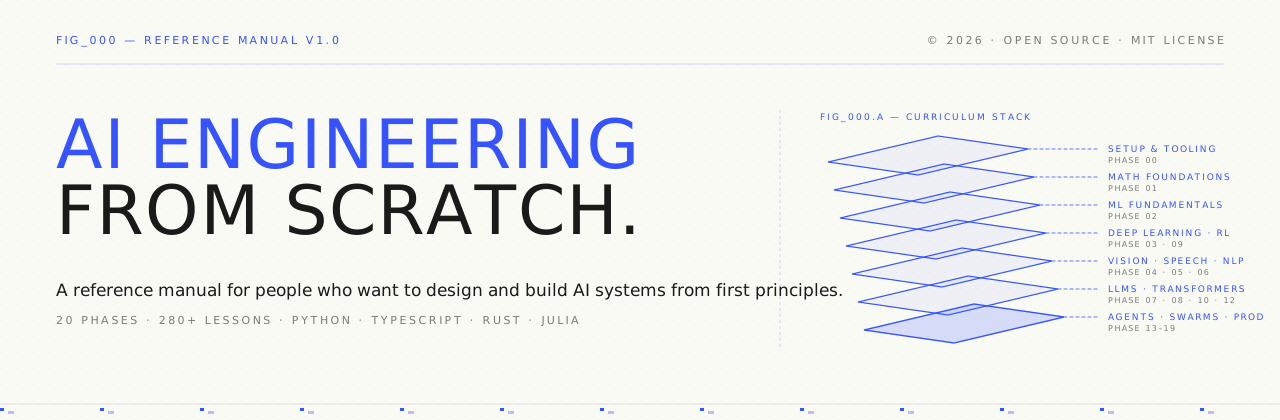
Into this confusion drops a GitHub repository claiming to be the spine. Twenty phases. Five hundred and three lessons. Roughly three hundred and twenty hours of material across Python, TypeScript, Rust, and Julia. It does not ask you to watch five-minute videos. It asks you to build backpropagation from scratch before you are allowed to import PyTorch.
The Spine, Not the Fragment
Most AI education is archaeological. A transformer paper here, a fine-tuning notebook there, an agent demo that works until it doesn’t. The pieces rarely line up. You can ship a chatbot without knowing what attention does inside the model calling it.
This curriculum treats the field as a single stack. Linear algebra and calculus are the floor. Autonomous swarms and production infrastructure are the roof. The structure is aggressively linear. Phase 0 covers dev environments and GPU setup. Phase 1 runs through Fourier transforms and convex optimization. By Phase 10 you are pre-training a 124-million-parameter GPT. By Phase 14 you are building agent loops in pure Python. By Phase 19 you are shipping a terminal-native coding agent or a speculative-decoding inference server as a capstone.
The pedagogical spine is a six-beat loop: state the motto, define the problem, explore the concept, build it from raw math, use it in a production framework, then ship the artifact. The build phase demands no imports. The use phase repeats the same algorithm in PyTorch or JAX. The insight is simple: you understand what the framework is doing because you wrote the smaller, slower version yourself first. It is an old-school engineering rigor applied to a discipline that usually trades in notebook demos and copy-paste deploys.
A Curriculum That Ships
What makes the repository genuinely unusual is that it treats education as infrastructure. Every lesson ends with a reusable artifact: a prompt template, a skill file, an agent definition, or an MCP server. By the end, the repository claims to ship hundreds of skills and prompts, installable into Claude, Cursor, Codex, OpenClaw, or Hermes. You do not graduate with a certificate. You graduate with a toolchain.
Phase 14, lesson 1, is representative. You construct a minimal reasoning-and-acting agent loop in roughly 120 lines of pure Python. Then you ship a skill file that teaches any compatible agent how to implement the same loop, plus a debugger prompt that diagnoses where an agent trace went wrong. The Phase 14 capstone goes further, producing a complete Agent Workbench pack—schemas, initialization scripts, verification gates, and handoff contracts—that can be scaffolded into an existing repository. The curriculum is not just teaching you about agents; it is producing the agents’ tooling.
This mirrors where the industry is actually heading. A recent survey of real-world agent deployments notes that successful implementations solve narrow, well-defined problems and integrate with tools people already use. The curriculum forces exactly that discipline: each lesson’s output must be a concrete, narrow tool, not a theoretical exercise. The agents that fail, the survey notes, try to do too much. This manual responds by making every lesson do one thing, and do it visibly.
The Shape of the Stack
The breadth is almost comical. Twenty phases cover math foundations, classical machine learning, deep learning core, computer vision, natural language processing, speech and audio, transformers, generative AI, reinforcement learning, large language models from scratch, LLM engineering, multimodal AI, tools and protocols, agent engineering, autonomous systems, multi-agent swarms, infrastructure and production, ethics and alignment, and finally eighty-five capstone lessons. It includes material on 3D Gaussian splatting, constitutional AI, red-teaming, and FinOps for LLMs. There are lessons on differential privacy and on disaggregated prefill and decode for latest-generation GPUs.
The language selection is deliberate. Python carries most of the load, but Julia appears for math foundations, Rust for tokenizer construction, and TypeScript for multi-agent communication protocols. The website compiles the entire corpus into six volumes of a book edition, rebuilt by continuous integration on every release. That ambition is both the project’s strength and its central tension.
The Weight of 320 Hours
The obvious question is who has the time. The README is honest about the scope: complete beginners should budget over three hundred hours; senior engineers who only want the agent stack can start at Phase 14 and expect around sixty hours. But even that is a significant commitment, and the stack is precarious. The authors warn explicitly: skip ahead if you know the lower layers, but do not skip and then wonder why something at the top is breaking.
This tension between theory and practice is alive in the broader community. On one popular forum, a learner asks whether they can jump straight into machine learning and backfill probability later. A mentor replies that you do not need much calculus to get started. This curriculum takes the opposite hard line: math first, but executable. It is a bet that the shortcut to a job is not shorter than the stack itself.
There is also the matter of maintenance. A curriculum this large is a snapshot of a fast-moving field. The repository acknowledges its own fragility in an unusual way: it is maintained on sponsorship alone, and the README includes a detailed rate card for corporate backing. That transparency is refreshing, but it also signals that a 503-lesson monument needs sustained effort to stay current.
Defining the Job by Building It
Despite the weight, the project makes a compelling argument. If the industry cannot agree whether an AI engineer is a cloud API integrator, a PyTorch researcher, or an agent orchestrator, this repository responds by saying yes, and you should be able to build all of it from scratch. The capstone projects—cross-repo semantic search, real-time voice assistants, autonomous research agents, multi-agent software teams—are not homework. They are proposed job descriptions.
The curriculum arrives at a moment when enterprises are desperate to move from AI experiments to production systems. One industry analysis predicts forty percent of enterprise apps will integrate task-specific AI agents by 2026, but notes that most projects fail because they try to automate too much at once. This manual’s insistence on narrow, shippable artifacts aligns with that reality. It teaches not just how to call an API, but how to build the tokenizer, train the model, optimize the inference, wire the MCP server, and red-team the result.
Whether the future belongs to generalists capable of traversing all twenty phases, or to specialists who deep-dive into one layer, remains unresolved. But by publishing the entire stack under an MIT license, the repository has effectively open-sourced the job description. That alone makes it a useful reference point in a field that is still figuring out what the job actually is.
Sources
- AI Engineering from Scratch
- Training for AI engineers
- A practical guide to building agents
- 5 Skills That'll Make You a $300K AI Engineer in 2026
- I'm a total noob, but I want to build real AI agents. where do ...
- I built a free, open-source AI Engineering course: 260+ lessons ...
- Who Is an AI Engineer? Role, Skills, and Career Path Explained
- Building AI Agents that actually work (Full Course)
- Best way to learn AI engineering from scratch? Feeling stuck between two paths
- 🚀 Top AI Careers and Their Core Skills: Your 2025 Roadmap | Anil Inamdar
- 21 Real-World AI Agent Examples [2025 Overview]
- AI engineer learning path