phuryn/pm-skills · 14 Jun 2026 · Feature
Product Management’s Best Frameworks Are Becoming AI Loadable Modules

Erik Johansson
Staff Writer
A curated marketplace turns Teresa Torres and Marty Cagan into structured agent skills, aiming to replace generic AI chatter with rigorous product decisions.
phuryn/pm-skills
★27.4k stars Velocity · 7d +26 ★/day ↘cooling
star history
The Hype Moment: Why Now
The agent-skills economy is accelerating faster than its own supply chain can secure. Between late 2025 and mid-2026, the number of major skills marketplaces exploded from one to eight 7. SkillsLLM now catalogs over three thousand open-source skills across ten categories, from MCP servers to CLI tools 4. But volume has not brought trust. A security audit spanning 22,511 skills found an average of 6.3 issues per skill, and Snyk’s ToxicSkills research detected prompt-injection vulnerabilities in 36 percent of those tested 7. Most catalogs, including the largest, apply no formal review or creator payments 7.
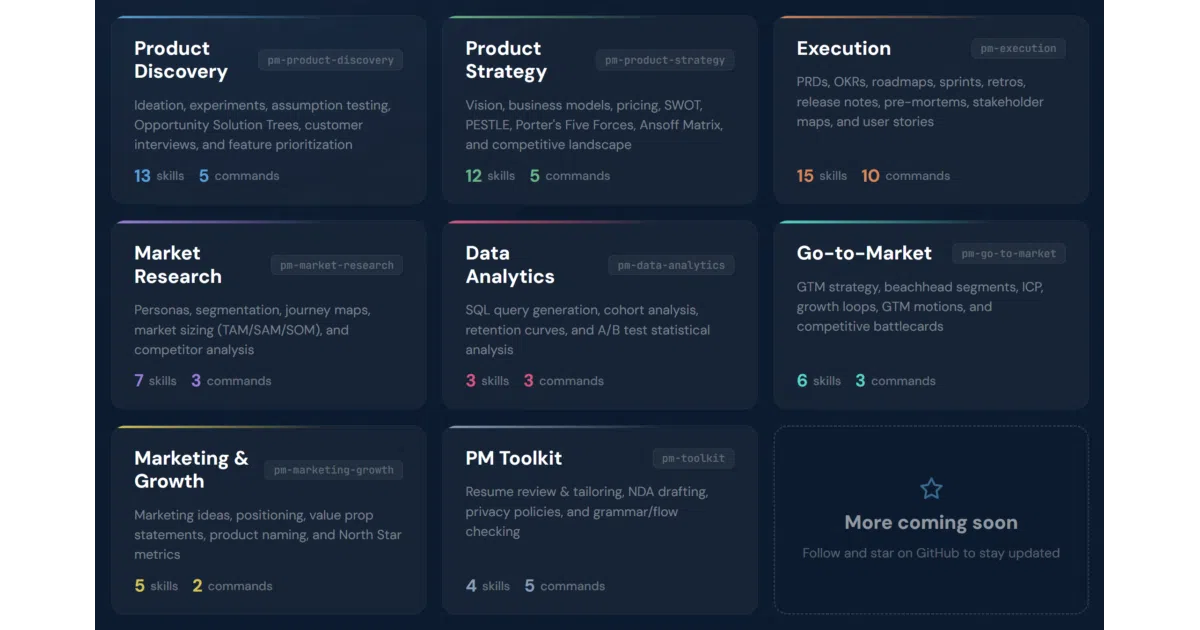
Into this noisy horizontal marketplace, phuryn/pm-skills makes a vertical bet. It offers sixty-five product-management skills and thirty-six chained workflows across eight plugins, curated by Paweł Huryn and designed primarily for Claude Code and Cowork. The premise is narrow and deliberate: when an AI agent assists with discovery, it should follow Teresa Torres’s Opportunity Solution Tree, not hallucinate a framework that merely sounds like one.
The Core Idea: Frameworks as Runtime
The project is built on the Agent Skills open standard, which treats expertise as declarative infrastructure. Each skill is a markdown file with YAML frontmatter describing its purpose; the agent reads that description to decide whether to auto-invoke the capability, loading the full body only when needed to conserve context window space 12. This is not prompt engineering in the traditional sense—there is no copy-pasting of text into a chat box. It is context engineering: domain knowledge installed into the agent’s filesystem so the agent can discover and route to it autonomously.
Within pm-skills, these capabilities are organized into three layers. Skills are single-domain instructions—identify-assumptions-existing, opportunity-solution-tree, prioritization-frameworks. Commands chain them into end-to-end workflows invoked with slash commands: /discover runs ideation, assumption mapping, prioritization, and experiment design in sequence. Plugins group related commands and skills into installable packages covering discovery, strategy, execution, market research, data analytics, go-to-market, and marketing growth.
The result is a shift from reference to runtime. The /write-prd command does not simply ask the model to “write a PRD.” It invokes the create-prd skill, which enforces an eight-section structure, ensuring the agent addresses problem statement, goals, user stories, test scenarios, and release criteria rather than drifting into a vague feature description. Similarly, /analyze-test pipes A/B test results through a skill that checks statistical significance, sample size validation, and ship-or-stop recommendations rather than offering a confident but ungrounded interpretation. Previously, a PM might read Marty Cagan’s INSPIRED or Teresa Torres’s Continuous Discovery Habits, then attempt to apply the lessons in a whiteboard or Notion doc. Here, the frameworks are encoded as executable logic. The README states the goal explicitly: “better product decisions, not just faster documents.”
The Ecosystem: Curation vs. Chaos
The repository arrives at a moment when product management itself is being redefined by agentic tooling. Aakash Gupta, citing Box CEO Aaron Levie, argues that managing AI agents represents the largest inflection point in PM history since mobile, with new roles demanding context engineering and agentic orchestration skills that command salaries above $300,000 11. Yet the operational reality remains messy. Lenny Rachitsky’s newsletter notes that while PMs are eager to automate busywork, actually operationalizing agents is difficult due to steep learning curves, security concerns, and cost 8.
pm-skills attempts to bridge that gap by offering curation over automation. The intellectual debt is explicit and extensive: the skills draw from Cagan, Torres, Alberto Savoia, Dan Olsen, Roger Martin, Ash Maurya, Strategyzer, Christina Wodtke, Anthony Ulwick, and others. This is not decorative name-dropping; each skill encodes a specific framework—Savoia’s pretotyping, Olsen’s Lean Product Playbook, Porter’s Five Forces—into agent-readable structure. In a landscape where most marketplaces scrape GitHub repositories with only a two-star minimum 7, that level of manual curation is itself a feature.
The security implications of the broader marketplace are hard to ignore. When skills can be scraped from any public repository with minimal filtering, a PM installing a third-party prioritization skill has little assurance that the markdown does not contain hidden prompt-injection instructions or exfiltration logic. pm-skills mitigates this, at least in theory, by keeping everything in readable markdown under an MIT license, curated by a named practitioner with a public newsletter and reputation. It is not a formal security audit—Agensi’s eight-point scan remains rare—but it is a step above the scrape-and-list model that dominates the field.
The project also signals a philosophy of inspectability. The companion pm-brain repository proposes a local “second brain” of plain markdown files—no vector database, no cloud, no agent memory tricks—that Claude reads before answering and updates after. The skills themselves are plain text, auditable and portable to Cursor, Gemini CLI, OpenCode, and other agents that follow the same directory convention. Only the chained slash commands remain Claude-specific.
The Judgment Gap: When Agents Follow Checklists
For all its structure, the project sits on a tension that the broader PM community is already debating. A commenter on Gupta’s LinkedIn post criticized the elevation of tool-specific skills—naming n8n, for instance—as a vulnerability compared to tool-agnostic core product thinking 11. The same risk applies here. If /discover handles assumption mapping, does the PM still learn to identify bad assumptions, or merely learn to invoke the command?
The README attempts to guard against this by keeping the human in the loop. Commands suggest next steps rather than closing autonomous loops. The skills are loaded automatically when relevant, but the agent does not execute a full product lifecycle while the PM is at lunch. The design implies that judgment remains human; the skills serve as guardrails against generic AI drift.
There is also a platform-dependency caveat. While the individual skill files are universal, the orchestrated workflows—the chaining logic that makes /discover more valuable than the sum of its parts—are tied to Claude Code and Cowork. A user on Cursor or Gemini CLI can copy the skill folders into the appropriate directory and gain the raw capabilities, but they do not get the composed workflows without manual reconstruction.
Outlook: Expertise as Selection
pm-skills is best understood as an early draft of how professional knowledge might survive the transition from human memory to agent context. In a marketplace where expertise is increasingly scraped, repackaged, and injected with security flaws, a tightly curated vertical library offers a different model: frameworks as trustworthy dependencies.
The open question is where the premium accrues. If any founder can install the strategy plugin and generate a nine-section Product Strategy Canvas, the scarce resource stops being knowledge of the canvas and starts being the judgment to know when the canvas is wrong. The value of pm-skills may not lie in any single skill, but in the curation—the decision that these sixty-five skills, and not others, constitute a coherent operating system for product work.
That is the bet. As AI agents move from chat interfaces to file-system residents, the professionals who thrive will be those who treat expertise as something they compose, not merely something they possess. This repository is a working prototype of that shift.
Sources
- I built a marketplace for AI agent skills because I was tired of hunting ...
- What are useful AI agents for product work? : r/ProductManagement
- product-on-purpose/pm-skills: 66 plug-and-play, best ... - GitHub
- AI Skills Marketplace: SkillsLLM
- 10 AI Agents for Product Managers - MindStudio
- TOP PM skills : r/projectmanagement - Reddit
- The Best AI Agent Skills Marketplaces in 2026 — Honest Comparison
- Make product management fun again with AI agents
- PM Skills – Project Management Skills Training
- AI Agent Marketplace - ServiceNow Store
- Product management for AI agents is wild. | Aakash Gupta - LinkedIn
- Every PM Should Be Building Skills - by Aman Khan