nitrocloudofficial/nitrostack · 30 Jul 2026 · Feature
Bringing Enterprise Backend Discipline to the Wild West of MCP Servers

Patrick Donovan
Staff Writer
A TypeScript framework that treats Model Context Protocol servers as first-class enterprise backends, complete with decorators, dependency injection, and a visual IDE.
nitrocloudofficial/nitrostack
★2.5k stars
star history
When Anthropic published the Model Context Protocol in November 2024, the pitch was seductively simple: a “USB-C port for AI applications” that could replace the tangle of bespoke integrations between large language models and external data sources [5][2]. The protocol standardized how an LLM discovers tools, invokes functions, and consumes structured data across repositories, databases, and business systems. Early demos showed agents accessing Google Calendar, generating web applications from Figma designs, and querying organizational databases through a unified interface [2][5]. What the specification did not provide, however, was a mature developer experience for building the servers on the other end of that cable. That gap is where NitroStack has planted its flag.
NitroStack is an open-source TypeScript framework for constructing production-grade MCP servers. Its central thesis is that an MCP server is not a toy script or a transient glue layer; it is an enterprise backend that happens to speak JSON-RPC 2.0 over standard input/output or server-sent events [11]. To that end, the project imports the full architectural vocabulary of modern backend engineering—decorators, dependency injection, middleware pipelines, authentication guards, and lifecycle-scoped services—into a domain that currently consists largely of raw protocol handlers and reference implementations [1][10].
The syntax will feel immediately familiar to anyone who has worked with NestJS. A developer defines a tool with @Tool, attaches a Zod schema for input validation, stacks @UseGuards(ApiKeyGuard) for authentication, adds @Cache({ ttl: 300 }) for response memoization, and even tags a @Widget('product-grid') to specify that the output should render as an interactive React component rather than a flat JSON blob [1]. The framework handles schema generation, request routing, and execution context plumbing automatically. The result is a declarative surface that resembles a REST controller but emits an MCP-compatible capability manifest. Because Zod definitions drive both the runtime validation and the static TypeScript types, the framework claims end-to-end type safety from schema to runtime, eliminating the manual synchronization between code and protocol metadata that often plagues JSON-RPC services [1].
This decorator-driven approach matters because MCP servers are, by protocol design, stateless and passive. They expose tools and resources; a central planner—usually the LLM itself—decides when to call them, marshals arguments, and synthesizes results into a final response [8][11]. That separation keeps the wire protocol simple, but it also means the server developer must handle cross-cutting concerns without the benefit of a request-response lifecycle that HTTP frameworks have refined for decades. NitroStack effectively backfills that missing infrastructure. It gives the server its own internal architecture, complete with an inversion-of-control container supporting singleton, transient, and scoped lifecycles, plus exception filters and pipes that can transform or reject inputs before they reach the business logic [1]. For developers who already think in terms of modules, providers, and guards, this is a significant cognitive discount.
Where NitroStack pushes beyond mere framework plumbing is in its treatment of user interface. The @Widget decorator is a genuinely unusual addition: it allows a tool output to carry a reference to a React component that a compatible client can render. In the project’s own example, a search_products tool does not simply return a JSON array; it signals that the result should be displayed as a product-grid [1]. This acknowledges a reality that raw protocol specifications usually ignore—agents are increasingly embedded in chat clients, IDEs, and dashboards where structured data benefits from visual presentation. By bundling a React SDK (@nitrostack/widgets) alongside the server framework, NitroStack collapses the distance between backend capability and frontend consumption. The server becomes not just an API endpoint but a full-stack delivery mechanism for interactive capabilities [1].
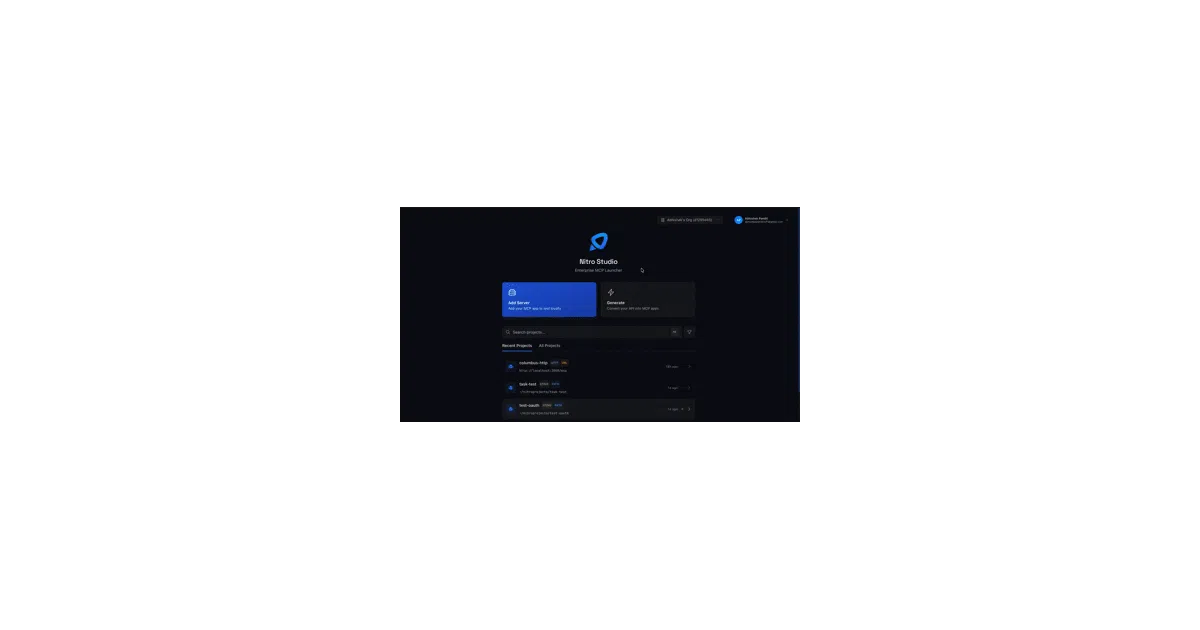
The ambition does not stop at code. NitroStack is positioning itself as a vertically integrated platform, not merely a library. NitroStudio is a desktop IDE that opens a project folder, manages the dev server, and provides a visual inspector for tool calls, payload debugging, and an integrated AI chat for end-to-end testing [1]. For a protocol where debugging often involves peering at opaque JSON-RPC messages, having a dedicated simulator that renders the request-response cycle in real time is a practical luxury. NitroCloud offers managed serverless hosting with automatic scaling, custom domains, and claims of sub-two-second cold starts alongside scale-to-zero behavior [1]. NitroChat is a white-label client that connects to MCP servers via HTTP/SSE, giving developers a complete product surface rather than forcing them to build their own frontend [1]. The company argues that most MCP tooling provides only a framework, leaving testing, deployment, and user interface as “separate decisions and separate points of failure” [10].
This platform strategy is NitroStack’s attempt to solve a fragmentation problem that already plagues the broader AI agent ecosystem. A recent survey of the landscape identifies at least eight distinct frameworks—LangGraph, CrewAI, OpenAI Agents SDK, LlamaIndex Workflows, Google ADK, and others—each optimized for orchestrating multi-agent workflows, retrieval pipelines, or reasoning graphs [9][12]. NitroStack is not competing directly with those orchestrators. It is building the layer underneath them: the server infrastructure that exposes the tools and data sources those agents consume. In that sense, it is less like LangChain and more like Express or Fastify, if those frameworks had been designed specifically for the MCP wire format. You could imagine a CrewAI agent delegating tasks to tools served by NitroStack backends; the two are complementary rather than substitutive [9].
The distinction is important, because the MCP protocol itself is still young. Anthropic open-sourced it less than a year ago, and while adoption is spreading—Claude, ChatGPT, Cursor, and VS Code are listed as supported clients—the server ecosystem remains a patchwork of ad-hoc implementations [2][5]. Early production users like Block and Apollo have integrated MCP, and development tool vendors including Replit and Sourcegraph are experimenting with it for coding context [5]. But the protocol’s stateless architecture has already drawn academic scrutiny. Researchers proposing Context-Aware MCP (CA-MCP) note that the standard pattern forces the central LLM to maintain all reasoning state, while servers remain oblivious to shared context [8]. This can lead to repeated inference calls, context loss between steps, and cascading errors on long-horizon tasks. CA-MCP introduces a Shared Context Store that allows servers to read and write shared memory, enabling autonomous coordination without constant central planning [8]. NitroStack’s current framework appears to align with the standard stateless model; it does not yet implement shared context stores or autonomous server-side execution logic. That is not a flaw so much as a boundary: the framework is enterprise-grade in the backend sense, but it is still operating within the constraints of a protocol that itself may evolve.
There are also the usual risks of betting on a young standard with a small team. NitroStack’s LinkedIn profile lists two to ten employees, and its public footprint includes a student hackathon at Amrita Vishwa Vidyapeetham where participants used the platform to build and deploy AI applications with MCP support [10]. The project is ambitious—advertising built-in JWT, OAuth 2.1 with PKCE, RBAC roles, and compliance-oriented security—but its “production-ready” promise will be tested only as MCP traffic moves from prototypes to sustained enterprise load [1]. The hosting layer, NitroCloud, advertises 99.99% uptime and sub-two-second cold starts, yet those figures will face scrutiny once real-world workloads arrive [1].
Still, the timing is defensible. MCP is gaining momentum precisely because it abstracts away the integration chaos that NitroStack now targets. If the protocol becomes the dominant interface between AI applications and external systems, demand for disciplined server frameworks will follow. Backend developers already know how to build REST and gRPC services; NitroStack’s wager is that they will want to build MCP servers the same way, with decorators, dependency graphs, and type-safe schemas, rather than hand-rolling JSON-RPC handlers. The protocol provides the port. NitroStack wants to provide the factory.
Sources
- NitroStack — Full-Stack MCP Platform | Build MCP Servers, MCP Apps ...
- Model Context Protocol - What is the Model Context Protocol (MCP)?
- Top 5 TypeScript AI Agent Frameworks You Should Know in 2026 : r/AI_Agents
- Does Nitro Stack ? : r/discordapp
- Introducing the Model Context Protocol
- What's the best framework for production‑grade AI agents right now?
- Build Full-Stack Servers
- Enhancing Model Context Protocol (MCP) with Context-Aware Server ...
- Not every AI Agent framework is suited for your use case | Rakesh Gohel
- NitroStack
- What is Model Context Protocol (MCP)? A guide
- The best AI agent frameworks in 2026