nextlevelbuilder/ui-ux-pro-max-skill · 17 Jul 2026 · Feature
Teaching AI Agents to Stop Designing Like Developers

Diana Powell
Editor
UI UX Pro Max is not a design tool. It is a structured taste layer for coding agents, built to stop "vibe coding" from producing generic, inaccessible interfaces.
nextlevelbuilder/ui-ux-pro-max-skill
★140.4k stars Velocity · 7d +451 ★/day ↗accelerating
star history
The Vibe Coding Hangover
Andrej Karpathy’s term “vibe coding” captured the moment AI agents started generating entire React frontends from a sentence or two. The stack has already converged: React, Tailwind CSS, and increasingly TypeScript, served up by Claude Code, Cursor, or Codex CLI. The problem is that large language models write interfaces the way a backend engineer might sketch a dashboard at 2 a.m.—functional, but often visually incoherent, accessibility-hostile, and prone to the dreaded “AI purple gradient” anti-pattern. [Source 11]
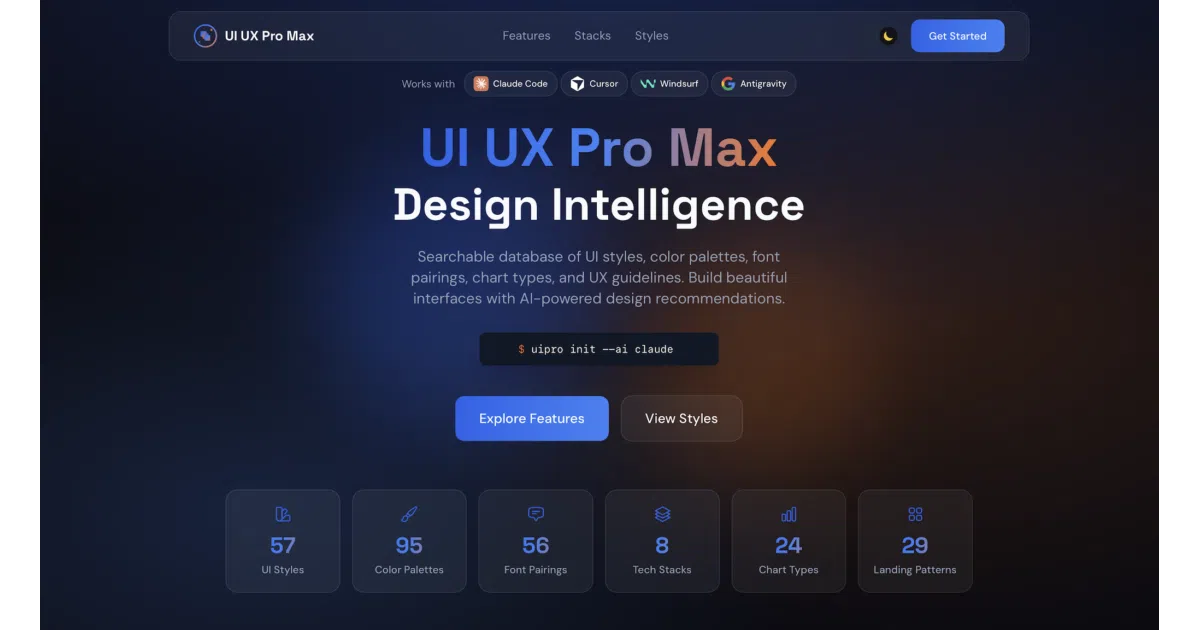
Enter UI UX Pro Max, an open-source “skill” for AI coding assistants. Rather than generating pixels itself, it sits between the user’s prompt and the agent’s code generator, acting as a design director that enforces taste before a single line of JSX is written. Its premise is simple: give the agent a curated, searchable design database and a reasoning engine that turns vague requests into specific constraints.
A Database with Opinions
At first glance, the repository looks like a meticulously organized set of lookup tables. The README advertises 67 UI styles, 161 color palettes, 57 font pairings, 25 chart types, and 99 UX guidelines. The real work, however, happens in the 161 industry-specific reasoning rules introduced in version 2.0. [Source README]
When a user asks for a landing page for a beauty spa, the skill does not guess. It launches five parallel searches across product type, style, color, landing pattern, and typography domains. A BM25 ranking pass surfaces the best matches, then a JSON-conditioned reasoning engine filters out anti-patterns—such as forbidding neon colors for wellness brands or banning emoji-as-icon substitutes. The output is a complete design system delivered in ASCII or Markdown: recommended page structure, color hex codes, Google Fonts pairings, animation durations, and a pre-delivery checklist that includes contrast ratios and focus-state visibility. [Source README]
This is essentially retrieval-augmented generation, but optimized for agentic workflows. The model does not need to memorize design heuristics; it queries them, then applies them as hard constraints to the code it subsequently writes. The project site illustrates a six-step pipeline—prompt, reasoning, database search, code generation, quality checklist, final result—that keeps the host agent grounded in specifics rather than letting it hallucinate a layout. [Source 9]
The Master and the Override
One of the more architecturally interesting features is the persistence layer. The skill can emit a master design system file that serves as a global source of truth for a project, alongside page-specific override files. During a session, the agent checks for a page file first; if one exists, its rules override the master, otherwise the master reigns exclusively. [Source README]
This hierarchical retrieval pattern acknowledges a practical limitation of current agents: context windows are large but not infinite, and design decisions drift across long sessions. By externalizing the design system to the filesystem, the skill turns ephemeral prompt context into project state. It is a small but significant shift from prompt engineering to prompt infrastructure. The project’s blog hints at pushing this further, advocating that agents define design tokens before components so that generated Tailwind UIs do not scatter raw hex values across dozens of class strings and become unmaintainable by Friday. [Source 9]
Skills as Infrastructure
UI UX Pro Max is distributed through the Claude Code Skills marketplace, where it is listed with over 265,000 installs, and it supports more than a dozen AI assistants including Cursor, Windsurf, GitHub Copilot, and Kiro. [Source 12] This places it in an emerging layer of the AI stack: not the foundation model, not the IDE, but the domain-specific reasoning module that fine-tunes agent behavior.
The distinction matters. Tools like UX Pilot or Figma AI generate screens for human designers to refine. [Source 1, Source 10] UI UX Pro Max generates constraints for machines to obey. It is infrastructure for the “AI-first development” workflow, where the goal is not a prototype but production-ready code that respects accessibility, responsive breakpoints, and platform-specific interaction patterns. [Source 11] Its coverage spans web frameworks like React, Next.js, Astro, Vue, and Svelte, but also extends to mobile and native stacks including SwiftUI, React Native, Flutter, Jetpack Compose, and even Laravel Blade. That breadth signals an ambition to translate taste across platforms, not just to decorate yet another React landing page.
The Limits of Good Taste
The project is, at its core, glue code wrapped around a well-curated CSV database. A Python script handles the search and reasoning; platform-specific skill files are generated dynamically from templates by an npm CLI installer. [Source README] Its intelligence is bounded by its curation. If an industry is missing from the 161 product types, the agent falls back to generic rules.
There are also discrepancies in the project’s own marketing. The README claims 67 UI styles and 161 color palettes, while an earlier version of the official project site listed 57 styles and 95 palettes, and the numbers on an unofficial translation site vary slightly again. [Source README, Source 3, Source 9] These inconsistencies are minor, but they hint at a rapidly evolving dataset that may not always be perfectly synchronized across distribution channels.
Moreover, the tool cannot replace a human designer’s eye for brand nuance. It can tell an agent to use soft shadows and Cormorant Garamond for a luxury wellness site, but it cannot judge whether the resulting composition actually feels calming. It provides guardrails, not genius.
Checklists Over Charisma
Where UI UX Pro Max earns its keep is in the unglamorous details. The rule system prioritizes accessibility as critical: contrast ratios of 4.5:1, keyboard focus rings, ARIA labels, and respect for reduced-motion preferences. It enforces minimum touch targets, bans placeholder-only labels, and mandates visible feedback for every interactive element. [Source 6]
These are the things developers skip when shipping fast. By encoding them as non-negotiable rules that the agent must read before writing code, the skill acts as an automated UX auditor. In a landscape where AI-generated interfaces are proliferating faster than design review can keep up, that function may be more valuable than another glassmorphism generator.
For now, UI UX Pro Max is a reminder that the bottleneck in AI-assisted frontend development is rarely syntax. It is judgment. And judgment, it turns out, can be shipped as a skill.
Sources
- My 7 Best AI Tools for UI Design
- Build a Full-Stack AI UI/UX Generator with Next.js & Tailwind ...
- UI UX Pro Max - Design Intelligence for Claude Code
- I Tested the 5 Best AI Tools for UI Design With the Same ...
- I built a simple tool to generate TailwindCSS based UI with AI
- ui-ux-pro-max Skill - nextlevelbuilder
- What's one AI tool (besides chatGPT ofc) that actually ...
- Generate your UI with AI - Use for Free for Tailwind CCS Projects
- UI UX Pro Max Skill — Design Intelligence for Claude Code
- Top AI Tools for UX Designers in 2026
- React + Tailwind + TypeScript for AI-First Development
- Ui Ux Pro Max | Claude Code Skills