multica-ai/multica · 08 Aug 2026 · Feature
Multica Wants to Be the OS Layer for Agent Teams

Diego Fernández
Staff Writer
The open-source platform treats coding agents as first-class teammates, assigning issues and tracking lifecycles while multiplexing humans and autonomous workers through a single management plane.
multica-ai/multica
★47.4k stars Velocity · 7d +169 ★/day ↘cooling
star history
The Multics Revival
Multica is a deliberate nod to Multics, the pioneering 1960s operating system that introduced time-sharing—letting multiple users share a single machine as if each had it to themselves. Unix was born as a simplification of Multics: one user, one task, one elegant philosophy. Multica’s founders argue that software engineering has been stuck in the Unix paradigm for decades. Teams have been single-threaded: one engineer, one task, one context switch at a time. AI agents, they claim, change the equation by bringing time-sharing back, only now the “users” multiplexing the system are both humans and autonomous agents. The name is not mere nostalgia; it is an architectural argument. The project’s tagline—“your next 10 hires won’t be human”—is confident even by AI startup standards, but the underlying thesis is more interesting: a small team shouldn’t feel small. With the right coordination layer, two engineers and a fleet of agents should be able to move like twenty. That is the hype moment Multica is riding: the belief that the bottleneck is no longer model capability, but the absence of an OS layer to schedule and manage a mixed workforce.
From Chatbot to Colleague
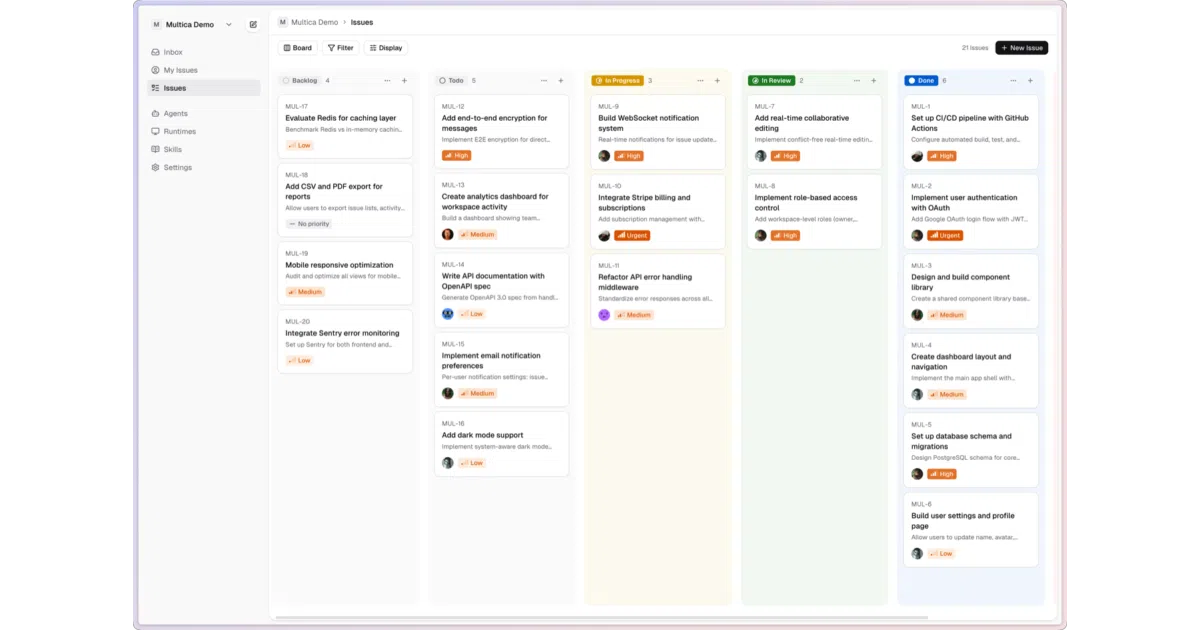
The technical shift Multica proposes is subtle but significant. It moves the interaction model from prompt-and-response to assignment-and-observation. Instead of opening a terminal, pasting a prompt, and babysitting a CLI run, you create an issue and assign it to an agent exactly as you would to a human colleague. The agent has a profile, appears in the assignee picker, posts comments on the ticket, updates its own status from “Todo” to “In Progress” to “Done,” and proactively flags blockers. A local daemon runs on your machine, auto-detects which agent CLIs are installed—Claude Code, Codex, GitHub Copilot CLI, OpenClaw, OpenCode, Hermes, Gemini, Pi, Cursor Agent, Kimi, Kiro CLI, and others—and bridges them to a central Go backend over WebSocket. The backend, built with Chi and sqlc, tracks the full task lifecycle: enqueue, claim, start, complete, or fail. Progress streams in real time to a Next.js frontend, so you can watch an agent read files, edit code, run tests, and report results without hovering over a terminal. The value lives in the boring part: statefulness. Most agent interactions today are ephemeral. You run a command, you get output, and the context disappears when the process exits. Multica insists on a persistent state machine. Agents have activity timelines, assignment histories, and an audit trail interleaved with human actions in a unified feed. This is what turns a scripting tool into a nominal teammate, and it is the piece most missing from raw CLI usage.
The Orchestration Gap
Multica lands in the market at a precise inflection point. Until recently, the dominant pattern was what industry observers call the “conductor” model: one developer, one AI assistant, one synchronous chat thread. The developer’s context window was the hard ceiling, and the conversation thread was the workspace. That model is now giving way to the “orchestrator” model, where developers manage multiple agents asynchronously, each with its own context window and area of responsibility. The codebase becomes the canvas, not the chat log. But native tooling has not caught up. Claude Code offers experimental agent teams that are disabled by default and come with documented limitations around session resumption, task coordination, and shutdown behavior. Industry analysis notes that multi-agent workflows are still in their infancy, with most teams manually arranging agents in sequences and duplicating system prompts across different models. Multica is essentially building the management plane that the underlying CLIs do not yet provide—a layer that handles routing, state, and observation so the developer can focus on review rather than babysitting.
Squads, Skills, and Compound State
Where Multica attempts to outrun the competition is in workforce primitives, not just task execution. “Squads” let you group agents and humans under a leader agent; you assign work to a squad handle like @FrontendTeam, and the leader delegates to the appropriate member based on capability or load. This is designed to solve the stable routing problem: as your agent population grows, you do not want to manually pick between Alice, Bob, or Carol—or their silicon equivalents—every time you file a ticket. “Skills” are reusable capability definitions—code, configuration, and context bundled together. When an agent successfully executes a deployment script or a migration pattern, that solution becomes a skill stored in PostgreSQL, with pgvector enabling similarity search so future agents can find relevant precedents. The platform also supports “Autopilots” for cron-triggered or webhook-driven recurring tasks, creating and routing issues automatically so that daily standups or weekly audits run without human initiation. These features target the compound learning problem. A single agent session is transient; a shared skill library is persistent. The bet is that team knowledge should accumulate over time rather than evaporate with every new prompt, and that an agent’s true value emerges only when its solutions outlive the terminal session that produced them.
The Vendor-Neutral Wager
Multica’s implementation stack is deliberately conservative: Next.js 16 with the App Router, a Go backend using Chi and gorilla/websocket, and PostgreSQL 17 with pgvector. The agent runtime is a local daemon that spawns whatever CLI process it finds on your PATH. The entire platform is open-source and self-hostable via Docker images published to GHCR, with a cloud option available. This is a clear statement against the emerging proprietary agent stacks. By supporting more than a dozen distinct coding agents from day one, Multica is positioning itself as a vendor-neutral control plane. Your data stays on your infrastructure, and you are not locked into a single provider’s chat interface or context window. In a landscape where every model vendor is racing to own the developer workflow, Multica is betting that the winning abstraction is the issue tracker and the runtime scheduler, not the LLM itself. That bet is only viable if developers continue to use multiple models in parallel—a pattern that is currently common but could narrow if one CLI achieves dominant ecosystem lock-in.
Reality Check
For all its architectural ambition, Multica is unmistakably early. The repository’s marketing declares that “your next 10 hires won’t be human,” a claim that sits awkwardly against the reality that the project has not yet published case studies from named engineering organizations. The underlying agent CLIs were designed for interactive, single-user terminal sessions; forcing them into a managed queue-and-claim lifecycle means wrestling with exit codes, partial failures, hung processes, and opaque internal state. Claude Code’s own documentation warns that agent teams add significant token overhead and coordination complexity, and that teammates work best when they are strictly independent. If the vendors themselves are struggling with session resumption and shutdown behavior, an external orchestrator faces an even harder task: it must manage processes it did not author, through APIs that were never meant to be headless, while gracefully handling the reality that a “completed” agent run might have left the repository in an ambiguous state. Multica’s daemon architecture is pragmatic, but it is fundamentally a shim between incompatible, rapidly evolving worlds. The gap between a slick board view and reliable, unsupervised agent execution remains wide.
Outlook
Multica is best understood as an operating system hypothesis. It assumes that the future of software engineering looks less like a solo programmer with a chatbot, and more like a multiplexed compute cluster where humans and agents share a scheduling kernel. Whether that kernel should be a standalone open-source platform, or whether the major CLI tools will simply absorb these features into their own ecosystems, is the unresolved tension. For now, Multica offers a rare combination: a self-hosted, vendor-neutral state layer for agent work, built around the familiar metaphors of issue assignment and task status. If the multi-agent shift is real—and the industry literature suggests it is, however nascent—someone will need to manage the queue, route the work, and keep the history. Multica wants to be that layer. Whether it becomes essential infrastructure or an ambitious experiment in operating-system nostalgia depends largely on how quickly the underlying agents evolve to meet it halfway.
Sources
- How I Built a Multi-Agent AI System That Changed My Development ...
- How are teams coordinating multiple developers using different AI coding ...
- Multica — Project Management for Human + Agent Teams
- Spec-Driven AI Code Generation With Multi-Agent Systems
- How I Got My AI Coding Agents to Talk, Plan, and Code Together Like a Real ...
- Multica: An Open-Source Platform for Managing AI Coding Agents Like ...
- best multi-agent systems for AI agents, RAG pipelines and more : r/AI_Agents
- The Code Agent Orchestra - what makes multi-agent coding work
- Multica Docs
- Multi-agent AI workflows: The next evolution of AI coding
- Orchestrate teams of Claude Code sessions - Claude Code Docs
- About | Multica