microsoft/generative-ai-for-beginners · 06 Aug 2026 · Feature
Microsoft’s 21-Lesson GitHub Syllabus for the Generative AI Gold Rush

Omar Haddad
Editor-at-Large
A free, massively multilingual curriculum turns GitHub into a classroom for developers racing to build LLM applications.
microsoft/generative-ai-for-beginners
★120.1k stars Velocity · 7d +68 ★/day ↗accelerating
star history
The Hype Moment: Talent Scarcity in a Boom Market
The enterprise generative AI market is caught in a paradox: everyone is buying, but few know how to build. Gartner polling suggests fifty-five percent of organizations are piloting generative AI, yet only ten percent have pushed anything to production [3]. BCG research frames the bottleneck less as an algorithmic shortage and more as an organizational one, proposing a 10-20-70 rule in which seventy percent of the effort belongs to people, processes, and cultural transformation [6]. Databricks, aggregating McKinsey and Goldman Sachs estimates, places the potential annual economic value between $2.6 trillion and $4.4 trillion, with the bulk flowing through customer operations, software engineering, and R&D [12]. Google Cloud maintains a running tracker of over 1,300 real-world use cases, first published in April 2024 and last updated in April 2026, reflecting what the company calls the fastest technological transformation it has observed [5]. Against that backdrop, a skills famine is arguably the biggest bottleneck.
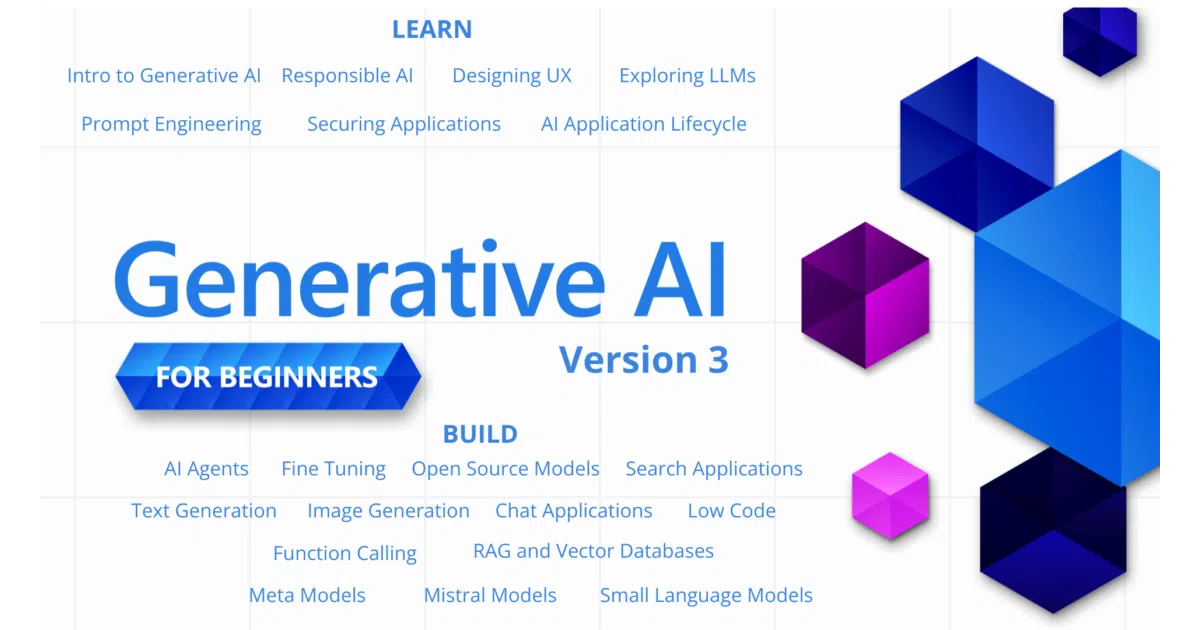
That is the vacuum Microsoft’s “Generative AI for Beginners” repository stepped into. Hosted on GitHub and maintained by Microsoft Cloud Advocates, the project is not a framework, a model, or a deployment tool. It is a curriculum—twenty-one lessons with video companions, written READMEs, and code samples—designed to take a developer from zero to functional generative AI applications [1][4]. In a landscape saturated with product announcements and scattered blog posts, the repo offers something rarer: a structured, zero-cost syllabus backed by a major cloud vendor.
Curriculum as Infrastructure
The repository’s real engineering is pedagogical. It organizes knowledge into twenty-one discrete lessons, each tagged as either “Learn” (conceptual) or “Build” (practical) [1]. The arc begins with LLM fundamentals and prompt engineering, moves through vector databases, retrieval-augmented generation, and function calling, and finishes with fine-tuning, small language models, and third-party model families such as Mistral and Meta [1]. This sequencing matters. It mirrors the way practitioners actually encounter friction: first they wrestle with prompts, then with context windows, then with grounding data, and finally with model selection. The progression from prompt fundamentals (lessons 4 and 5) to RAG and vector databases (lessons 8 and 15) to fine-tuning (lesson 18) roughly follows the maturity curve of an enterprise AI team [1].
A notable structural choice is the dual-track code support. Where possible, lessons provide examples in both Python and TypeScript, and they target multiple backends—Azure OpenAI Service, the GitHub Marketplace Model Catalog, and the OpenAI API itself [1]. That neutrality is relative, of course; Azure OpenAI is listed first and the entire course is cross-linked with Microsoft Learn modules and Azure AI Foundry forums [1][10]. Still, by offering polyglot samples and multi-provider configurations, the curriculum acknowledges that enterprise AI is rarely a single-vendor affair. It functions as a standardized on-ramp rather than a product manual, displacing the typical self-directed path of reading a dozen inconsistent blog posts and trying to reconcile OpenAI’s docs with Azure’s portal.
The Translation Factory
If the lesson plan is the brain, the localization pipeline is the logistical marvel. The repository ships translations in over fifty languages—Arabic to Vietnamese, including variants such as Traditional Chinese for Hong Kong, Macau, and Taiwan, and Nigerian Pidgin [4]. These are not static forks. Microsoft documents them as maintained via an automated GitHub Action characterized as “always up-to-date” [4]. The README credits contributor John Aziz with creating the workflows that keep this machinery running [1].
The sheer volume creates a genuine storage cost: the README explicitly warns that the translation directories bloat the repository and advises a sparse-checkout workaround if the user wants the English course without the overhead [1]. This is not mere accessibility theater. In the same way that foundation models are trained on multilingual corpora, the audience for generative AI education is global. By industrializing translation inside a GitHub Action workflow, Microsoft has turned the repo into a distributed classroom that scales without a proportional scaling of human translators. It is one of the few places where open-source infrastructure principles—automation, version control, community contribution—are applied to pedagogy at this scale.
The Ecosystem Tentacles
To call the curriculum vendor-agnostic would be generous. It is better described as a soft on-ramp to the Microsoft AI stack. Lessons point to Azure OpenAI Service as the primary runtime, and the companion ecosystem includes a .NET edition, LangChain variants, and an “AI Agents for Beginners” sibling repo, all cross-linked in the README [1]. Learners are nudged toward the Azure AI Foundry Discord server and a dedicated developer forum for product feedback [1]. The course setup lesson assumes a GitHub account and familiarity with forking repositories, which neatly reinforces the platform allegiance. The Microsoft Learn portal hosts an accompanying video series presented by advocates including Carlotta Castelluccio, explicitly using startup narratives as a framing device [10]. This situates the GitHub repo within a broader content strategy that spans documentation, video, and community forums.
That said, the vendor alignment does not invalidate the content. The lessons on responsible AI, UX design for AI applications, and securing generative AI systems are framework-agnostic enough to travel [1]. And in an era when enterprises are moving from passive AI assistants to autonomous agentic teams that orchestrate workflows across supply chain, compliance, and financial forecasting [5], the need for vendor-curried baseline education is arguably more urgent than the need for ideological purity.
Hard Edges and Honest Limits
The repository is explicitly for beginners, and its limits show. Several video slots in the lesson table are still marked “Video Coming Soon,” including the course setup and the final lessons on small language models and third-party model families [1]. The depth is necessarily shallow: you will not learn to pre-train a transformer from scratch, nor to optimize inference on custom silicon. The “Build” lessons are introductory applications—text generation, chat, image generation, low-code integrations—rather than production system architecture [1]. It is, by design, a consumption layer. The repository does not advance the state of the art; it explains the state of the art to newcomers.
There is also the matter of repository obesity. Fifty-plus language packs make the clone large enough that the maintainers document workarounds in the opening paragraphs [1]. For a course aimed at beginners, warning learners about blob filters before they have written a single prompt is a minor absurdity, albeit an understandable one.
Outlook: Version 3 and the Expanding Frontier
The project is currently branded as Version 3, and its recent expansion tracks the broader market’s evolution [1]. Lessons nineteen through twenty-one introduce small language models, Mistral, and Meta’s model families—an acknowledgment that enterprise AI is no longer synonymous with OpenAI’s frontier models [1]. Earlier lessons already cover AI agents and function calling, positioning the curriculum to absorb the industry’s pivot toward agentic orchestration [1][5].
Where the course goes next depends on how quickly the hype cycle moves. BCG distinguishes generative AI—which creates content—from AI agents, which reason, plan, and execute across systems [6]. If Microsoft continues to expand the syllabus, the gap between “Build a chat app” and “Build an autonomous agent team” is the logical next chasm to bridge. The course is unlikely to satisfy researchers or engineers optimizing inference on custom silicon. But in a market where BCG argues the hardest part of generative AI is the human and procedural seventy percent, a canonical, vendor-backed syllabus carries disproportionate weight [6]. For now, the repository remains exactly what it promises: a beginner’s course. In a market where ninety-two percent of Fortune 500 companies have already implemented generative AI in some form [3], defining the baseline for “beginner” may be the most influential thing it can do.
Sources
- Generative AI for Beginners
- Generative AI use cases for the enterprise
- Why Businesses Are Adopting Generative AI Faster Than ...
- Generative AI for Beginners
- Real-world gen AI use cases from the world's leading ...
- How Generative AI Is Transforming Business
- Generative AI for Beginners
- Generative AI: Applications, Use Cases, and Examples
- Why Businesses Must Adopt Generative AI to Stay ...
- Introduction to Generative AI and LLMs (Part 1 of 18)
- 20 Examples of Generative AI Applications Across Industries
- Generative AI for Business: A Complete Strategy and ...