mereyabdenbekuly-ctrl/clodex-ide · 14 Jul 2026 · Feature
The Agentic IDE That Treats Model Output as Untrusted Input

Yuki Tanaka
Editor
Clodex is an open-source, local-first development environment that treats AI-generated code as a security boundary rather than a convenience, wrapping every agent action in explicit policy, isolated runtimes, and human review.
mereyabdenbekuly-ctrl/clodex-ide
★870 stars
star history
The agentic coding wave has arrived with numbers that no longer look experimental. A large-scale study of 129,134 GitHub projects estimates that coding agents—tools which delegate entire tasks rather than autocomplete the next line—have already penetrated between 15.85% and 22.60% of repositories, a remarkable reach for a category that only crystallized in the first half of 2025 1. Jellyfish’s analysis of 25 million pull requests finds the median company now generates nearly 2% of its PRs autonomously, while top-quartile adopters exceed 14%, up from roughly 3% in January 2. Anthropic’s own telemetry shows that experienced users of Claude Code have shifted from manually approving every step to enabling full auto-approve on more than 40% of tasks, with the AI’s unsupervised run time doubling to over 45 minutes in the longest sessions 3.
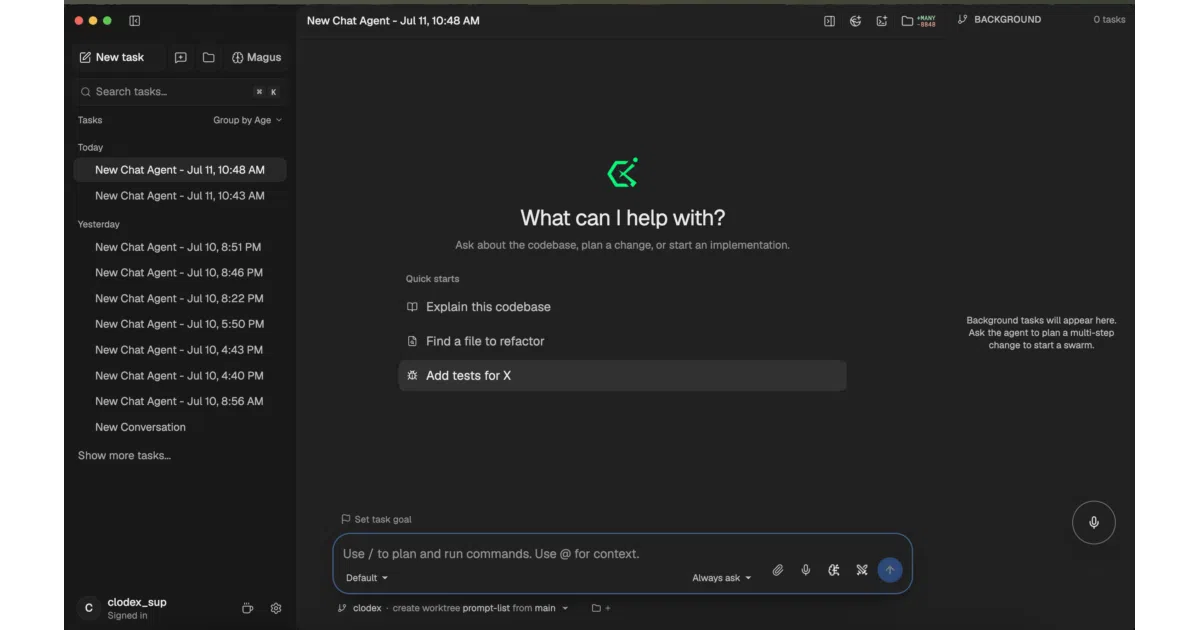
The industry’s trajectory is unambiguous: developers are increasingly willing to let agents write, test, and submit code with minimal interruption. Enterprise strategists already describe autonomous coding agents as core cloud infrastructure for production systems, embedding them for data integration and workflow generation 4. The prevailing assumption is that agents will live inside managed cloud sandboxes and CI/CD pipelines. Clodex, a technical preview released as open-source under AGPL-3.0 by a solo independent researcher, is making a contrarian bet on governance and locality. Its governing principle is stated bluntly in the documentation: “Model output is untrusted input. Authority comes from explicit policy, isolated runtimes, and user-controlled review.”
This is not a security checklist added after the fact; it is the load-bearing wall of the architecture. The Electron renderer handles the user interface, but it does not talk to the agent directly. Instead, communication flows through Karton, a typed IPC layer, to the main process, which in turn spawns separate processes for the Agent Host, the MCP Host, and sandboxed workers. The Agent Core manages task lifecycles, model routing through a provider-neutral Model Fabric, and an evidence-backed memory system with append-only records, provenance tracking, and bounded context injection. Checkpoints capture session state for crash recovery, and the system even experiments with session teleportation—moving a task’s runtime context between machines—though that capability remains labs-gated. Yet the core cannot open a terminal session or make a network request on its own. Every sensitive capability routes through a Guardian module that makes independent authorization decisions based on explicit, deterministic policy. The default posture is fail-closed: if the authorization result is ambiguous or invalid, the action simply does not execute. Possessing a tool does not grant authority to use it; the model’s stated intent is evaluated separately from the system’s permission to act, and the two must align before any code runs.
That separation of intent and authority is where Clodex diverges from the mainstream. The current generation of agentic tools largely treats the model as a trusted junior developer who occasionally needs a hall monitor. Clodex treats the model as a compromised process. Sensitive operations—shell commands, network egress, browser access, Git merges, credential retrieval—pass through deterministic controls that live outside the model runtime. Network destinations are validated independently of what the model claims it is doing. Credentials sit in OS-backed storage, inaccessible to the agent process. Pending edits and high-impact actions queue for human review before they touch the working tree. Even extensions and MCP servers face supply-chain checks: signatures, integrity hashes, compatibility validation, and quarantine before activation.
The result is an IDE that feels architecturally paranoid in a landscape currently optimizing for frictionless delegation. Where Anthropic’s research notes that users are progressively removing friction—moving toward auto-approve and longer uninterrupted sessions—Clodex adds deliberate friction at the trust boundary. It is a bet that the next phase of agentic adoption will not be won by the tool that delegates the fastest, but by the one that can prove why its autonomous actions are safe to merge.
Functionally, Clodex wraps this security model around a persistent task system. Tasks retain state across application restarts, maintain token and time budgets, and can fork or be reviewed like code branches. The workspace integrates files, Git worktrees, terminal sessions, browser contexts via CDP, and MCP tools into a single Electron window, but each surface runs under its own isolation boundary. The terminal and browser contexts are not mocked stubs; they are persistent shell sessions and real CDP-attached browser tabs that the agent can inspect via screenshots and console output, yet all of it remains subject to the same Guardian policy that governs local file access. The Model Fabric handles routing across providers with health checks and budget controls; the Execution Fabric dispatches work locally, over SSH, into Docker runners, or toward cloud-backed environments, though Docker runners and cloud tasks remain preview-grade or gated behind “promotion evidence.” That gating is deliberate: the project will not label a foundation as stable production capability until it has accumulated real installation evidence, monitoring, rollback drills, and manual sign-off.
Extensibility follows the same guarded philosophy. The MCP runtime connects to local stdio or remote Streamable HTTP servers, reflecting the protocol’s emergence as a common integration surface for agentic tools 5. The Runner SDK allows custom execution backends, and the plugin system supports signed capabilities with bounded grants. Even “generated apps”—interactive tools spawned by the agent during a task—carry explicit capability declarations rather than inheriting the agent’s full permissions. This is a direct response to the supply-chain and prompt-injection risks that come from letting an LLM dynamically create and execute new software.
The project’s positioning is as notable as its architecture. Clodex is the work of a single researcher, funded by cryptocurrency donations across seven blockchains, and released under a copyleft license that ensures any networked derivative stays open. The donation page lists USDT addresses across BNB Chain, Ethereum, Solana, and others—a detail that underscores both the project’s independence and its precarious funding model. It arrives in a market where agentic infrastructure is being built by well-funded labs—OpenAI, Anthropic, Microsoft, Google—and venture-backed startups racing to own the developer workflow 6. The README even includes a job pitch: the builder is open to core engineering roles at frontier AI labs. That tension between architectural independence and the gravitational pull of big-tech funding permeates the project. It is simultaneously a fully realized argument for zero-trust agentics and a proof-of-concept seeking resources.
That resource constraint shows in the capability matrix. While desktop workspace, file editing, Git, terminal, browser, and local execution are available for local testing, the Guardian and managed network egress remain in preview. Cloud tasks and session teleportation are locked in labs. Stable cross-platform distribution is still pending promotion evidence. This is refreshingly conservative in an ecosystem that often ships agentic features to production on Monday and apologizes on Tuesday. But it also means Clodex is not yet a drop-in replacement for the cloud-hardened, continuously deployed agents developers are already using.
Whether that caution is a feature or a liability depends on what you believe the agentic future needs. The arXiv study notes that agent-assisted commits are already larger than human-only commits and skew heavily toward feature additions and bug fixes 1. As agents move from autocomplete to authorship, the blast radius of a bad action expands. Clodex’s core argument is that the industry has spent the last eighteen months making agents capable and now needs to spend the next eighteen making them accountable. Its answer is process isolation, deterministic policy enforcement, and an audit ledger that intentionally avoids storing prompts, source code, or credentials. That privacy-aware design suggests the builder is thinking not only about agentic safety but also about the compliance and liability headaches that follow when a machine handles proprietary code.
The risk, of course, is that convenience usually wins. Developers are already voting with their auto-approve settings, and corporate buyers tend to prefer integrated suites from known vendors over independent AGPL projects, however well-architected. But if the agentic coding wave continues at its current pace—doubling capability roughly every seven months by one benchmark cited in the literature 1—the failures will scale just as fast. Clodex is a bet that someone will want an IDE built for that moment: local-first, fail-closed, and fundamentally suspicious of the very AI it hosts.
Sources
- Mobile IDE for Codex AI GPT - App Store - Apple
- 8 best agentic AI tools I'm using in 2026 (free + paid)
- Autonomous Coding Agents: Beyond Developer Productivity
- is codex sufficient or do i need a separate IDE
- What is Agentic AI and How Does it Work?
- Autonomous Coding Agents Adoption Accelerates
- Codex IDE extension | ChatGPT Learn - OpenAI Developers
- Agentic.ai: Agentic AI Tools Directory — Find AI That Actually ...
- Agentic Much? Adoption of Coding Agents on GitHub
- Codex & Claude Code IDE -Locus - App Store - Apple
- Agentic AI, explained
- Measuring AI agent autonomy in practice