liustack/modlens · 22 Aug 2026 · Feature
Pasting Images Into Chatbots That Cannot See

Camila Reyes
Senior Editor
ModLens routes pasted images through whatever multimodal engine you already have, feeding structured evidence back to text-only models like DeepSeek.
liustack/modlens
★4.2k stars Velocity · 7d +8.4 ★/day ↘cooling
star history
The Hype: A First for the Harness
DeepSeek Harness (dsh) is a command-line interface for running DeepSeek models as coding agents, but the underlying models ship without vision. You cannot show them a screenshot of an error, a UI mockup, or a data chart and expect them to react. They are text-in, text-out. That limitation has kept multimodal workflows locked to other providers, or forced users into clumsy workarounds: save the image, pass a file path, hope the model hallucinates less than it guesses.
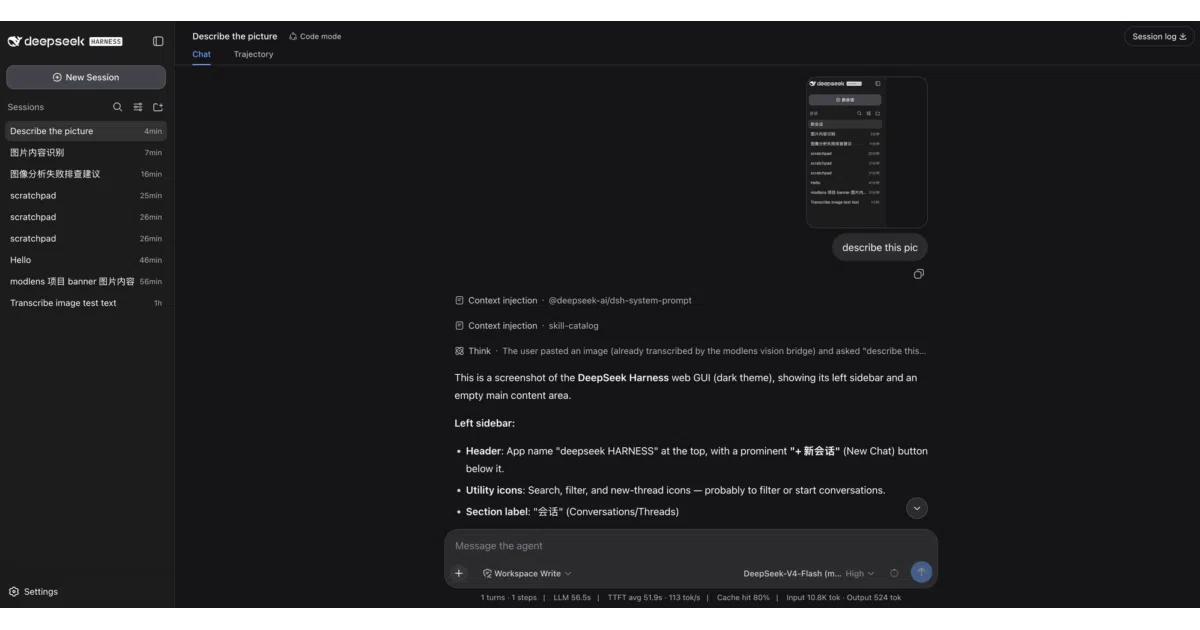
ModLens arrives as a self-proclaimed first: the inaugural vision plugin for DeepSeek Harness. Its pitch is bluntly practical. Paste an image into chat. The text-only model behind the harness reads it. No file path ritual, no context-switching to a different model family. As of August 2026, the repository has accumulated 3,431 GitHub stars and 93 forks—modest by blockbuster standards, but significant for a narrow infrastructure tool aimed at a single harness ecosystem. The attention spike is less about raw popularity and more about the relief it offers to developers who want to stay inside DeepSeek’s reasoning loop without surrendering visual context.
The Mechanism: Evidence, Not Imagination
ModLens is not a vision model. It is a TypeScript bridge that sits between the chat interface and the text-only language model, intercepting image inputs and forwarding them to an available multimodal engine. The engine returns structured evidence—full transcription, reading-order layout regions, entity and relation lists—and that evidence is injected back into the conversation as grounded context. The text-only model then reasons over facts rather than generating airy captions from its training data.
The distinction matters. A generic image-to-text caption might note that a screenshot contains “a scatter plot with many dots.” ModLens, according to its documentation, returns specifics: both axes, the log scale, per-provider color coding, highlighted regions, and individual model markers. The model can quote numbers—5.4M views, 1.6K replies—because the bridge extracted them rather than asking the text-only LLM to intuit them.
This philosophy echoes a broader academic trend. The SeeingEye framework decouples perception from reasoning by using a small vision-language model as a translator that distills visual inputs into structured intermediate representations for a text-only reasoner. ModLens operates in the same conceptual lane, but as shipping software rather than a lab experiment. It targets coding agents, not benchmark leaderboards, and it sacrifices theoretical purity for the pragmatism of a one-line plugin install.
The bridge offers two interaction modes. In the first, a pasted image becomes a private temporary file processed by a native read_image tool. In the second, the harness model selector gains new entries—DeepSeek-V4-Flash (modlens vision) and DeepSeek-V4-Pro (modlens vision)—that display a thumbnail and convert the image to structured evidence at request time. The plugin auto-discovers text-only DeepSeek and GLM provider routes and deliberately excludes those families’ native vision models, ensuring it only intercepts models confirmed as blind by metadata.
The Zero-Config Gambit
The most technically boring part of ModLens is probably its most aggressive feature: it reuses credentials and engines already present on the machine. If Claude Code, Codex, OpenCode, or Pi are installed and logged in, ModLens asks permission to borrow their multimodal backends. Nothing to configure, no new API keys to manage, no local proxy daemon to keep alive. The README calls this a “zero-config start,” and a third-party skill registry notes it uses “no hooks, wrappers, local proxy daemons, or harness configuration changes.”
For users with no existing multimodal setup, the bridge falls back to a free Gemini API key or the Antigravity CLI, a no-sign-up channel. The health-check flow inventories what vision capacity is reachable through other harness CLIs and asks per-harness whether to reuse it. Every borrowed read is labeled with whose quota it spent, which turns the plugin into a kind of routing accountant rather than a freeloader.
This piggyback strategy reveals a subtle insight about the current AI tooling landscape. Developers already have fragmented multimodal access scattered across half a dozen agents and CLIs. ModLens treats that fragmentation as an asset, pooling disparate engines into a single vision backend for the one model that lacks eyes. It is glue code, but glue code that recognizes the modern development environment is already saturated with orphaned capabilities.
Bridges vs. Native Multimodality
ModLens does not exist in a vacuum. The Copilot Provider Bridge, another recent project, similarly equips text-only models such as GLM-5.3 and DeepSeek V4 Pro with a Vision Agent Tool that delegates visual tasks to multimodal backends including Gemini and Qwen. That tool, however, is tightly coupled to VS Code’s Copilot Chat and its Custom Endpoint BYOK support. ModLens, by contrast, is harness-agnostic across dsh, Claude Code, Codex, Pi, and OpenCode.
The broader market is also moving toward native document understanding. Azure Document Intelligence’s layout model and platforms like Unstructured.io offer cloud-based pipelines that ingest PDFs and images and return structured JSON with geometric and logical roles—titles, tables, figures, headers. These are heavy, enterprise-grade systems with page limits, tiered pricing, and SDK contracts. ModLens occupies the opposite end of the spectrum: a lightweight, client-side plugin that returns structured evidence without a cloud contract or file-size gate. It is closer to a chat augmentation than a document-processing pipeline, though it borrows the same obsession with preserving structure over raw text dumps.
The tension between these approaches is unresolved. Native multimodal models will inevitably improve, and DeepSeek or GLM may eventually ship vision variants that make a bridge unnecessary. Until then, ModLens bets that structured perception routed through a text-only reasoner is not merely a stopgap but a preferable architecture—cheaper to run, easier to audit, and modular enough to swap vision engines as they improve.
Rough Edges and Governance
For all its slickness, ModLens carries visible rough edges. The README dedicates an entire troubleshooting section to a pnpm release-age gate that can install an outdated version lacking the required dsh.bundle declaration, requiring a one-line fix. That is the kind of paper cut that greets early adopters.
More structurally, the project is maintained by a single author who refuses pull requests. The README states this is a “deliberate choice for reliability,” and while that ensures consistent vision, it also concentrates bus factor. A third-party security scan flagged a low-severity issue: a remote-install script reference embedded in the documentation. The project is also explicitly a wrap for DeepSeek and GLM text models only; it will not augment other blind models, nor will it assist vision-capable variants in those families.
Dependency is another open question. The plugin’s quality and latency are bounded by whichever upstream engine it borrows. A free Gemini key brings reads down to five or ten seconds, but quota limits and upstream terms of service remain the user’s responsibility. ModLens is a router, not a provider, and its usefulness scales with the generosity of the engines it borrows from.
Outlook
ModLens is best understood as a tactical response to a strategic gap. DeepSeek’s text-only models reason well and cost little, but blindness is a hard wall in a coding workflow dominated by screenshots, charts, and UI mockups. Rather than waiting for a native vision model, ModLens treats sight as a pluggable peripheral—something you bolt on by routing pixels through whatever multimodal engine is already lying around.
Whether that approach endures depends on how quickly the base models evolve. If DeepSeek ships a competitive native vision variant, the plugin’s core value proposition shrinks. Yet even then, the project’s emphasis on structured evidence—transcription, layout regions, entity lists—suggests a lingering utility. Native vision models can see, but they do not always report what they see with the same forensic granularity. A bridge that forces the model to quote specifics rather than summarize impressions may remain useful as an interpretability layer, not merely a sensory one.
For now, ModLens has carved out a narrow but genuine niche. It is the first to give DeepSeek Harness literal sight, and it does so with the lightest possible touch: paste the image, and let the text model read.
Sources
- Vision Bridge: Empower LLM Coding Agents with Visuals
- Build AI Document Understanding Pipelines
- Modlens gallery
- modlens - AI Agents on GitHub | SkillsLLM
- Document layout analysis - Document Intelligence
- MODLENS STUDIO
- thejjw/copilot-provider-bridge: Use third-party AI coding ...
- AI Document Processing: Beyond OCR for Structured JSON
- Modlens Studio (@modlens_studio) • Instagram photos and videos
- SeeingEye: Agentic Information Flow Unlocks Multimodal ...
- What Is JSON Output From OCR?
- About us - MODLENS STUDIO