lemomo-ai/lemo-opuscar · 08 Nov 2026 · Feature
The AI Film Studio That Refuses to Generate Video

Camille Laurent
Contributing Editor
Lemo-Opuscar turns a coding agent into a director that renders every frame in code — no video model, no stock footage, no cloud — and the interesting part is what that refusal buys you.
lemomo-ai/lemo-opuscar
★13.7k stars Velocity · 7d +1648 ★/day ↗accelerating
star history
Somewhere on the internet right now, someone is prompting a video generation model to make a short film, and somewhere else, a different person is getting a six-minute-twenty-five-second film in which a small pixel character walks through all 98 Best Picture winners from 1927 to 2025, each one redrawn in a visual style that fits that specific film. The second film — OPUSCAR 98, the flagship of the Lemo-Opuscar project — contains no generated video at all. Every frame, every note of music, and every cut was written as code by Claude Opus 5.5. That distinction is the entire project.
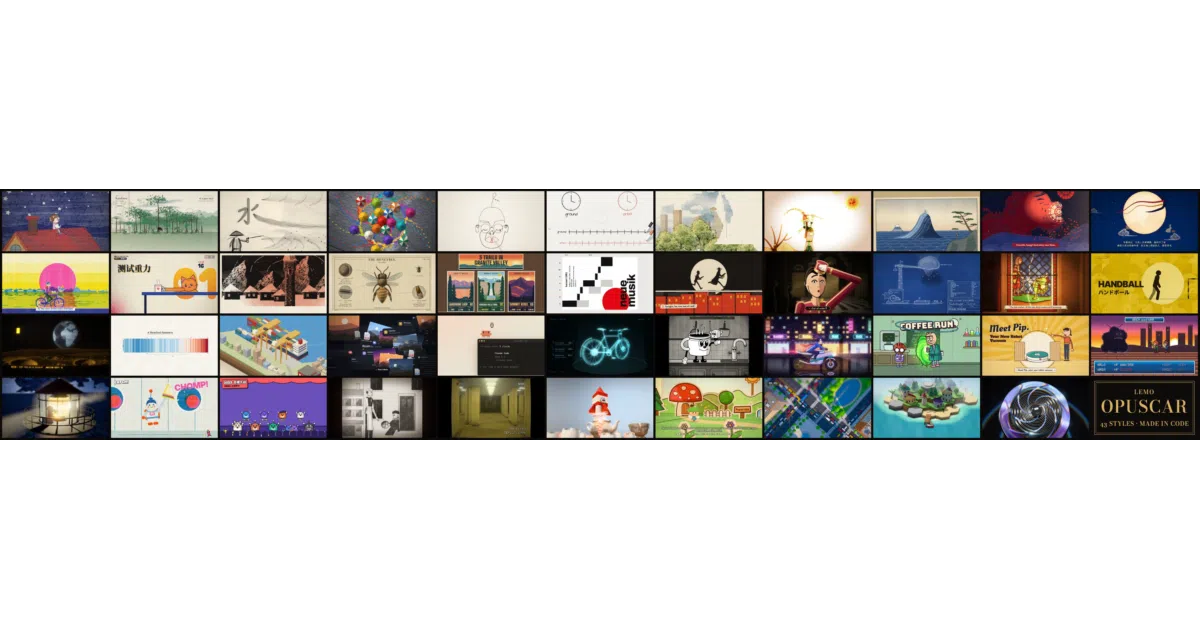
Lemo-Opuscar, published by the developer known as Lemomo, is a library of film styles — the README counts 39, a review site says 43, and the live gallery now headlines 66, so the number drifts depending on when you look, which itself tells you the thing is being actively fed. Each style ships with a short demo film made entirely in code, plus a STYLE.md file describing what the style looks like, what it sounds like, and how the demo was built. You pick a style, bring a story, and let a coding agent direct the film. The agent renders canvas and WebGL pages frame by frame, composes original music from free sample libraries, generates narration with local text-to-speech, and assembles the result with ffmpeg. No video generation model. No stock footage. No cloud render farm.
The contrarian bet
The timing is what makes this interesting rather than merely charming. The AI filmmaking conversation in 2026 is dominated by video generation — Sora, Kling, Veo, Seedance — and by platforms like Higgsfield’s Cinema Studio, which lets you attach up to 50 references per generation, regrade scenes to cinematic eras, and stack camera moves as hashtags, all on top of a claimed 40-million-user community. The adjacent tooling reflects that consensus: the ai-shortfilm-prompts skill, which rode a viral short film to notoriety, is explicitly a prompt factory for those generators — its method anchors output to real film aesthetics by naming actual camera hardware in prompts, but the pixels still come from a diffusion model.
Lemo-Opuscar takes the opposite side of that bet. Its wager is that a sufficiently good coding agent, given the right instructions, can construct film rather than sample it — that a watercolor short about rain crossing Australia, or a shadow-puppet telling of Hou Yi shooting the suns, is better produced as deterministic, inspectable code than as one lucky roll of a generative model. The results are, by the project’s own framing, stylized rather than photoreal. You will not mistake the impasto oil painting demo for footage. But you also will not get a mangled hand, a morphing background, or a five-second clip limit, because none of those failure modes exist in a system where every frame is a function call.
The boring part is the product
Here is the thing most coverage will get wrong about Lemo-Opuscar: the code is not the interesting artifact. The interesting artifact is three Markdown files.
The agent that makes these films reads a DIRECTOR.md guide covering story, sound, rhythm, camera, and performance — including self-checks, which is a quietly professional touch; a director who reviews their own rough cut is rarer than it should be, human or otherwise. It reads a TECHNIQUE.md guide on frame-by-frame rendering, voice, music, and mixing. And it reads the per-style STYLE.md. That’s the whole studio. The rendering stack — headless browser, ffmpeg, sample libraries, a local TTS model — is commodity infrastructure. What Lemomo actually built and published is a corpus of directorial knowledge, encoded in prose, tuned until a specific model reliably turns it into watchable film.
This is the same insight behind the agent-skills movement generally, and the TypingMind listing makes the portability argument plainly: the skill is a Markdown file loaded on demand, consuming tokens only when a request matches, and because it’s plain prose rather than provider-specific code, it works with GPT, Gemini, Grok, DeepSeek, Mistral, Llama, or local models. The bundled resources are read-only and never executed. In an industry currently obsessed with fine-tuning and tool-use protocols, there’s something almost retro about the idea that the transferable unit of capability is a well-written document.
The workflow design also shows unusual restraint. The agent asks you exactly once, up front: the things it can’t decide about your topic, whether you have your own voice or music, and whether you want to see a storyboard first. If you say yes, it stops once to show key shots rendered in the real style before committing to the full render. One interruption, deliberately placed. Anyone who has babysat an agent through a long task will recognize how much discipline that takes.
Not just art styles
The gallery reveals a second identity that the README’s painterly framing undersells. Alongside the watercolor and ukiyo-e, the project site catalogs a whole family of evidence-driven formats: a captioned news short on US bee colonies (1.3 million lost, yet the count up 6%), a split-screen countdown of the final minute of the Artemis II launch expanding from one cell to nine, a Hindenburg investigation aligning newsreel, photos, testimony, and the 1937 inquiry on one timeline, a satellite briefing on the Aral Sea, a LiDAR survey finding 3.4 kilometers of old farm walls under a Connecticut forest, and an archive story where the Wright brothers’ glass negatives show 59 seconds against the telegram’s 57.
These are data-journalism pieces. And for that genre, the code-only approach isn’t a contrarian bet at all — it’s arguably the correct one. A chart that is drawn from the data, where every number on screen is a variable in the source, is more trustworthy than a generated video that merely depicts numbers. Newsrooms already build motion graphics this way with tools like Remotion; Lemo-Opuscar is essentially packaging that discipline as agent-readable style guides. The Medium writeup by a DigiCert field CTO, who built a Claude Code video pipeline with Remotion and ElevenLabs in a single morning — complete with an eight-phase sandboxed package-installation pipeline and a pinned Remotion version to dodge a prototype-pollution vulnerability — shows the same pattern emerging independently: coding agents plus programmatic video is becoming a genre, and Lemo-Opuscar is its most elaborately curated instance.
The catch, and it’s a real one
The project’s own README contains its most honest disclaimer: the styles are tuned for Claude Opus 5.5, and other models may not reproduce them. This is both a strength and a structural fragility. A style guide that reliably produces a coherent 80s cel-anime short from one model is a genuine achievement — it means the prose encodes real, transferable craft. But it also means the corpus is coupled to one vendor’s model, and the review listing repeats the caveat while noting the other costs: each film takes the agent 30 to 60 minutes and a substantial number of tokens, so the “free and open-source” framing is true of the license (MIT for code, CC BY 4.0 for guides and films) but not of the operating cost, which is your Claude plan or API bill. The same listing is blunt that this is style-focused direction, not a full editor — it won’t trim or re-cut your existing footage, and the TypingMind page says so explicitly too.
Adoption, at least by GitHub standards, is real: the TypingMind listing reports 8.3K stars and 927 forks. There’s also third-party coverage in the wild — an overview video with roughly 6,900 views walks through the code-driven-versus-cloud distinction, the storyboard review step, and the canvas/TTS/music/ffmpeg componentry, and a YouTube video titled “This NEW METHOD just solved AI FILMMAKING” appears to cover it, though its page content was inaccessible to this survey, so I can’t verify what it actually claims. Reddit discussions of the project exist but were likewise blocked from retrieval. The verifiable reception is the star count, the forks, and the fact that people are packaging it for non-Claude agents at all.
Where this goes
The open question is whether code-rendered film is a niche or a category. For photorealistic narrative work, video generation will keep winning; a diffusion model does in seconds what frame-by-frame construction does in an hour. But for explainers, data stories, product films, title sequences, and anything where the source of truth is structured data or a design system, the code route has structural advantages: determinism, editability, exact reproducibility, and zero per-render inference cost beyond the agent’s own tokens. The fact that Lemo-Opuscar’s most impressive formats — the Hindenburg timeline, the Artemis countdown, the LiDAR survey — sit squarely in that category suggests the project already knows which side of the line it belongs on.
The second question is model dependence. If the style guides are genuinely good prose, they should degrade gracefully on other models rather than fail; if they’re secretly a stack of Opus-5.5-specific incantations, the whole library is one model deprecation away from becoming an archive. The README’s candor suggests Lemomo knows this. Either way, the project has already made its point: the scarce resource in AI filmmaking isn’t compute, it’s knowing what a director knows. Someone wrote that down, and now an agent can read it.
Sources
- This NEW METHOD just solved AI FILMMAKING [Free & Local!]
- Made an experimental short film entirely from code — Claude ...
- Lemo-Opuscar GitHub Overview
- Which AI Video Generation Model Do I use for a short AI film?
- GitHub - jnMetaCode/ai-shortfilm-prompts: Claude Code ...
- Lemo-Opuscar · 66 film styles for Claude Code, made in ...
- Cinema Studio — AI Filmmaking Workspace
- How I Added AI Video Production to Claude Code in One ...
- Lemo Opuscar by lemomo-ai — AI Skill for Any LLM
- How I Make Realistic AI Short Films Using Seedance 2.5
- Making an AI Short Film With Claude, Seedance, and ...
- Lemo Opuscar: Film Style Prompts for Claude Code