langchain-ai/openwiki · 11 Jul 2026 · Feature
Why LangChain Thinks Your Agent Instructions Should Point, Not Explain

Camille Laurent
Contributing Editor
OpenWiki generates a living wiki for your codebase and teaches your coding agent to look there instead of loading hundreds of pages into a single instruction file.
langchain-ai/openwiki
★17k stars Velocity · 7d +18 ★/day ↘cooling
star history
The CLAUDE.md Bloat Problem
Every useful thing you add to CLAUDE.md makes the file a little less useful. That observation, pinned to the top of a Medium post that landed within hours of OpenWiki’s release, captures the irritant LangChain is trying to scratch. Developers using Claude Code, Cursor, and similar agentic coding tools have taken to dumping architecture notes, API conventions, testing rituals, and edge-case lore into a single markdown file at the root of their repository. The assumption is that the agent will read it before every task and internalize the shape of the codebase. The reality is that the file grows until it becomes a haystack in which the needle—whatever the agent actually needs right now—is lost.
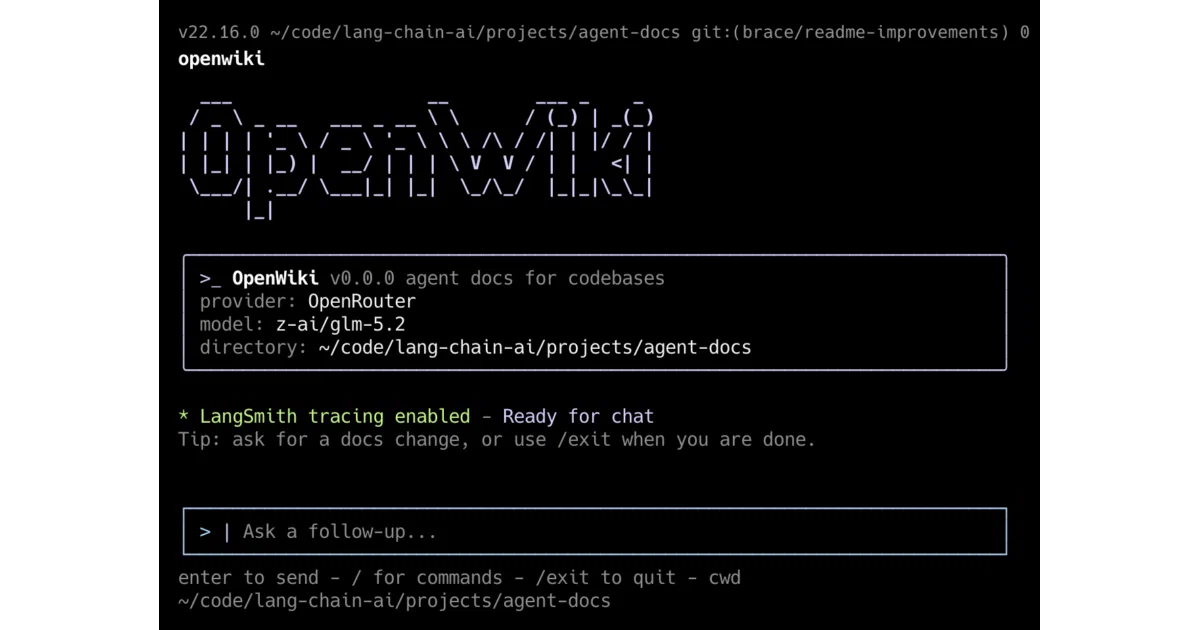
LangChain shipped OpenWiki on July 1, 2026, as an open-source CLI and GitHub Action. The tool does not try to replace the instruction file. Instead, it treats CLAUDE.md or AGENTS.md as a signpost. OpenWiki generates a dedicated wiki directory containing structured documentation about the repository, then appends a brief reference to that wiki inside the agent’s instruction file. The agent still reads the instructions, but the instructions no longer contain the entire repository. They simply tell the agent where to look. The launch post by Brace Sproul frames the problem as a storage mismatch: those instruction files were never meant to hold hundreds of pages of documentation (OpenWiki: Open Source Repo Documentation for Coding Agents).
Pointers, Not Payloads
The architectural bet here is on indirection. As LangChain’s launch post puts it, instruction files “should point the agent toward the right context, then let the agent retrieve what it needs” (OpenWiki: Open Source Repo Documentation for Coding Agents). This sounds obvious, but it runs against the current default behavior of stuffing ever more context into a monolithic prompt. In a large repository, a wiki can span hundreds of files. Loading all of that into every agent run is wasteful even for models with generous context windows, and it risks diluting the signal of the specific module the agent is currently editing.
OpenWiki generates the initial wiki by walking the repository, then shifts into maintenance mode. A scheduled GitHub Action runs the CLI with an update flag, checks which commits have landed since the last pass, reads the git diffs, and refreshes only the relevant wiki pages. The idea is to close the loop between code change and documentation decay without asking a human to manually update a wiki after every pull request. The CLI is built on LangChain’s DeepAgents framework and can trace its reasoning to LangSmith, which lets developers inspect exactly what the agent decided to document and why. The tool supports both interactive and one-shot modes; it can stay open for follow-up messages or fire a single command and exit.
Under the hood, the tool is essentially an orchestration layer. It wraps inference calls—defaulting to OpenRouter with open models, but supporting Anthropic, OpenAI, Fireworks, Baseten, and custom model IDs—and pipes the output into a predictable directory structure. It also handles the busywork of injecting the pointer into AGENTS.md or CLAUDE.md, creating those files if they do not exist. The value is not in any single LLM call; it is in the convention. By establishing a standard location for agent-facing documentation, OpenWiki turns repo context into a retrievable resource rather than a prompt payload.
The Agent-Readability Land Rush
OpenWiki did not emerge in a vacuum. The launch post cites DeepWiki, AutoWiki, and Andrej Karpathy’s “LLM Wiki” concept as prior art (OpenWiki: Open Source Repo Documentation for Coding Agents). All of these projects share the same hunch: agents need durable, structured context about a codebase, and a single flat file is the wrong container. The difference is that OpenWiki is open source, runs locally or inside your own CI, and explicitly targets the AGENTS.md/CLAUDE.md workflow that has become standard in agentic coding.
This fits into a broader restructuring of how documentation is produced and consumed. According to Mintlify’s survey of the landscape, nearly half of traffic to documentation sites now comes from AI agents rather than humans (Best AI Documentation Tools in 2026 - Mintlify). The documentation stack is splitting into human-facing publishing layers and machine-facing retrieval layers. Platforms like Mintlify, GitBook, and Fern now optimize for both audiences, generating llms.txt and skill.md files and exposing MCP servers so that agents can query docs as tools. Mintlify categorizes the current wave into four workflows: publishing for humans and agents, generating drafts from code, adding retrieval over existing content, and answering questions via embedded chat (Best AI Documentation Tools in 2026 - Mintlify). OpenWiki sits primarily in the draft-generation camp, but it bleeds into retrieval by creating a structured target that an agent can query on demand rather than reading front to back. It does not build a website, expose an MCP server, or host a chat interface. It simply writes markdown files that other agents are already trained to read.
That makes OpenWiki closer to a private retrieval layer than a public documentation platform. It competes not with ReadMe or GitBook, but with the ad-hoc convention of pasting directory trees and search results into a chat window. In that sense, it is a bet on hygiene: if agents are going to read documentation anyway, that documentation might as well be current, structured, and stored where the agent can find it without being forced to ingest it all at once.
Day-One Hype and the Glue-Code Reality
For all the conceptual elegance, the execution is still early. One of the first write-ups to greet the release noted that the “day-one hype is running well ahead of the actual repo” (Stop Stuffing Your Repo Into CLAUDE.md. OpenWiki Has a Better Pattern). The GitHub repository is thin. The README is quick-start oriented. The GitHub Action is a cron-scheduled wrapper around a CLI flag. The heavy lifting is delegated to DeepAgents and the user’s chosen LLM provider. In other words, OpenWiki is largely glue code holding together a sensible convention.
That is not a fatal flaw—many useful developer tools are glue code—but it does mean the quality of the output depends almost entirely on the model and the prompt engineering that LangChain has not fully exposed. The tool ships with a handful of pre-defined models but allows custom model IDs for each provider, which means the wiki’s tone, depth, and accuracy are ultimately functions of whichever model you pay for. The sources do not describe how the tool handles large monorepos, whether the generated wiki can be safely hand-edited without being overwritten by the next automated update, or how it avoids hallucinating module relationships. These are the questions that determine whether a scheduled wiki update is helpful noise or a reliable source of truth.
There is also an open question about whether a generated wiki is the right abstraction at all. As agents grow more capable at reading raw source code, navigating ASTs, and querying semantic indexes, a human-readable wiki might become an unnecessary middleman. Why read a summary of the API when the agent can read the API? OpenWiki’s counterargument is that agents, like humans, write better code when they understand intent and architecture, not just syntax. But that claim is still more theoretical than proven at scale.
From Codebases to Context Layers
LangChain is explicit that this first release is “built for codebases first” (OpenWiki: Open Source Repo Documentation for Coding Agents). The longer play is to generalize the pattern. Agents need durable context for many kinds of work—data pipelines, infrastructure configurations, research notebooks—not just software repositories. If the wiki convention sticks, it could become a standard location for agent-readable context across domains.
The unresolved tension is between curation and automation. A wiki that updates itself daily from git diffs is convenient, but it is also a machine-generated artifact that no human may ever read. If the wiki drifts from the mental model of the maintainers, the agent will be consulting a hallucinated consensus. The alternative—keeping agents inside a tight loop of vector search, AST traversal, and explicit human-written architecture decision records—requires more setup but offers more control.
OpenWiki lands squarely on the convenience side of that trade. It is a pragmatic admission that most teams will not manually maintain agent documentation, so the agent might as well maintain it itself. Whether that produces better code or just more confident guesses remains to be seen. The project’s success will likely depend less on its current CLI implementation and more on whether the wiki directory becomes a convention that other tools—editors, review agents, deployment scripts—learn to expect. If that happens, OpenWiki will have succeeded not as a product, but as a pattern. For now, the most valuable thing it offers may not be the wiki itself, but the permission to stop stuffing your repository into a single markdown file.
Sources
- How do I use AI agents to automate document workflows? - YouTube
- Auto Document Your Code: Tools & Best Practices Guide ...
- OpenWiki: Open Source Repo Documentation for Coding Agents
- Best AI Documentation Tools in 2026 - Mintlify
- I built an AI tool that generates documentation for GitHub repos — Codec8
- Introducing OpenWiki, an open source agent for repo documentation
- What's your experience with AI agent documentation writing / review?
- Tool for understanding and generating documentation of a repo
- CLI that writes and maintains agent documentation for your codebase
- 8 Best Workflow Documentation Tools for AI Automation - Tango
- GenAI to generate documentation from Git Repositories
- Stop Stuffing Your Repo Into CLAUDE.md. OpenWiki Has a Better ...