koala73/worldmonitor · 23 Jul 2026 · Feature
An Open-Source Nervous System for a Restless Planet

Lukas Brandt
Staff Writer
World Monitor fuses 500 news feeds, ship trackers, market data, and cyber signals into one AGPL-licensed dashboard. Breadth is its strategy; maintenance is its gamble.
koala73/worldmonitor
★89.5k stars Velocity · 7d +112 ★/day ↗accelerating
star history
The Hype Moment
World Monitor claims more than two million users across over 190 countries and a feature in WIRED [1]. In an era where journalists reportedly predicted the invasion of Ukraine by monitoring TikTok [11], and where nation-state actors increasingly weaponize geopolitical narratives online [11], the appetite for accessible intelligence tools has exploded. The global market for risk and threat intelligence solutions was valued at $13.5 billion in 2023 and is projected to reach $43.3 billion by 2033 [8]; open-source intelligence specifically is forecast to approach nearly $30 billion by 2026 [2]. Against that backdrop, a free, browser-based fusion center with no signup required looks less like a side project and more like a response to structural demand.
The Architecture of Omniscience
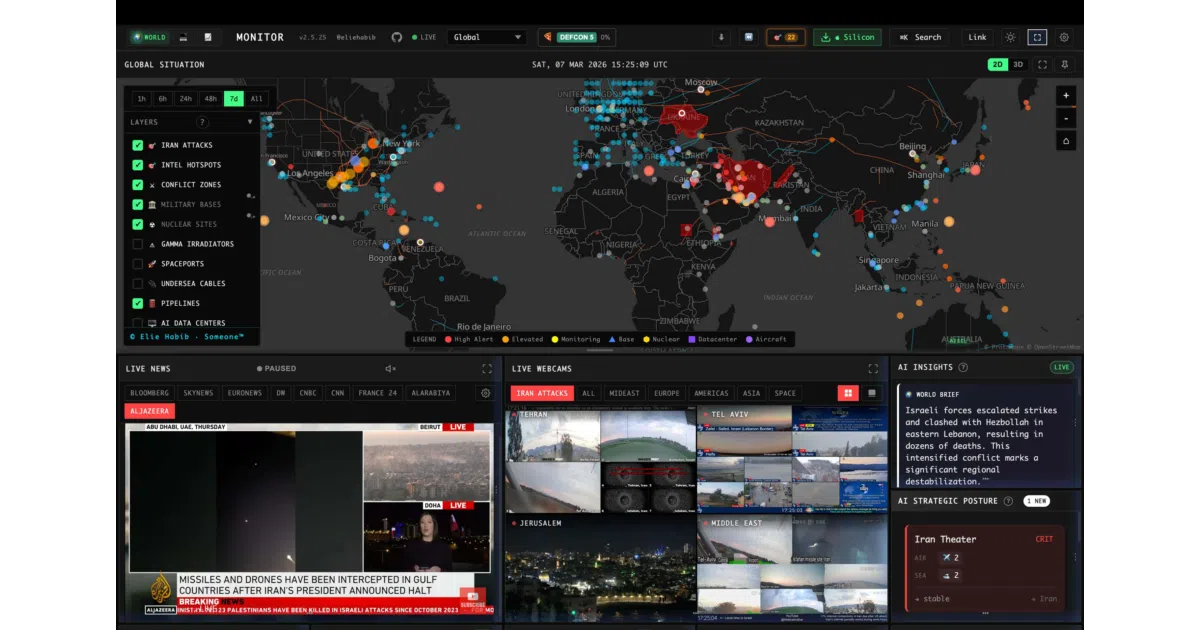
The project is not a newsreader with a map skin. It is an attempt to render the planet’s stress points in real time using 56 live map layers fed by more than 65 external providers [1]. The scope is almost comically broad: ACLED and UCDP conflict events across 29 scored hotspots; AIS vessel tracking through 13 maritime chokepoints including Hormuz, Bab el-Mandeb, Suez, and Malacca; ADS-B flight tracking and in-browser SGP4 satellite-pass calculations for the ISS and Starlink; 88 pipelines and LNG terminals; 313 mapped AI datacenters with power and operator metadata; 86 submarine cables with landing stations; 92 stock exchanges alongside IMF, BIS, and FRED macro data; NASA FIRMS fire detection; USGS earthquakes; and cyber signals ranging from BGP hijacks to ransomware feeds [1].
To display this, the interface runs a dual map engine: a 3D globe built on globe.gl and Three.js for atmospheric and spatial data, and a WebGL flat map using deck.gl and MapLibre GL for maritime and terrestrial routes [1]. The choice is pragmatic. Satellite passes and global flight corridors read naturally on a sphere; shipping lanes and pipeline networks need the measured precision of a flat projection.
All of this ships from a single TypeScript and Vite codebase that compiles to six thematic variants—world, tech, finance, commodity, energy, and, somewhat incongruously, “happy.” The existence of a “happy news” skin on the same engine that tracks ballistic missile alerts and banking risk indices is the ultimate proof that the component architecture is thoroughly decoupled.
Signal Discipline in a Noisy Era
The most intellectually interesting design choice is the alert logic. Breaking alerts trigger only after five independent origin types corroborate an event—news classification, keyword velocity, hotspot escalation, military surges, and official sirens—with deduplication and rate-limiting applied [1]. In an information environment saturated with synthetic media and viral misinformation, this is a deliberately conservative posture. It trades the raw speed of a social feed for the slower certainty of a fusion cell.
The platform synthesizes these signals into a Country Instability Index spanning 12 signal categories, daily AI briefs, a Scenario Engine, and a Route Explorer [1]. The AI layer can run entirely locally via Ollama, requiring no API keys. That is a genuine differentiator in a monitoring landscape where most AI features are SaaS tollbooths. For users who do not wish to ship their geopolitical interests to a cloud provider, local inference turns the dashboard into a private intelligence station.
Integration at Industrial Scale
Beneath the interface, World Monitor is integration engineering at scale. The repository defines 276 Protocol Buffer contracts across 34 services. This is not a hobbyist’s JSON mashup; it is an attempt to build a stable schema for planetary events. The value lies in normalization: ACLED’s conflict taxonomy, AIS maritime identifiers, ADS-B hex codes, IMF macro indicators, and USGS seismic data all speak different dialects. The project translates them into a common schema with inline citations and timestamps [1].
The desktop packaging reinforces this seriousness. A Tauri 2 binary—Rust core, Node.js sidecar—runs on Windows, macOS Apple Silicon, macOS Intel, and Linux AppImage. One binary switches between all six variants in-app. Browser-based OSINT tools often hit CORS and rendering limits when displaying thousands of live entities; a local binary can proxy, cache, and compute more aggressively without browser sandbox restrictions.
The Attack Surface of Transparency
That same desktop architecture has already drawn security scrutiny. Researcher Cody Richard disclosed three findings in 2026 covering IPC command exposure, renderer-to-sidecar trust boundary analysis, and fetch patch credential injection. These are not fatal flaws—they were responsibly disclosed and presumably patched—but they reveal the tension of wrapping a web-based intelligence aggregator in a privileged native shell. When an application ingests ransomware feeds, BGP anomaly data, and military posture signals, then patches global fetch mechanisms inside a Tauri renderer, it creates a high-privilege attack surface. The AGPL-3.0 license mitigates this by permitting inspection, but anyone self-hosting or running the desktop build must accept that they are operating a personal fusion center with all the attendant risks.
Against the Enterprise Stack
World Monitor enters a field crowded with well-funded proprietary platforms. Signal AI aggregates over 30,000 podcasts and broadcast access through TVEyes, offering entity-based sentiment analysis and automated translation across 75 languages [12]. Talkwalker and Maltego provide visual investigation graphs, dark-web monitoring, and predictive narrative clustering [5]. Babel Street and Recorded Future serve government and enterprise clients with deep analytical pipelines [2][8].
World Monitor does not pretend to match their per-feature analytical depth. Instead, it competes on accessibility, scope, and license. It is the Linux to their Solaris: less polished in any single domain, but free, inspectable, and astonishingly broad. The Vuelio blog argues that by 2026 AI media monitoring has become the “operating system” for public relations, using semantic understanding to predict reputational trajectories up to 90 days in advance [9]. World Monitor is not doing long-term prediction; it is doing real-time triage for an audience that cannot afford enterprise threat-intelligence contracts.
The Agent Play
The most forward-looking component is the 39-tool MCP (Model Context Protocol) server, which exposes the platform’s data to AI agents [1]. Rather than trying to out-analyze proprietary platforms, World Monitor appears to be positioning itself as the structured substrate for autonomous systems. In a landscape where Hugging Face hosts over a million public models and open-source AI adoption is accelerating in newsrooms and research organizations [6], being the feed layer that an agent queries for “current Red Sea shipping disruption” or “Starlink pass over Tehran” is a viable long-term bet. The dashboard becomes infrastructure.
The Sustainability Question
The unresolved tension is maintenance. Five hundred curated feeds, 65 external providers, 35 source groups monitored for freshness, and a project led by founder Elie Habib. The open-source model invites community contributions, but the domain expertise required to simultaneously maintain a finance radar tracking 92 exchanges, a military posture tracker, and a cyber-signal pipeline is immense. Breadth is the project’s superpower, yet breadth also creates a maintenance surface that would strain a well-funded startup, let alone a volunteer-driven repo.
World Monitor is either a proof-of-concept that has escaped the lab, or the seed of a new category of open-source critical infrastructure. The next few years will determine whether its architecture can institutionalize its upkeep without collapsing under the weight of the world it tracks.
Sources
- World Monitor
- Top 15 OSINT Tools for Expert Intelligence Gathering
- AI's Role in Smarter News Monitoring, with AskNews CEO Robert Caulk
- World Monitor — Live world map of news, markets, conflicts & incidents
- 13 Best OSINT (Open Source Intelligence) Tools for 2025
- This journalist wants you to try open-source AI: “AI is shiny, but value ...
- World Monitor download
- OSINT and Threat Intelligence Solutions
- Top 10 AI Media Monitoring Tools in 2026 - Vuelio
- I built World Monitor - a dashboard to monitor the situation around the world
- Using OSINT in geopolitical assessment: A practical guide
- AI-Powered Media Monitoring