jamiepine/voicebox · 15 Jul 2026 · Feature
Voicebox Wants to Be the Local Voice Layer for AI Agents

Conor Walsh
Staff Writer
A new open-source desktop app bundles seven TTS engines, Whisper, and a local LLM into a bidirectional voice I/O stack that runs entirely on your hardware.
jamiepine/voicebox
★58.5k stars Velocity · 7d +85 ★/day ↘cooling
star history
A Shipping Product with a Borrowed Name
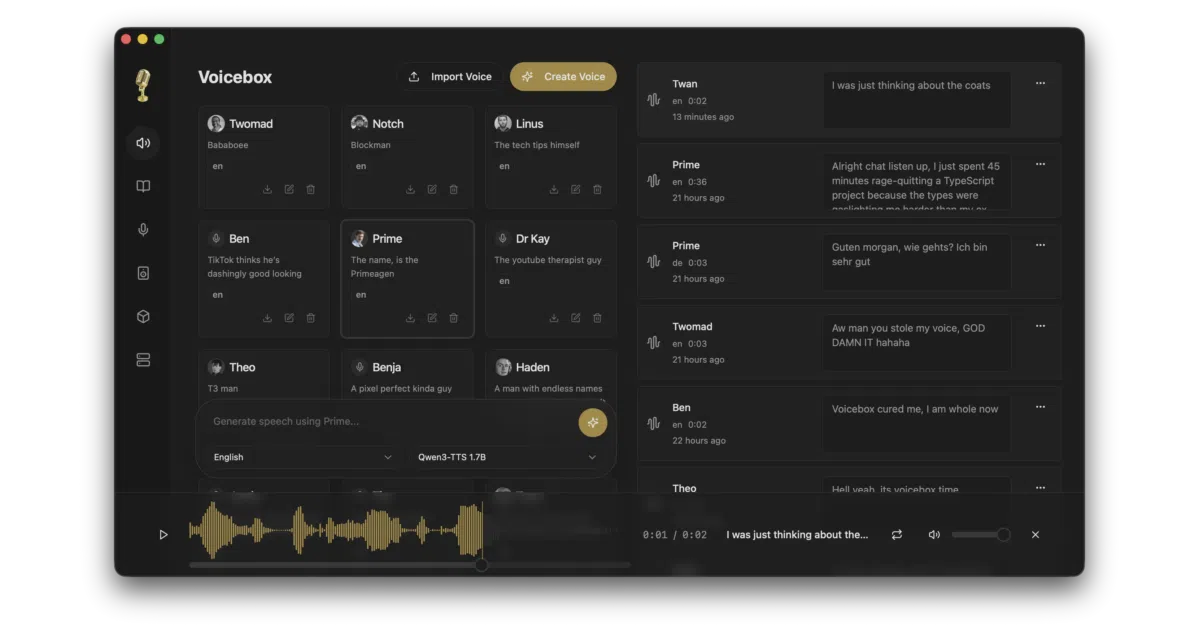
Technically literate readers who follow Meta AI’s research may already know a project called Voicebox: a flow-matching speech generation model trained on 60,000 hours of English audio, capable of zero-shot TTS and noise removal, which Meta explicitly chose not to release publicly [9]. The repository jamiepine/voicebox has no relation to that model. It is, however, a real product you can download today—version 0.2.0, built in Tauri and Rust, shipping DMGs and MSIs for macOS and Windows [3]. Where Meta’s Voicebox is a research paper, this Voicebox is a consumer voice studio that happens to share the name. The collision is unfortunate, but the distinction matters: one is a theoretical architecture, the other is an attempt to package the entire open-source voice pipeline into a single local application.
The Integration Play
Open-source voice cloning has long suffered from fragmentation. A 2026 overview by Resemble AI notes that while tools like Coqui XTTS, OpenVoice, Bark, and VITS variants exist, they typically demand heavy GPU resources, deliver inconsistent speech quality, and lack emotional control or built-in safety guardrails [4]. Voicebox’s response to this chaos is not to invent a new model, but to bundle seven distinct text-to-speech engines under one roof and let the user switch between them per generation [3].
The roster is deliberately heterogeneous. Qwen3-TTS, developed by Alibaba’s Qwen team, offers high-quality multilingual cloning from as little as three seconds of reference audio and reportedly achieves latencies around 97 milliseconds [10]. Chatterbox Turbo, a 350-million-parameter English model from Resemble AI, interprets paralinguistic tags like [laugh] and [sigh] that other engines read literally [3]. LuxTTS targets lightweight deployment at roughly one gigabyte of VRAM with 48 kHz output. HumeAI’s TADA scales to 700-plus seconds of coherent audio. Kokoro provides fifty curated preset voices in an 82-million-parameter footprint [3]. The insight here is that no single open-source engine dominates every dimension—latency, language coverage, expressiveness, and hardware efficiency—so the application becomes a router, not a model.
This is, in essence, a curated distribution of the open-source voice ecosystem. The value lies less in novel research than in curation: resolving dependencies, normalizing APIs, and shipping binaries that run on Apple Silicon via MLX, NVIDIA via CUDA, AMD via ROCm, Intel Arc, and even CPU fallback [3].
Local-First as Architecture
Voicebox positions itself as a free, local alternative to ElevenLabs on the output side and WisprFlow on the input side [3]. The local-first posture is architectural, not merely marketing. Models, voice data, and audio captures never leave the machine; transcription runs via local Whisper instances (Base through Large, plus a Turbo variant), and a bundled Qwen3 LLM handles text refinement and personality rewriting without cloud round-trips [3].
The choice of Tauri over Electron for the desktop shell is telling. Rust handles global hotkey capture, focus introspection, and accessibility-verified paste injection on macOS—operations that require native privileges and atomic clipboard management so your clipboard is not clobbered after dictation [3]. On Apple Silicon, the stack routes through MLX to exploit the Neural Engine; on Windows and Linux it targets CUDA or DirectML [3]. These are product characteristics, not afterthoughts: the application is designed to behave like system software, not a web page in a frame.
The MCP Layer: When Agents Acquire Voices
Where Voicebox departs from being merely a competent voice studio is its MCP server. Model Context Protocol support turns the application into infrastructure for AI agents. Claude Code, Cursor, Cline, and any other MCP-aware client gain four tools: speak, transcribe, list captures, and list profiles [3]. An agent can invoke voicebox.speak with a profile name, and the application surfaces a system-level pill overlay showing which voice is talking and for how long [3].
This matters because it collapses the voice I/O loop into agentic workflows. The same local LLM that cleans up dictation transcripts can rewrite agent output in the persona attached to a voice profile—Compose and Rewrite modes let a cloned voice speak in character [3]. Per-client voice bindings mean you can pin Claude Code to one voice and Cursor to another, using auditory cues to distinguish which agent is interrupting you [3]. The pill overlay is shared between human dictation and agent speech, so the mental model is consistent: the machine is either listening, thinking, or talking, and you see which state it is in regardless of who initiated it.
In a landscape where Google Cloud reports thousands of organizations deploying agentic systems across customer, employee, and creative domains [2], Voicebox is betting that voice will become a standard agent interface rather than a standalone application. The REST API and bundled stdio shim for MCP clients that do not speak HTTP make the stack embeddable in custom harnesses and shell pipelines [3].
The Dictation Loop and the Captures Pipeline
The input half of the loop is global dictation. A configurable chord triggers Whisper-based transcription, with optional local LLM refinement to strip filler words and false starts before pasting into the focused text field on macOS [3]. Every capture—whether from dictation, in-app recording, or upload—lands in a local SQLite-backed log paired with its transcript, replayable, re-transcribable with a different Whisper size, or promotable directly to a voice-cloning sample [3].
This creates a closed pipeline: you speak to the machine, the machine speaks back in a voice you cloned, and every intermediate artifact remains on disk in your data directory. For clinicians, journalists, or developers who currently pay approximately $1.99 per minute for manual transcription services that take days to return [11], the economic argument is obvious, though the quality trade-offs between Whisper sizes and the lack of human review remain.
Where It Fits (and Where It Doesn’t)
Voicebox inherits the limitations of its upstream engines. The Resemble AI assessment notes that open-source voice tools generally lack built-in watermarking, safety classifiers, and enterprise security guarantees [4]. Voicebox does not appear to add these; there is no mention of synthetic audio watermarking in the documentation, and the inclusion of pre-built personas named Jarvis, Morgan Freeman, Samuel L. Jackson, and Bob Ross suggests the project is not prioritizing provenance or impersonation guardrails [3]. That is a rough edge visible in the sources, not a speculative criticism.
The project is also early. Version 0.2.0 lacks pre-built Linux binaries, and the roadmap acknowledges that Windows and Linux auto-paste parity is still pending [3]. GPU acceleration is table stakes for real-time use; while LuxTTS claims 150-times realtime performance on CPU, larger engines like TADA or Qwen3-TTS will expect dedicated VRAM [3].
The Road Ahead
Voicebox’s roadmap looks beyond the current text-pipe architecture toward end-to-end speech models such as Moshi, GLM-4-Voice, and Qwen2.5 Omni—systems that process voice natively without transcribing to text in between [3]. That trajectory aligns with industry benchmarks showing voice AI latency falling below 300 milliseconds, approaching the threshold for natural conversation [5]. The market context is supportive: projections place the global voice-data market above $23 billion by 2030, with 76 percent of companies already embedding conversation intelligence in most customer interactions [11].
For now, Voicebox is a pragmatic integration layer—a way to run the fragmented open-source voice stack on your own hardware and plug it into the emerging agent ecosystem via MCP. It is not a research breakthrough, but it is a usable artifact in a domain where usable artifacts are scarce. Whether it becomes infrastructure or remains a clever bundling exercise depends on whether the project can outrun the cloud incumbents on latency, quality, and convenience before the end-to-end speech models make the current pipeline obsolete.
Sources
- Best Open Source Voice Cloning if you have lots of reference audio?
- Real-world gen AI use cases from the world's leading organizations
- Voicebox - Open Source Voice Cloning Desktop App
- Best Open Source AI Voice Cloning Tools in 2026
- Complete Guide to Voice AI: Use Cases & Major Players
- Home | Voicebox Karaoke in Portland
- Freakishly Good AI Voice Cloning is Now Open & Free...
- 5 Mind-Blowing Use Cases of NEW Google AI Studio
- Home | VoiceBox
- I Found an Open Source Voice Cloning Model That Actually Works
- 10 speech-to-text use cases to inspire your applications
- I Tried the Open Source ElevenLabs Alternative (Voicebox)