harry0703/MoneyPrinterTurbo · 13 Jun 2026 · Feature
The 85,000-Star 'Slop Machine': What MoneyPrinterTurbo Reveals About AI Video's Race to the Bottom

Rajiv Menon
Staff Writer
An open-source Chinese project automates the entire short-form video pipeline—script, stock footage, voiceover, subtitles, music—exposing how generative AI is commoditizing content creation faster than it is improving quality.
harry0703/MoneyPrinterTurbo
★122.9k stars Velocity · 7d +286 ★/day ↘cooling
star history
The Hype Moment: From Meme to Infrastructure
MoneyPrinterTurbo sits at an uncomfortable intersection of internet culture and genuine technical utility. The name itself is a wink at the “money printer go brrr” meme, but the repository’s 85,000 GitHub stars and sustained presence on trending lists suggest something more substantial than a joke. What began as a provocative label for automated content generation has become, for a significant slice of the developer community, a practical tool for producing the flood of short-form video that now saturates TikTok, YouTube Shorts, and Instagram Reels.
The attention spike is not mysterious. Social media posts frame the project in deliberately provocative terms: “A few years ago, making 100 videos required a team. Today it requires a prompt” [11]. Another post describes it as “the internet’s most-loved slop machine” [11]. The irony is thick, but the adoption is real. The project offers what an ecosystem of paid services—Canva’s AI TikTok generator, InVideo AI, Renderforest—charge monthly subscriptions for, and it offers it without the subscription [2][7][10]. For developers in particular, the appeal of owning the pipeline rather than renting it is strong.
What It Actually Does: Plumbing, Not Magic
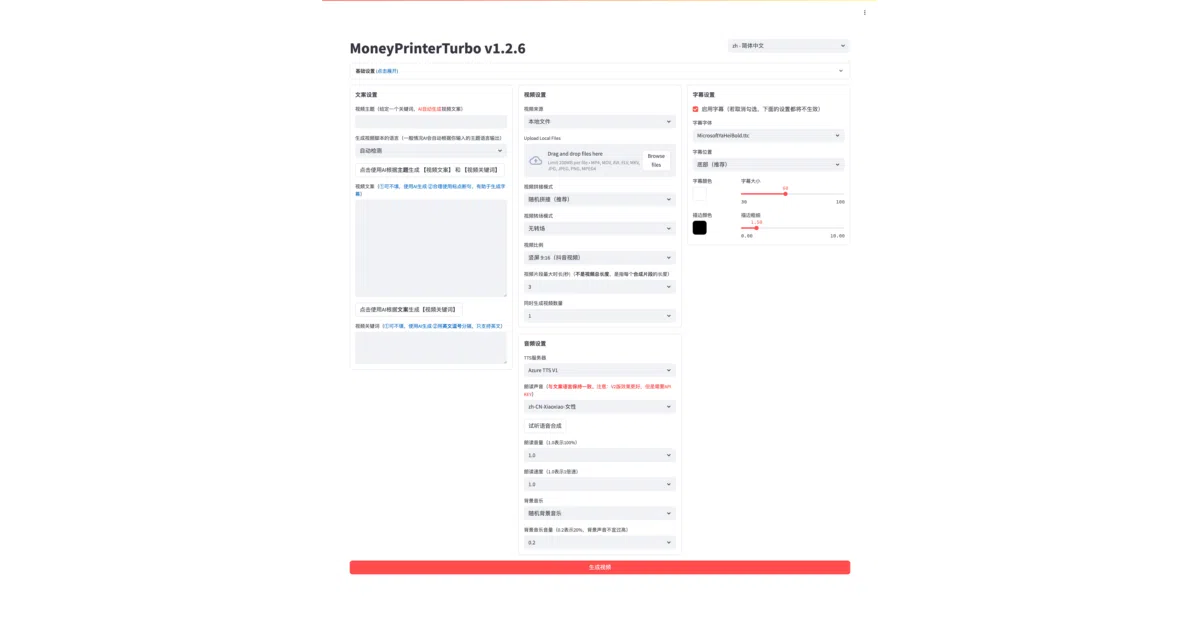
Strip away the branding and MoneyPrinterTurbo is essentially an orchestration layer. A user provides a topic or keyword; the system generates a script via large language model, sources stock video clips (primarily from Pexels, by default), synthesizes voiceover through text-to-speech, generates subtitles with timing, layers background music, and composites the result into a 1080p video in either 9:16 or 16:9 aspect ratio. The README emphasizes that GPU is optional—CPU and RAM are the actual bottlenecks for most workflows, with GPU only becoming relevant if you enable local whisper-based transcription or batch processing [README].
The technical architecture is deliberately conventional: MVC pattern, Python backend, Streamlit web interface, FastAPI for programmatic access, Docker for deployment. The project supports a sprawling list of LLM providers—OpenAI, Claude, Gemini, DeepSeek, Moonshot, Azure, Ollama, and numerous Chinese platforms including Tongyi Qianwen, Wenxin Yiyan, and MiniMax [README]. This provider agnosticism is a genuine design strength. It means the project is not hostage to any single model’s pricing or availability, and users can optimize for cost (gpt4free, Pollinations) or quality (Claude, GPT-4) as their use case demands.
Voice synthesis defaults to Edge TTS, Microsoft’s free service, with an upgrade path to Azure’s paid Speech SDK for more natural voices. Subtitle generation offers two paths: fast alignment using Edge TTS’s timestamp metadata, or slower but more accurate transcription via local faster-whisper models [README]. The project recently migrated from ImageMagick to Pillow for subtitle rendering, eliminating a common deployment headache [README].
None of this is technically novel. What is notable is the integration completeness. The project does not generate video from scratch—there is no diffusion model, no neural rendering. It is, candidly, glue code. But it is glue code that connects the right APIs in the right order to produce a finished artifact that satisfies platform algorithms and, apparently, substantial audiences.
The “Slop” Economy and Its Incentives
The critical term here is “slop,” now widely used to describe AI-generated content of low originality, produced at scale for engagement farming. MoneyPrinterTurbo’s social media reception leans into this openly. One X post notes the “funny” trend of “a healthcare LLM, a WiFi-sensing Rust binary, and the internet’s most-loved slop machine” appearing together on GitHub trending [11]. Another frames it explicitly for side-hustle culture: “想要搞副业的一定要去研究一下 MoneyPrinterTurbo”—“Those who want to start a side hustle must study MoneyPrinterTurbo” [11].
This positioning reveals something important about the current AI video landscape. The project is not competing with Runway’s Gen-4.5 or OpenAI’s Sora on quality [4][9]. It is competing with human patience. The videos it produces—demos include titles like “How to Increase Life’s Fun,” “The Role of Money,” “What Is the Meaning of Life” [README]—are generic by design. They are meant to be consumed in passing, not scrutinized. The stock footage is “HD and copyright-free” [README], which is to say, visually competent and legally safe. The voiceover is intelligible, not emotive. The script is coherent, not insightful.
The commercial ecosystem this sits within is vast and growing. Zapier’s 2026 roundup of AI video tools categorizes seventeen distinct services across generators, editors, and creation suites [9]. Canva, InVideo, Renderforest, Adobe Firefly, and numerous others offer variations on the same promise: reduce video production from hours to minutes [2][7][10][12]. MoneyPrinterTurbo’s distinction is that it is free, self-hosted, and transparent about its limitations. The README notes that Edge TTS subtitle timing “may not be accurate enough for complex sentences” [README]. It warns that whisper model downloads require HuggingFace access, problematic in China, and provides Baidu Pan and Quark Pan alternatives [README]. These are the rough edges of a project that is maintained by actual humans responding to actual constraints.
The China Angle and Platform Realities
The project’s Chinese origin is not incidental. The README is bilingual, with Chinese listed first. The sponsor is AIHubMix, a platform aggregating access to global and Chinese LLMs [README]. The default TTS service, Edge TTS, works without API keys and without crossing China’s internet boundaries. The documentation assumes users may need VPNs configured for “global traffic mode” [README].
This matters because China’s content ecosystem has different structural incentives. Short-video platforms—Douyin, Kuaishou—have enormous user bases and algorithmic distribution that rewards volume. The “passive income” framing of MoneyPrinterTurbo [11] resonates in an environment where platform monetization thresholds are lower and content farming is a documented phenomenon. The project’s availability on Google Colab, with no local installation required, further lowers barriers [README].
There is also a parallel commercial ecosystem. The README thanks “Reccloud” for offering a hosted version based on the project, and notes that deployment remains “somewhat of a threshold” for novice users [README]. This is the classic open-source pattern: the project drives awareness, hosted derivatives capture less-technical users, and the core maintains developer credibility.
Where the Quality Debate Actually Lives
The meaningful comparison is not between MoneyPrinterTurbo and Sora. It is between MoneyPrinterTurbo and the human-equivalent workflow it replaces: a person with a script template, access to stock libraries, basic editing software, and time to burn. For that use case, the project is genuinely competitive. The batch generation feature—“generate multiple videos, then choose the most satisfactory” [README]—acknowledges the probabilistic nature of generative outputs and builds selection into the workflow.
But the gap between this and genuine creative tools is widening, not closing. Runway’s Gen-4.5 offers camera control, motion brushes, and custom model training [4]. Adobe Firefly integrates with professional post-production pipelines and emphasizes commercial safety [12]. Sora, Kling, and Luma Dream Machine generate original footage from prompts rather than assembling stock [4][9]. These are different categories of tool serving different markets.
MoneyPrinterTurbo’s limitation is also its protection. It does not pretend to generate original visuals. It is not subject to the uncanny valley of AI-human faces, the “glitching and moving in this strange, robotic way” that Runway’s output exhibited in testing [4]. Its stock footage is real footage, its limitations are known limitations. In a landscape where generative video quality is improving but remains inconsistent, this predictability has value.
The Unresolved Tension
The project’s trajectory raises questions it does not answer. The star count suggests broad interest, but GitHub stars are not usage metrics. The Reddit discussion of the project was blocked by network security at the time of access, preventing assessment of actual user experiences [3]. The SourceForge mirror exists but its traffic is unknown [8].
More fundamentally, the project embodies a tension in AI tooling: between accessibility and accountability. The easier it becomes to produce content at scale, the harder it becomes to maintain quality signals. Platforms are already saturated with algorithmically optimized video; MoneyPrinterTurbo makes the production side cheaper without addressing the distribution or consumption sides. The “slop machine” nickname is affectionate but not inaccurate.
The technical maintenance burden is also real. The project must track API changes across a dozen LLM providers, manage dependency updates (the MoviePy 2.x migration eliminated ImageMagick but required code changes), and handle platform-specific issues like Windows path handling and file descriptor limits [README]. The maintainer, harry0703, appears responsive—update.bat scripts, detailed troubleshooting, alternative download mirrors—but this is a single point of failure for a project with 85,000 stars.
What It Means for the Landscape
MoneyPrinterTurbo is significant less for what it invents than for what it reveals. The commoditization of short-form video production is essentially complete. The remaining differentiation is in distribution, audience trust, and creative vision—not in the mechanical ability to assemble clips and voiceover. The project’s popularity among developers suggests a professional class that wants to own this pipeline rather than subscribe to it, whether for cost, customization, or principle.
The broader AI video field is bifurcating. At one pole are tools pursuing cinematic quality, narrative coherence, and creative control—Runway, Sora, the emerging Veo and Kling generations [4][9]. At the other pole are tools pursuing friction reduction, volume, and speed—MoneyPrinterTurbo, InVideo, Canva’s Magic Design [2][7]. These are not converging. They serve different user needs and different economic logics.
For technically literate readers, the project’s value is as a case study in integration architecture and as a baseline for what “AI video” meant in 2024-2025: not generation from nothing, but automation of assembly. The next phase—whether generative models replace stock footage entirely, or whether platform algorithms adapt to filter automated content—remains open. MoneyPrinterTurbo will likely persist regardless, a utility in a landscape of ever-more-sophisticated toys.
Sources
- BEST AI Video Generator (Most Realistic) - YouTube
- Free Online AI Tiktok Video Generator - Canva
- I tested the 85k-star "MoneyPrinterTurbo" AI video repo. Here's why ...
- Top 10 Best AI Video Generators of 2026 (Tested & Compared)
- Using AI to make TikTok videos — anyone doing this for passive ...
- Best AI tool for image-to-video generation? : r/generativeAI - Reddit
- Free AI TikTok Video Generator - InVideo AI
- MoneyPrinterTurbo download | SourceForge.net
- The 17 best AI video generators in 2026 - Zapier
- Free Online AI TikTok Video Generator - Renderforest
- harry0703/MoneyPrinterTurbo — GitHub trending stats & insights
- Free AI Video Generator: Text to Video online - Adobe Firefly