gitroomhq/postiz-app · 01 Nov 2026 · Feature
The Social Media Tool That Wants AI Agents as Customers

Megan Russo
Staff Writer
Postiz is an open-source, self-hostable scheduler that has quietly repositioned itself as the publishing layer for AI agents — with humans demoted to reviewers.
gitroomhq/postiz-app
★40.4k stars Velocity · 7d +381 ★/day ↗accelerating
star history
Every category of software eventually gets the same question: what happens when the user stops being a person? Social media scheduling is answering it right now. The incumbents — Buffer, Hootsuite, Sprout Social — were built for a marketing employee staring at a calendar, dragging posts into slots. Postiz, an open-source scheduler out of Gitroom Limited, has spent the past year rebuilding itself around a different assumption: the thing doing the scheduling is increasingly a script, an agent, or a terminal session, and the human’s job is to glance at the queue and approve.
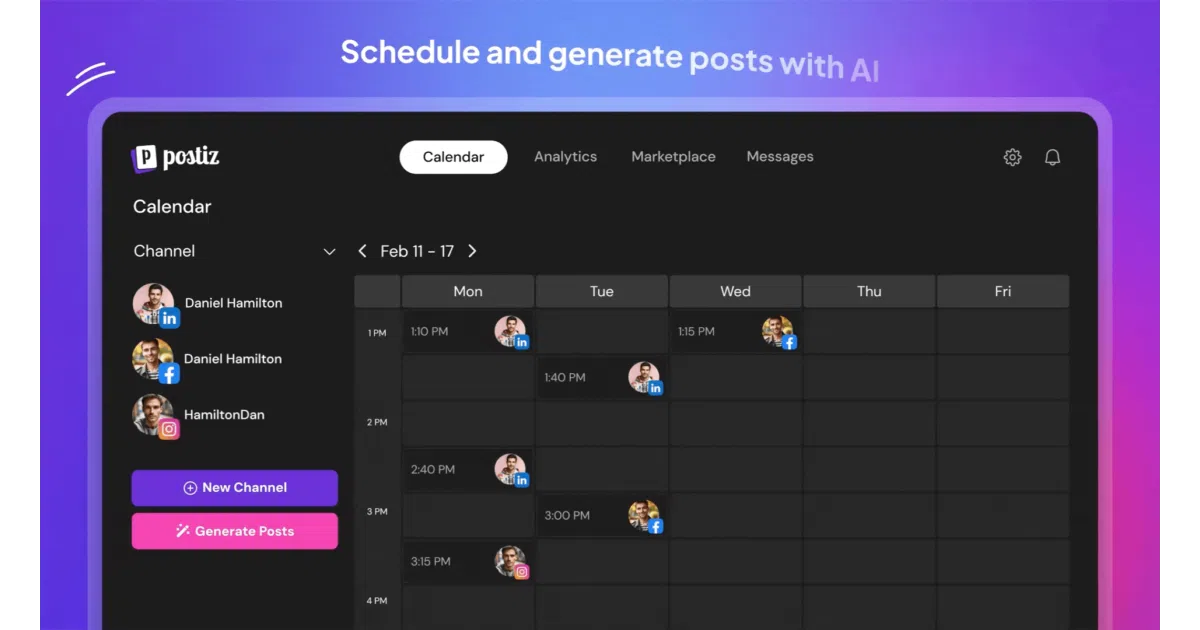
That repositioning — “agentic social media scheduler” is now the product’s own description — is the most interesting thing about an otherwise crowded category. It also explains why a self-hosted tool with a modest mainstream profile keeps showing up wherever people are wiring LLMs into real workflows.
The boring foundation, which is the point
Strip away the AI framing and Postiz is a competent, conventional scheduler. It publishes to more than thirty networks — X, LinkedIn, Instagram, TikTok, YouTube, Facebook, Threads, Pinterest, Reddit, Mastodon, Bluesky, Discord, Slack, Telegram — and wraps that in a calendar, analytics, team collaboration, a built-in image editor, and the usual assortment of evergreen reposts and cross-posting. The README is candid about the ambition: an alternative to Buffer, Hypefury, and Typefully.
The stack is unglamorous in the way that self-hostable infrastructure usually is: a pnpm monorepo, NextJS on the front, NestJS on the back, Prisma over PostgreSQL, and Temporal for the workflow engine that actually fires posts at their scheduled times. Temporal is the telling choice. Scheduling posts is a distributed-systems problem wearing a marketing hat — retries, timeouts, platform API flakiness, and the small horror of a job that must run at 9:00 AM next Tuesday even if the worker restarted Monday night. Using a durable workflow engine for that is the kind of decision you make when you’ve been burned by cron.
The project claims nearly three million Docker pulls and roughly twenty thousand repository views per month — figures it cites in its own sponsorship pitch, so treat them as vendor-reported. But the shape of adoption is visible elsewhere: a SourceForge mirror exists for people who want it outside Docker Hub, and the project has enough traction that Hostinger sells a one-click VPS deployment around it. This is software people are actually running on their own servers, which is more than most AGPL marketing tools can say.
The agentic pivot
Here is where Postiz diverges from every tool in the mainstream roundups. The product page now leads with agent integrations: ChatGPT, Claude via MCP, Claude Code in the terminal, Grok Bot, OpenClaw, Hermes Agent. There’s a CLI, an MCP server, a public REST API, a Node SDK, and native nodes for n8n plus integrations with Make.com and Zapier. The pricing page puts it bluntly — the hosted MCP server, CLI, API, and webhooks ship on every tier, from the $29 Standard plan to the $99 Ultimate plan, with no separate “agent” surcharge. The agents are the customers; the humans pay the invoice.
This is a genuinely coherent bet. The Zapier roundup of the best management tools of 2026 — nearly eighty apps tested — doesn’t mention Postiz at all, and neither do the Planable or TechnologyAdvice lists. In the world of marketing-team buyers, Postiz is invisible. But in the world where someone has an LLM pipeline that turns one video into platform-specific posts and needs something to actually publish them, Postiz is one of the few schedulers that speaks the native protocols. A testimonial on the product page describes exactly this: a user built an agent pipeline with Vercel’s “eve” that adapts content per platform and found Postiz made the integration easy where competitors didn’t.
The mobile app makes the philosophy explicit. The Google Play listing describes the app as a “command center for reviewing and approving what the agents produce” — per-channel editing, one-tap rescheduling, error detection before publishing, instant sync with what agents did via the web or CLI. The human is positioned as the last checkpoint in an otherwise automated pipeline. Whether that’s liberating or slightly dystopian depends on how much you enjoy approving your robot’s LinkedIn posts.
Compliance as a moat
The least glamorous section of the README may be the most strategically important. Postiz’s compliance statement is a list of things it refuses to do: it doesn’t automate or scrape platform content, doesn’t collect or proxy user API keys, and never asks users to paste credentials into the hosted product. Authentication goes through official, platform-approved OAuth flows, directly with each social network.
This matters because the ground under this category has shifted. The Zapier piece notes that before Elon Musk’s acquisition, Twitter had one of the most permissive APIs in the industry, which scheduling tools leaned on for monitoring and listening — features that can now cost thousands of dollars per month, confined to the most expensive tiers of tools like Sprout Social. Every social media management app, as that article puts it, is limited by what the networks expose via their APIs, and those surfaces have been shrinking and repricing for years. A tool that keeps its hands clean of key-scraping and unofficial automation is building to survive that environment, not just to pass a platform review today.
The open-source competition
Postiz is not alone in the self-hosted lane. Mixpost, a Laravel-based alternative, claims over a thousand businesses across forty countries, supports twelve platforms, and sells the same virtues: data ownership, no per-user fees, no vendor lock-in, Docker deployment on any VPS. Mixpost’s pitch is essentially the pre-agentic version of Postiz’s — control, privacy, cost — and it’s a solid pitch. Agencies that want approval workflows and a unified inbox without AI anything have a legitimate reason to pick it.
Postiz’s differentiation is the agent surface and the hosted/self-hosted parity claim. The README states there is currently no difference between the hosted version and the self-hosted one — meaning the self-hoster gets the same features, not a crippled community edition. That’s rarer than it should be in open-core products, and it’s the kind of promise worth watching, because it’s also the kind that erodes when a company needs hosted-only revenue. The AGPL-3.0 license does some work here: it makes a proprietary fork of the codebase legally awkward, which protects the project’s position even as it scares away some commercial users who misunderstand what AGPL requires of them.
The numbers nobody can check
The product page’s testimonials claim 2x–3x engagement boosts, 3x–4x traffic increases, follower growth of 10–50%, and $2,000–$3,000 saved monthly. These are marketing claims in the classic sense: unverifiable, unfalsifiable, and doing the work that a case study would do if anyone had written one. There is no independent review of Postiz in any of the three mainstream 2026 roundups consulted here, which cuts both ways — the roundups are aimed at marketing teams, not agent builders, but it also means nobody has put the tool through the kind of structured testing Planable applied to fourteen schedulers, where the interesting failures live. Planable’s testing found that almost every scheduler handles the first ten posts well and falls apart later — calendars slowing past a hundred posts a month, connections dropping before launches. Whether Postiz survives that kind of volume testing is, on the available evidence, simply unknown.
The Reddit threads in r/selfhosted — one from the project’s early rise, one announcing v2.11.3 — would be the natural place to find self-hoster complaints about upgrade pain, database migrations, or platform connection bugs. Both were inaccessible behind Reddit’s network security wall at the time of writing, so the community’s actual gripes remain unverified. What’s clear is that the self-hosting community has been paying attention since at least late 2024, which is roughly when the project’s star history curve takes off.
Where this goes
The open questions are the obvious ones. Can the hosted/self-hosted parity promise survive the company’s need to monetize? The pricing already shows the squeeze points — AI image and video generation quotas scale by tier, from a hundred images a month on Team to five hundred on Ultimate, and AI video minutes from three to sixty. The agent plumbing is free on every plan, but the generative features are metered, and metered features have a way of becoming the product.
The deeper question is whether “agentic scheduler” is a category or a feature. If Buffer ships an MCP server next quarter — and every SaaS vendor is shipping MCP servers this year — Postiz’s clearest differentiator compresses to its license and its self-hostability. Those are real advantages, durable ones for a certain audience, but they’re advantages Mixpost already competes on. What Postiz has that Mixpost doesn’t is the bet that the future of social media management looks less like a calendar and more like a review queue: agents drafting, agents scheduling, humans tapping approve from a phone.
For now, the bet looks reasonable. The same Zapier article that ignores Postiz also documents why the category is in flux — X’s API repricing, TikTok’s uncertain status, Threads’ emergence, LinkedIn’s resurgence. A scheduler that treats platforms as interchangeable endpoints behind a stable API, that lets automation tooling do the composing, and that a developer can run on their own VPS is well-shaped for a landscape where the platforms keep changing the rules. Postiz isn’t the best social media tool in any roundup. It’s something the roundups don’t have a column for yet.
Sources
- The 10 best social media management tools in 2026
- Postiz: The Agentic Social Media Scheduling Platform
- Postiz - open-source social media scheduling tool
- 14 best social media scheduling tools for 2026 (tested)
- Postiz v2.11.3 - open source social media scheduling tool! ...
- Mixpost: Open Source, Self-Hosted Social Media Management
- 8 Best Social Media Schedulers I've Tested for 2026
- Postiz Pricing : Agentic Scheduling from $29/month
- Best Social Media Scheduling Tools to Plan and Publish ...
- Postiz download
- Social Media Scheduling for Growing Teams | 2026 Guide
- Postiz: Agentic Scheduler - Apps on Google Play