freestylefly/awesome-gpt-image-2 · 29 Aug 2026 · Feature
Inside the GitHub Repo Turning Image Prompts Into Infrastructure

Grace Sullivan
Staff Writer
While the internet hoards GPT-Image-2 prompts like trading cards, one project treats them as composable code for agents and automation.
freestylefly/awesome-gpt-image-2
★35k stars Velocity · 7d +47 ★/day ↘cooling
star history
The release of OpenAI’s GPT-Image-2 model triggered a predictable gold rush. Within weeks, the web filled with galleries, prompt marketplaces, and curated lists competing to catalog the best incantations. YouMind alone hosts over sixteen thousand prompts across categories like avatar generation, infographic design, and app mockups [6]. Another popular repository, maintained by ZeroLu, has accumulated roughly 2,100 stars by collecting high-fidelity examples from X and the broader community, claiming the model delivers photorealistic output capable of resembling authentic photographs or screenshots [12]. Into this crowded landscape steps freestylefly’s project, a repository that acknowledges the same creative potential but proposes a different thesis. It argues that the value is no longer in simply having prompts, but in making them structured, reusable, and machine-readable.
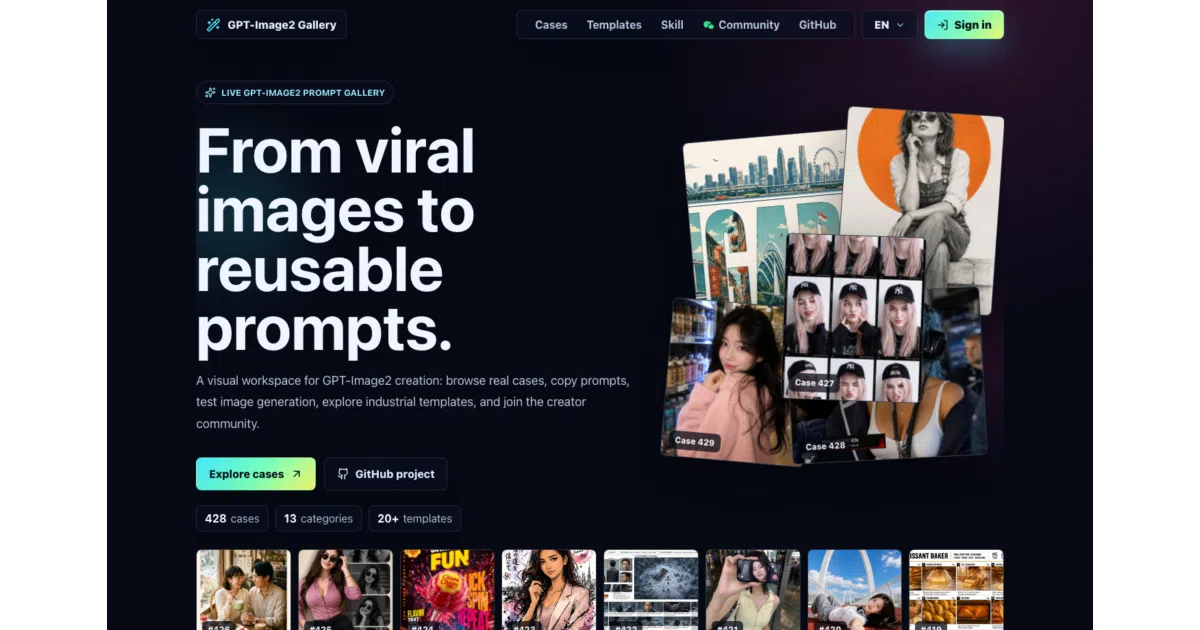
The repository’s central conceit is “Prompt as Code.” Rather than treating each prompt as a bespoke piece of prose, the project compresses scattered community examples into atomic schemas—splitting subjects, lighting, materials, layout, and visual details into composable parts. The stated goal is to move image generation from the novelty question—“can it make an image?”—to the production question: “can it make stable, controllable, reusable images?” This is a subtle but important distinction. A prose prompt is a one-off creative act; a template is a function with variables. By treating lighting, camera angle, and material as typed parameters rather than free-form description, the project makes prompts versionable, diffable, and composable—properties that matter enormously when an agent needs to generate thousands of product shots with consistent branding but varying backgrounds.
This shift mirrors a broader evolution in the field. Early prompt engineering relied on what OpenAI CEO Sam Altman once dismissed as “magic words,” manipulative phrases that might not survive model improvements [5]. The freestylefly project bets that the future belongs not to linguistic tricks, but to structured protocols that communicate intent clearly enough for agents and automation pipelines to consume. That bet is visible in the project’s taxonomy. The repository organizes 488 reverse-engineered cases into twelve industrial categories, from UI and interface design to classical Chinese scroll aesthetics. Each category feeds into more than twenty prompt templates designed for batch generation and template systems.
The templates emphasize control over layout, copy, and information hierarchy—capabilities that matter precisely because GPT-Image-2 itself has grown more precise. Adobe’s integration of the model into Firefly highlights its capacity for targeted edits, scene consistency across iterations, and legible in-image text for infographics and labels [10]. Kie.ai, an API aggregation platform, notes the model’s support for resolutions up to 4K and image-to-image generation with up to sixteen reference files [7]. These features reward structured prompting; a model that can follow precise instructions is wasted on vague prose.
What distinguishes this repository from larger prompt catalogs is not the volume of examples but the infrastructure wrapped around them. While YouMind-OpenLab’s rival project scales through a headless CMS and auto-generates sixteen localized README files twice daily [3], freestylefly has built a full-stack product layer. A companion website offers gallery browsing, prompt copying, and direct generation behind Google authentication. The backend runs on Supabase with credit-based billing, Stripe subscriptions, and a Vercel function proxying requests to the GPT-Image-2 API. The project even packages its taxonomy as an npm agent skill installable into Claude Code, Codex, and Cursor workflows. This turns a static list into a SaaS-adjacent ecosystem, complete with sponsor slots for API aggregators like Ciyuan API and PPToken.
The agent skill is perhaps the most telling signal of where prompt engineering is heading. Distributed via npm and GitHub Packages, the skill exposes the same style library used by the website, allowing an agent to select templates, categories, and scene tags programmatically. In other words, the project is not just documenting what humans typed into ChatGPT; it is building the middleware for machines to generate prompts on behalf of humans. This aligns with the observation that lighting and composition descriptors can improve output satisfaction significantly—one analysis claims by 50 to 70 percent—while structured negative prompts help eliminate common failure modes like distorted faces or blurry details [11]. By codifying these patterns into an agent-accessible library, the repository attempts to make prompt engineering reproducible at scale.
The emphasis on industrial categories is not accidental. UI mockups, technical infographics, and product photography are among the hardest tasks for generative image models because they demand geometric precision, readable typography, and coherent information hierarchy. The repository dedicates seventy-three cases to UI and interfaces, fifty-one to charts and infographics, and thirty-eight to product and e-commerce shots. These are not artistic experiments; they are commercial use cases where a misplaced shadow or garbled text string ruins the output. By reverse-engineering successful examples into structured templates, the project offers a control layer that raw prompt prose cannot easily provide.
Yet the project sits in an awkward transitional space. It openly acknowledges that its cases are reverse-engineered from public community sources, including YouMind and OpenNana, and it disclaims ownership of third-party content. That honesty exposes a vulnerability: prompt libraries are inherently transient assets. As GPT-Image-2 and its successors improve at inferring intent from natural language, the need for rigid template scaffolding may shrink. Altman’s prediction that manipulative prompt engineering will likely fade within five years hangs over the entire category [5]. If models soon understand a request for a Japanese team-member infographic with chibi avatars and radar charts without requiring an eight-layer structured prompt [9], then the industrial templates become training wheels rather than permanent infrastructure.
There is also the question of whether this is open-source community work or a commercial on-ramp. The repository’s MIT license and GitHub Sponsors page suggest the former, but the website’s Stripe integration, credit packs priced at five dollars per three hundred credits, and admin dashboard metrics tell a more complex story. The project is sponsored by API relay services that sell access to GPT-Image-2 and other models, positioning the repository as both a creative resource and a customer acquisition funnel for low-latency API providers. In this light, the “Prompt as Code” vision doubles as a clever lock-in mechanism: the more developers build workflows around these atomic schemas, the more likely they are to consume API credits through the project’s preferred aggregation channels.
Still, the underlying insight is sound. The freestylefly project recognizes that generative AI is shifting from artisanal vibe-coding to production pipelines. Whether the specific 488 cases retain their value matters less than the schema they demonstrate: atomic, composable, agent-ready prompt protocols. In a landscape where anyone can generate a pretty picture, controlling layout, typography, and information hierarchy at scale is the harder problem. The unresolved tension, of course, is whether OpenAI will eventually subsume this layer. If the model learns to infer layout grids and brand guidelines from a few examples, the middleware becomes unnecessary. Until then, projects like this serve as a bridge between the chaotic creativity of early generative AI and the boring, valuable discipline of production systems.
Sources
- GPT-Image-2 Model | OpenAI API
- Prompt Engineering Templates and Examples
- World's largest GPT Image 2 prompt library, updated daily — 2000+ ...
- What is GPT Image 2? OpenAI's newest image model
- Prompt Engineering: From Words to Art and Copy
- 16000+ Free GPT Image 2 Prompts 2026 - YouMind
- Affordable GPT Image 2 API for High-Precision ...
- AI-powered infographic creation with prompt engineering ...
- GPT Image 2 Prompts | AI Image Examples & Templates 2026
- GPT Image generator, now in Firefly.
- Prompt Engineering for AI Images — Tips & Templates
- Awesome GPT Image 2 - GitHub