farion1231/cc-switch · 16 Jun 2026 · Feature
The Switchboard Catching the AI CLI Deluge

Tyler Brennan
Staff Writer
CC Switch turns the chaos of managing Claude Code, Codex, and a half-dozen other terminal agents into a single, switchable control plane.
farion1231/cc-switch
★132.9k stars Velocity · 7d +213 ★/day ↗accelerating
star history
The Terminal Agent Explosion
By 2025, the autocomplete box had escaped the IDE. AI coding assistants migrated into the terminal as autonomous agents—Claude Code, OpenAI Codex, Gemini CLI, OpenCode, and others—capable of refactoring entire codebases from a single prompt. The 2024 Stack Overflow Developer Survey found that 76 percent of respondents already used or planned to use AI tools, and a wave of terminal-native agents soon followed [1]. Unlike IDE plugins that whisper suggestions as you type, these tools operate at the repository level: they plan changes, edit multiple files, run tests, and commit diffs [11]. Claude Code, in particular, is designed for discrete stages of development—scoping changes, validating diffs before committing—supporting a controlled, Git-native workflow rather than continuous in-editor assistance [11]. Meanwhile, open-source alternatives like OpenCode have accumulated significant community interest, reflecting a developer appetite for modular, provider-agnostic tooling [8].
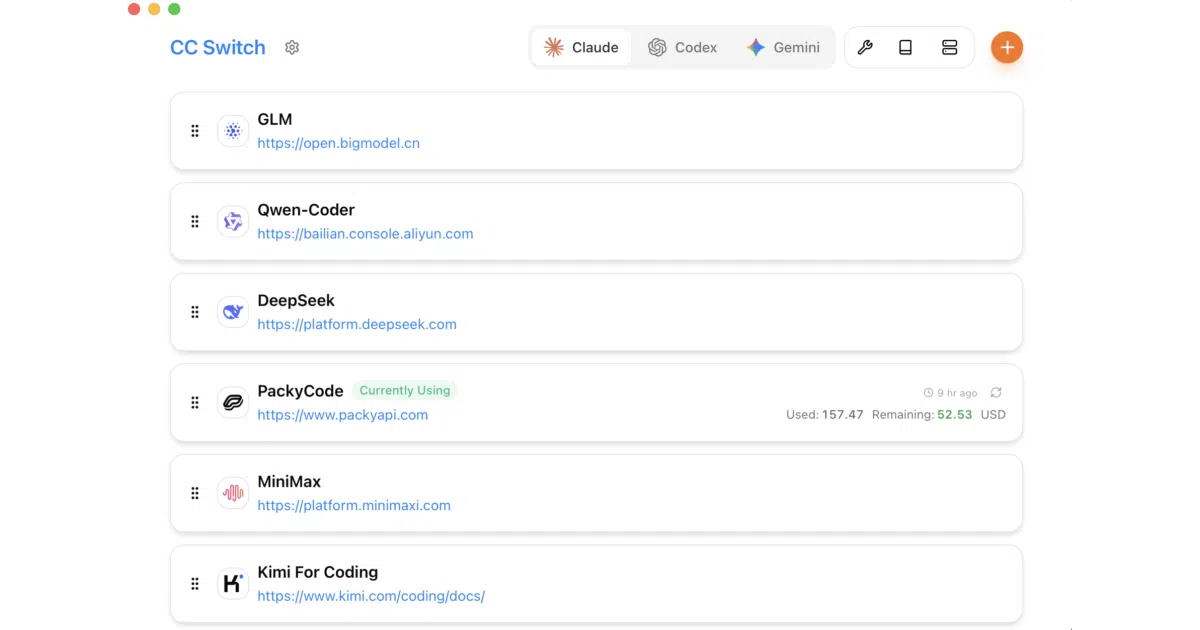
The trouble is that every vendor brought its own configuration religion. Anthropic prefers JSON and OAuth sessions. Google’s Gemini CLI has its own format. OpenCode and OpenClaw expect environment variables or TOML fragments. If you want to switch from an official Anthropic endpoint to a third-party relay, or from Claude to a self-hosted model, you must manually edit scattered files and pray you do not leave a trailing comma behind. There was no common layer to manage identities, model presets, or MCP servers across tools. The terminal became formidable, but also fragmented.
A Control Plane, Not a Client
CC Switch is not another AI coding client. It is a Tauri 2 desktop application—Rust on the backend, React and TypeScript on the frontend—that acts as a control plane for the tools you already use. Its job is to own the state that the vendors refuse to share: API keys, base URLs, provider presets, and middleware configurations. All of that state lives in a local SQLite database that serves as the single source of truth, with atomic writes using a temp-file-plus-rename pattern and mutex-protected connections to prevent race conditions. A separate JSON layer handles device-level UI preferences, keeping syncable data and local chrome cleanly separated.
The architectural insight is deeper than a pretty GUI for editing JSON. CC Switch exposes a fixed local endpoint at http://127.0.0.1:15721 and functions as a centralized routing layer [12]. Instead of pointing Claude Code or Codex directly at a vendor URL, you point them at your own loopback address. CC Switch then proxies the traffic, performing format conversion on the fly—translating Anthropic Messages requests into OpenAI Completions format when necessary, or routing to SiliconFlow’s unified endpoint so that a single API key can simultaneously service both protocols [9]. This turns the app into a lightweight reverse proxy and protocol adapter that lives on your machine, not in the cloud.
That local proxy mode also enables app-level failover. The tool can monitor provider health, apply circuit-breaker logic, and smooth requests across multiple backends without the underlying CLI knowing anything changed. For developers juggling official keys, AWS Bedrock credentials, NVIDIA NIM endpoints, and community relay services, this indirection is the difference between a twenty-second config swap and a twenty-minute debugging session.
The Marketplace on Its Back
Scroll through the project’s documentation and you will notice something unusual: the sponsor section is less a list of donors and more a bazaar of API relay services. PackyCode, AIGoCode, AICodeMirror, Crazyrouter, DMXAPI, and a dozen others occupy prime real estate, each offering CC Switch users a discount code for discounted tokens. The density of resellers is almost comical, but it is also revealing. The boom in terminal AI agents has spawned a shadow economy of API gateways, and CC Switch has become the dashboard those gateways want to inhabit. The project is arguably as much a distribution channel for third-party API providers as it is a developer utility—a sign of how aggressively the infrastructure layer beneath the models is commoditizing.
Unifying What Vendors Keep Apart
Where CC Switch moves beyond mere routing is in cross-tool state management. The application offers a unified MCP (Model Context Protocol) panel that can add, remove, or toggle servers across Claude Code, Codex, Gemini, OpenCode, and Hermes with bidirectional sync. If you add a filesystem MCP server in CC Switch, it can write the appropriate configuration to each tool’s live files and backfill changes when you edit an active provider. The same principle applies to prompts: a Markdown editor inside the app can sync a system prompt to CLAUDE.md, AGENTS.md, and GEMINI.md simultaneously, with backfill protection to prevent accidental overwrites.
Skills—reusable agent capabilities hosted in GitHub repositories—can be browsed and installed with one click, then symlinked or copied into the correct directories for each supported CLI. Session histories can be searched across tools. Usage and cost tracking supports custom per-model pricing, so developers who route through resellers with volatile rates can still monitor spend. A Deep Link scheme (ccswitch://) allows importing providers, MCP servers, prompts, and skills via URL, which means teams can distribute a standardized environment with a single link. Even the visual theme is pragmatic: dark, light, or system, with a system-tray menu that lets you switch providers without opening the full window.
Cloud sync via Dropbox, OneDrive, iCloud, or a generic WebDAV server means the same provider list and MCP configuration can follow a developer across multiple machines. For teams that standardize on specific relays or internal gateways, this turns a personal convenience into a shared operating procedure.
The Hard Limits of Glue
For all its polish, CC Switch remains glue code, and it is honest about the seams. Most of the supported tools require a terminal restart after switching providers; only Claude Code currently supports hot-switching without one. The app follows a “minimal intrusion” design principle—uninstall it, and the underlying CLIs continue to work with their last-known configuration—but that same principle means it cannot deeply integrate with closed-source agent loops. If Anthropic changes Claude Code’s config schema or OpenAI alters Codex’s authentication flow, CC Switch must chase the change.
The project also cannot fully abstract away vendor lock-in. Claude Code, for instance, is a managed, opinionated system with a closed-source agent loop and first-class support limited to Anthropic’s own model family [8]. CC Switch can swap the API endpoint underneath, but it cannot open the black box of planning and execution ordering. It is a multi-tool manager, not a multi-model engine. Even the shared config snippet feature, which extracts common plugin data before a switch to prevent configuration loss, is a workaround for the fact that each tool stores its state differently.
Outlook
The AI coding assistant landscape is splitting into two camps: closed, managed experiences optimized for a single vendor’s models, and open, modular stacks that let developers bring their own keys and models [8][11]. CC Switch is built for the second camp. It assumes that developers will multi-home—using Claude Code for one project, Codex for another, and OpenCode for a third—and that they would rather not memorize seven different configuration formats to do so.
The risk is that every major vendor eventually builds its own provider-switching UI, or that the open tools consolidate around a common standard, rendering a third-party switchboard redundant. The counterargument is that the number of models, relays, and agent frameworks is growing faster than the standards are converging. With more than fifty built-in provider presets and a local proxy that adapts protocols on the fly, CC Switch has positioned itself as the neutral ground in a turf war. Whether it remains essential infrastructure or becomes a transitional artifact of the pre-standardization era depends on whether the terminal agents it serves keep multiplying—or finally start cooperating.
Sources
- The Best AI Coding Assistants: A Full Comparison of 17 Tools
- 10 Leading Alternatives to Claude Code for Enterprise Development ...
- cc-switch download | SourceForge.net
- 8 best AI coding tools for developers: tested & compared! - n8n Blog
- Alternatives for Claude code, codex that I can use from my terminal ...
- CC Switch hits 67.2K stars as a unified manager for AI coding CLIs
- 9 Best AI Coding Agent Desktop Apps in 2026 (Ranked by Real ...
- OpenCode: The Best Claude Code Alternative - Tensorlake
- CC Switch - SiliconFlow
- We Tier Ranked Every AI Coding Assistant - YouTube
- 10 Claude Code Alternatives for AI-Powered Coding in 2026
- CC-Switch: One Address to Rule All AI Providers | by Chimin - Medium