debpalash/VoiceStudio · 06 Sep 2026 · Feature
VoiceStudio Wants to Unbundle ElevenLabs onto Your Desktop

Tomás Almeida
Editor
A desktop integration layer wraps open-source speech models in a local, 646-language package—no API keys, no cloud, and no guarantee it will stay in beta forever.
debpalash/VoiceStudio
★87k stars Velocity · 7d +1647 ★/day ↘cooling
star history
The Hype Wave and the Local-First Promise
VoiceStudio—formerly OmniVoice Studio—arrived with the kind of marketing that makes algorithmic feeds take notice. Social posts frame it as the moment open-source voice AI finally escaped the cloud. LinkedIn users call it “owned infrastructure, not rented SaaS.” YouTube reviewers describe a “breakthrough” that runs entirely on a laptop. The project claims over 221,000 release downloads, nearly 59,000 Docker pulls, and a Trendshift “Repository of the Day” badge. In a voice-cloning market projected to reach $25.6 billion by 2033, the timing is impeccable.
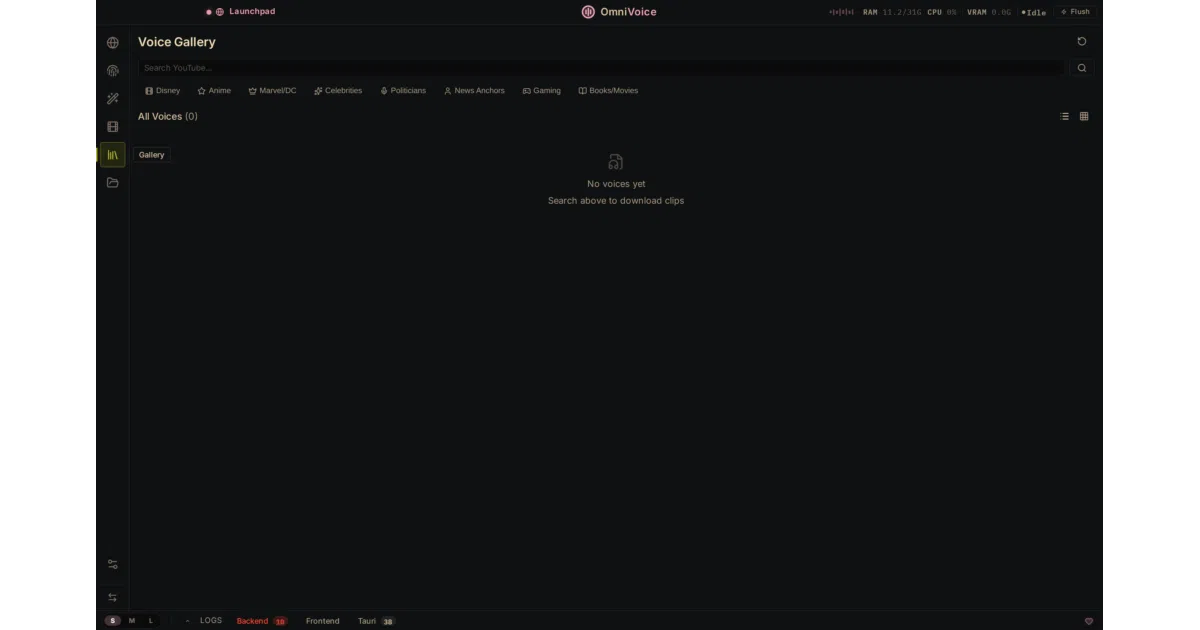
The pitch is seductive: zero-shot voice cloning from a three-second clip, video dubbing, real-time dictation, and speaker diarization, all inside a cross-platform desktop application. No API keys. No usage counters. No audio leaving the machine. The project claims support for 646 languages, a figure that dwarfs the offerings of most commercial competitors.
But beneath the glossy screenshots and the ElevenLabs comparison table lies a more complicated truth. VoiceStudio is not a single foundational model. It is a desktop orchestration layer—an ambitious piece of integration glue that packages existing open-source engines behind a React frontend and a FastAPI backend.
What It Actually Is
The application architecture is straightforward: a Tauri-based desktop shell hosts a React frontend that talks to a local FastAPI server over 97 endpoints, using SQLite for state and Server-Sent Events for streaming updates. The real work is delegated to a roster of specialized open-source projects. Speech-to-text defaults to WhisperX, with fallback options including Faster-Whisper, MLX-Whisper on Apple Silicon, and FunASR for multilingual scenarios with built-in voice-activity detection. Text-to-speech relies primarily on the k2-fsa OmniVoice diffusion model, but the backend registry also accepts CosyVoice 3, VoxCPM2, and a suite of Apple-optimized MLX-Audio engines. For post-processing, Meta’s Demucs handles source separation, Pyannote handles speaker diarization, and Meta’s AudioSeal provides invisible watermarking.
This is, in essence, a local alternative to a cloud API achieved through aggressive bundling. The value proposition is not a novel acoustic model but the plumbing: automatic GPU detection across CUDA, MPS, and ROCm; VRAM-aware offloading that pushes TTS to CPU when less than 8 GB is available; a batch queue that can process 50 videos sequentially; and a video pipeline that transcribes, translates, re-voices, and remuxes into MP4 without external dependencies.
The Integration Stack
The technical breadth is genuinely unusual. Where most open-source voice projects focus on a single task—TTS, ASR, or separation—VoiceStudio attempts to own the entire production workflow. The dictation widget registers a global system hotkey and streams recognition through a WebSocket. The dubbing pipeline performs scene-aware splitting and lip-sync scoring. An MCP server exposes the stack to Claude, Cursor, and other Model Context Protocol clients, letting AI agents trigger voice generation directly.
Extensibility is treated as a first-class concern. The project claims a new TTS engine can be added in roughly fifty lines by subclassing a backend registry. This design acknowledges a reality of modern open-source AI: the models are already out there, but running them together on a laptop without a DevOps degree is the hard part.
Still, the “646 languages” figure deserves scrutiny. The project attributes this to its default OmniVoice TTS engine, while ASR coverage via WhisperX is closer to one hundred languages, and translation quality depends on unspecified target pairs. The number is impressive if the TTS claim holds, but prospective users should understand that multilingual support is not uniform across the pipeline.
Licensing as a Business Model
VoiceStudio’s licensing strategy may be its most forward-looking feature. The code is released under the Functional Source License (FSL-1.1-ALv2), which permits free personal, educational, and internal commercial use while requiring a paid license for anyone building a competing product or service on top of the codebase. Two years after each release, that specific version converts automatically to Apache 2.0.
This is the same license family adopted by infrastructure companies that want to balance community access with revenue protection. It signals that the maintainer is thinking about sustainability, not just GitHub stars. Whether the project can convert that interest into a viable commercial tier—“VoiceStudio Pro” is listed as enquiry-only—remains an open question.
The Landscape and the Limits
The open-source voice space is crowded. Independent benchmarks and roundups highlight Fish Audio S2 Pro and Resemble AI’s Chatterbox as the current quality leaders for local TTS, with Chatterbox reportedly outperforming ElevenLabs in blind listener tests. VoiceStudio does not yet appear in these head-to-head quality comparisons. Its bet is on breadth and privacy, not on best-in-class fidelity.
There are also practical limits to the local-first promise. The software is in active beta, and the documentation warns that things may break between releases. Minimum requirements are modest—4 GB of VRAM, 8 GB of RAM—but performance on CPU is roughly three times slower than GPU, and the auto-offload logic is a concession to hardware reality, not a performance feature. For users expecting the polished latency of a cloud API, the desktop experience will feel different.
Moreover, the roadmap hints at a tension in the product vision. A fully local tool planning a hosted demo and cloud access for teams is flirting with the very infrastructure model it defines itself against. The upcoming plugin marketplace and audiobook editor suggest ambitions beyond a simple ElevenLabs clone, but they also expand the surface area for bugs in a project that is still largely a solo effort.
Where It Goes Next
VoiceStudio’s impact on the AI landscape is less about inventing new voice technology and more about demonstrating that open-source models have matured enough to unbundle commercial SaaS. It treats ElevenLabs not as a model to surpass, but as a pricing and privacy model to obsolete. If the integration quality can keep pace with the hype, it could become a reference architecture for local multimedia AI.
For now, it is a promising, noisy, slightly over-marketed integration project that solves a real problem: running modern voice AI on consumer hardware without sending your audio to someone else’s server. In a field obsessed with foundation models, that is a reminder that packaging, plumbing, and local-first design are still forms of genuine engineering.
Sources
- VoiceStudio (formerly OmniVoice Studio) — Local Voice AI
- Self hosted alternative to ElevenLabs' Conversational AI
- 8 Use Cases for Voice Cloning with Artificial Intelligence - Medium
- Voice Studio: Generate high-quality voiceovers with AI
- Best FREE ElevenLabs Alternatives & Opensource Text to ...
- Gen AI driven multilingual audio dubbing and synthesis system for ...
- VoiceStudio Pro: Home
- 7 best ElevenLabs alternatives compared (2026)
- How Good is AI Voice Cloning for Dubbing? - Slator
- VoiceStudio
- The Free, Open-Source Alternative to ElevenLabs Is Finally ...
- AI Voice Cloning Market Size, Share | CAGR of 28.4%